
Striped polecat
Ictonyx striatus
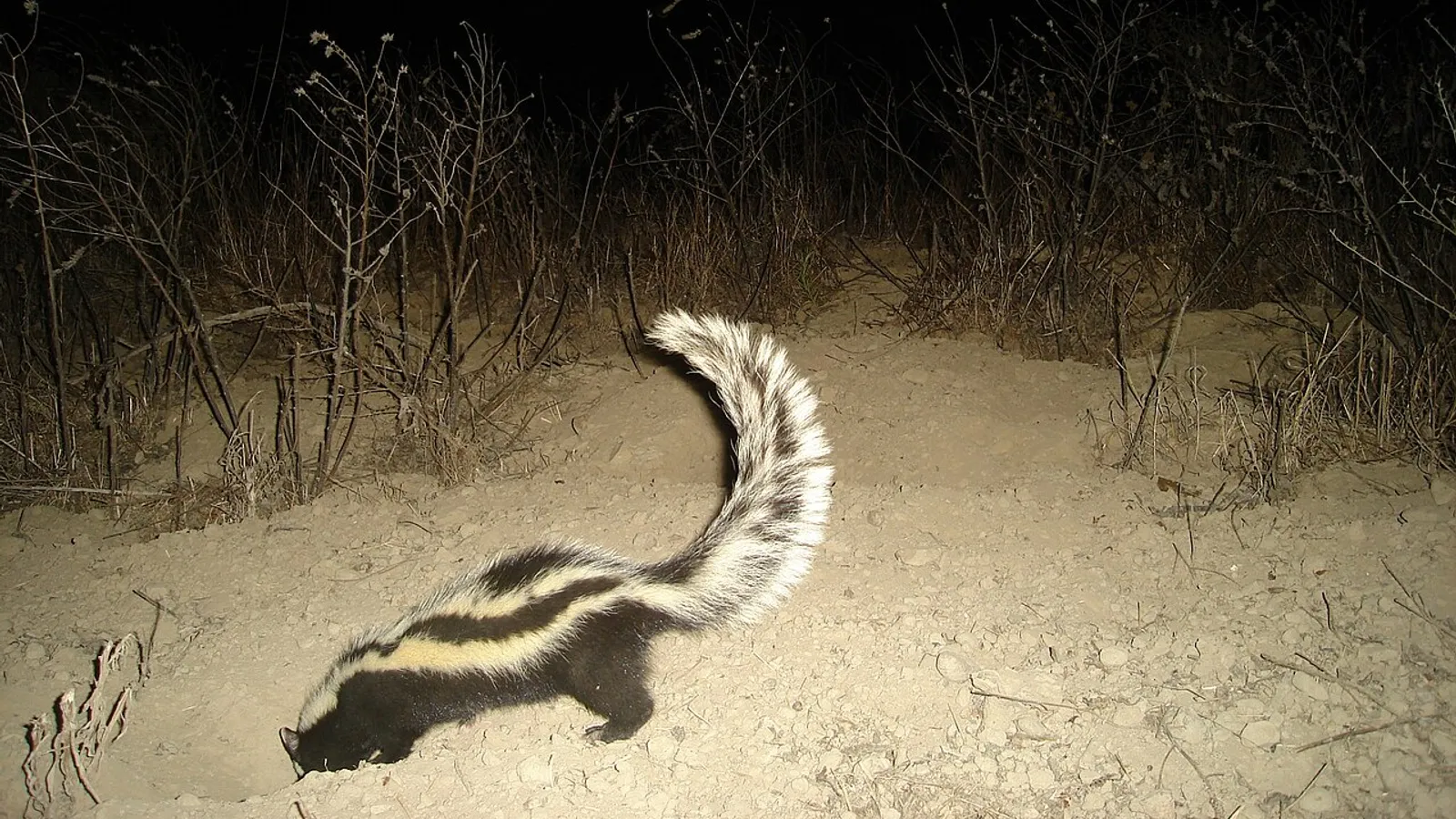
— Where the name comes from
Ictonyx is “weasel claw”, from the Greek iktís and ónyx; striatus describes the four white lengthwise bands on the black back. The common name comes from the Spanish zorrilla, “little fox”, a diminutive of zorra — which colonists applied to an animal that has nothing to do with foxes, being a mustelid. It is the reverse of the ringtail’s case: there a Greek word for “fox” on a procyonid, here a Spanish one on a polecat.
— Facts
- Group
- Mammals · Mammalia
- Order
- Carnivores
- Habitat
- Savannah, steppe, semi-desert, farmland
- Range
- Sub-Saharan Africa, from Senegal to Ethiopia and down to South Africa
- Size
- 28–38 cm of body, 0.4–1.4 kg
- Diet
- Carnivore — rodents, insects, snakes, eggs
- Lifespan
- 5 years in the wild, up to 13 in captivity
— Characteristics
- 01
Its anal glands produce a secretion reckoned among the foulest in the animal kingdom.
- 02
Threatened, it raises its brush tail and shows the black and white pattern before spraying.
- 03
It resembles the American skunk to a startling degree, without being related to it.
— What sets it apart
It is the African twin of the skunk, and the two are not close relatives: the resemblance — the conspicuous black and white, the plume of a tail, the stinking gland, even the tail-up warning posture — arose twice on two continents, because the same solution works against the same problems. It is one of the most cited cases of convergent evolution among mammals, and the only one in which the convergence concerns not appearance or diet but a message: both have invented the same danger sign.
