
Addax
Addax nasomaculatus
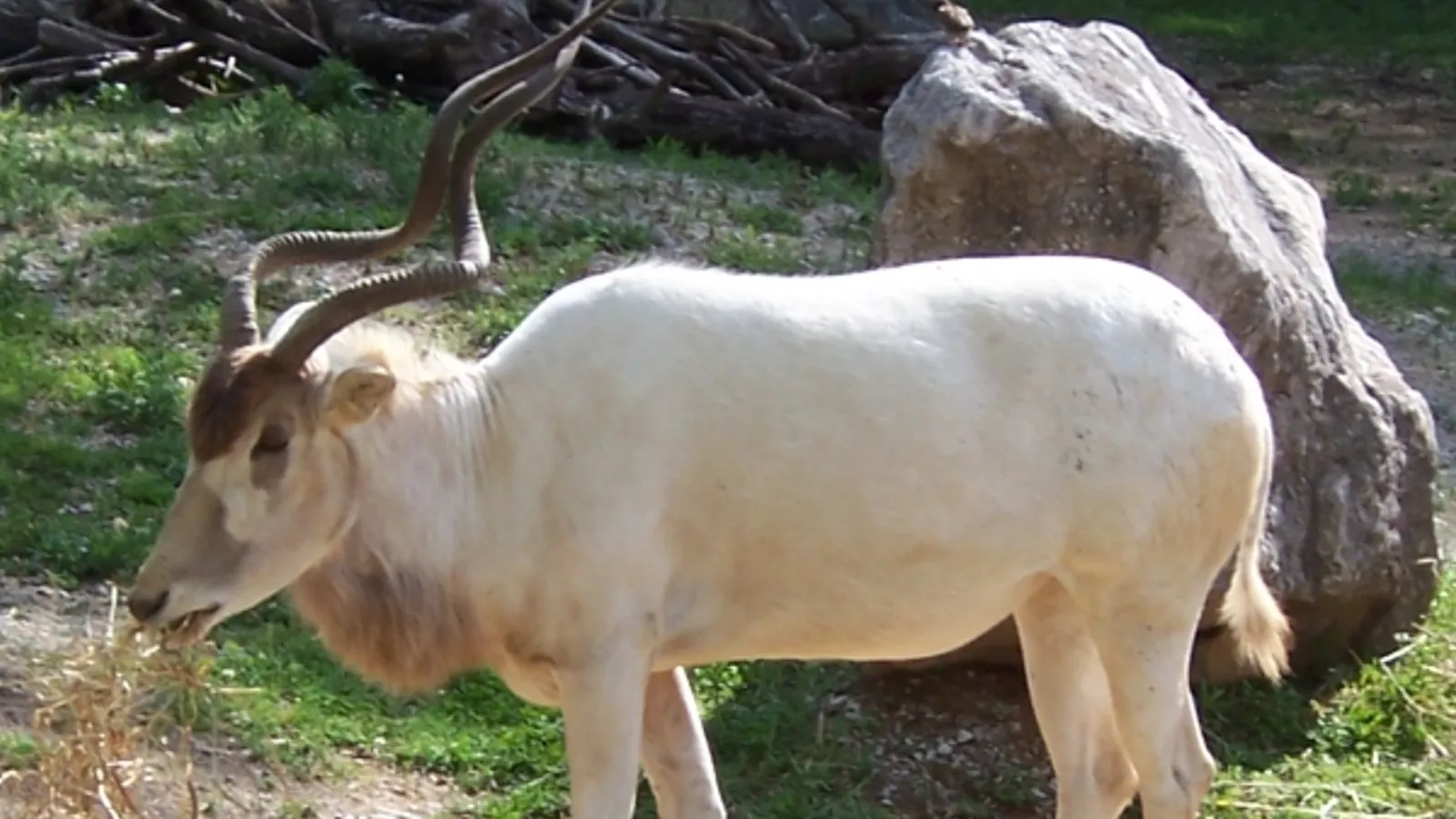
— Where the name comes from
Addax is a word Pliny records as African, perhaps Berber, and which has reached us unchanged: one of the very few animal names Latin took from the Sahara rather than from Greek. Nasomaculatus is pure description — “spot-nosed”, for the white band that crosses the face from cheek to cheek, the only marking on a coat that in summer turns almost white.
— Facts
- Group
- Mammals · Mammalia
- Order
- Even-toed ungulates
- Habitat
- True desert: sand seas, gravel plains, dunes
- Range
- The Sahara; in the wild it survives almost only in Niger and Chad
- Size
- 120–130 cm of body, 60–125 kg
- Diet
- Herbivore — desert grasses, shrubs, tubers
- Lifespan
- 19 years in the wild, up to 25 in captivity
— Characteristics
- 01
It can live its whole life without drinking: it takes its water from plants.
- 02
The coat changes colour with the season, grey-brown in winter and almost white in summer.
- 03
Its hooves are broad and flat so as not to sink into sand.
— What sets it apart
It is the antelope that solved the desert and did not survive the off-road vehicle. It never drinks — the moisture of plants and metabolic water suffice — and to avoid sweating it lets its own body temperature rise through the day, shedding it at night. But it is slow, and on flat ground with no cover a vehicle always catches it: motorised hunting has cut it to a few dozen free-living animals, while thousands live in captivity. The desert never beat it; wheels did.
