
Grévy's zebra
Equus grevyi
— Where the name comes from
Equus is the Latin for horse. The epithet recalls Jules Grévy, President of the French Republic, who in 1882 received one of these animals as a gift from the Negus of Abyssinia: the species therefore bears the name of a politician who never saw it in the wild. Zebra, by contrast, is said to come from the old Portuguese zevra, “wild ass”, a word used in the Iberian peninsula before Africa filled it with stripes.
— Facts
- Group
- Mammals · Mammalia
- Order
- Odd-toed ungulates
- Habitat
- Shrubby semi-desert, arid grassland
- Range
- Northern Kenya and southern Ethiopia
- Size
- 250–300 cm long, 350–450 kg
- Diet
- Herbivore — tough fibrous grasses other grazers refuse
- Lifespan
- 20–25 years
— Characteristics
- 01
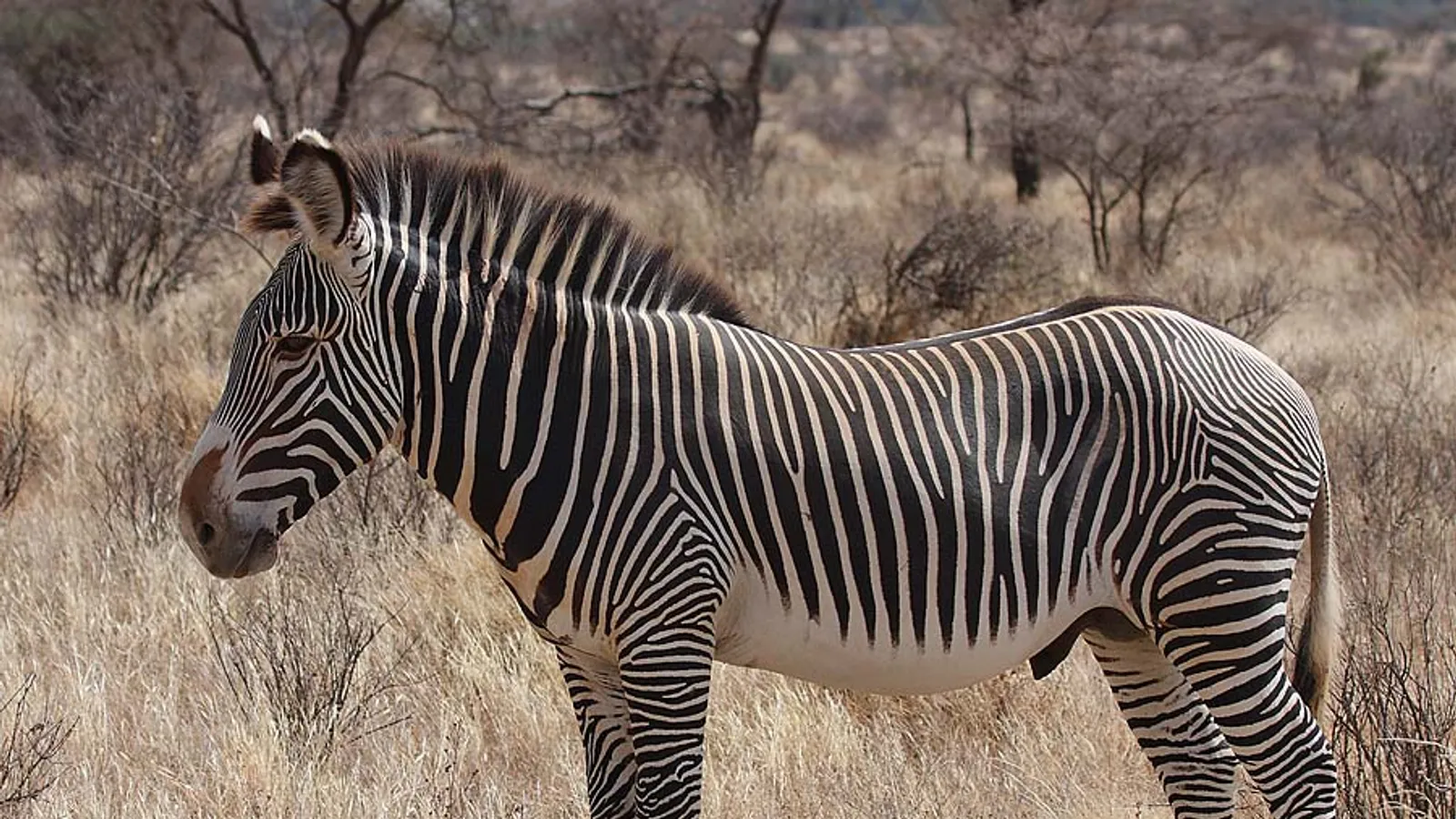
It is the largest of the zebras and has far narrower, denser stripes than the other species.
- 02
The ears are broad and rounded, almost mule-like, and the belly stays white and unstriped.
- 03
It forms no stable family groups: associations dissolve and reform continually.
— What sets it apart
What the stripes are for has been argued over for a century and a half: camouflage, individual recognition, cooling. Experiments in recent years point to a culprit far smaller than lions — horseflies. Blood-feeding flies land far less often on narrowly striped surfaces, and draping a horse in a zebra-patterned coat makes the bites collapse. In regions where those insects carry lethal diseases, the most elegant animal on the savannah is dressed in a repellent.
