
Red-necked wallaby
Notamacropus rufogriseus
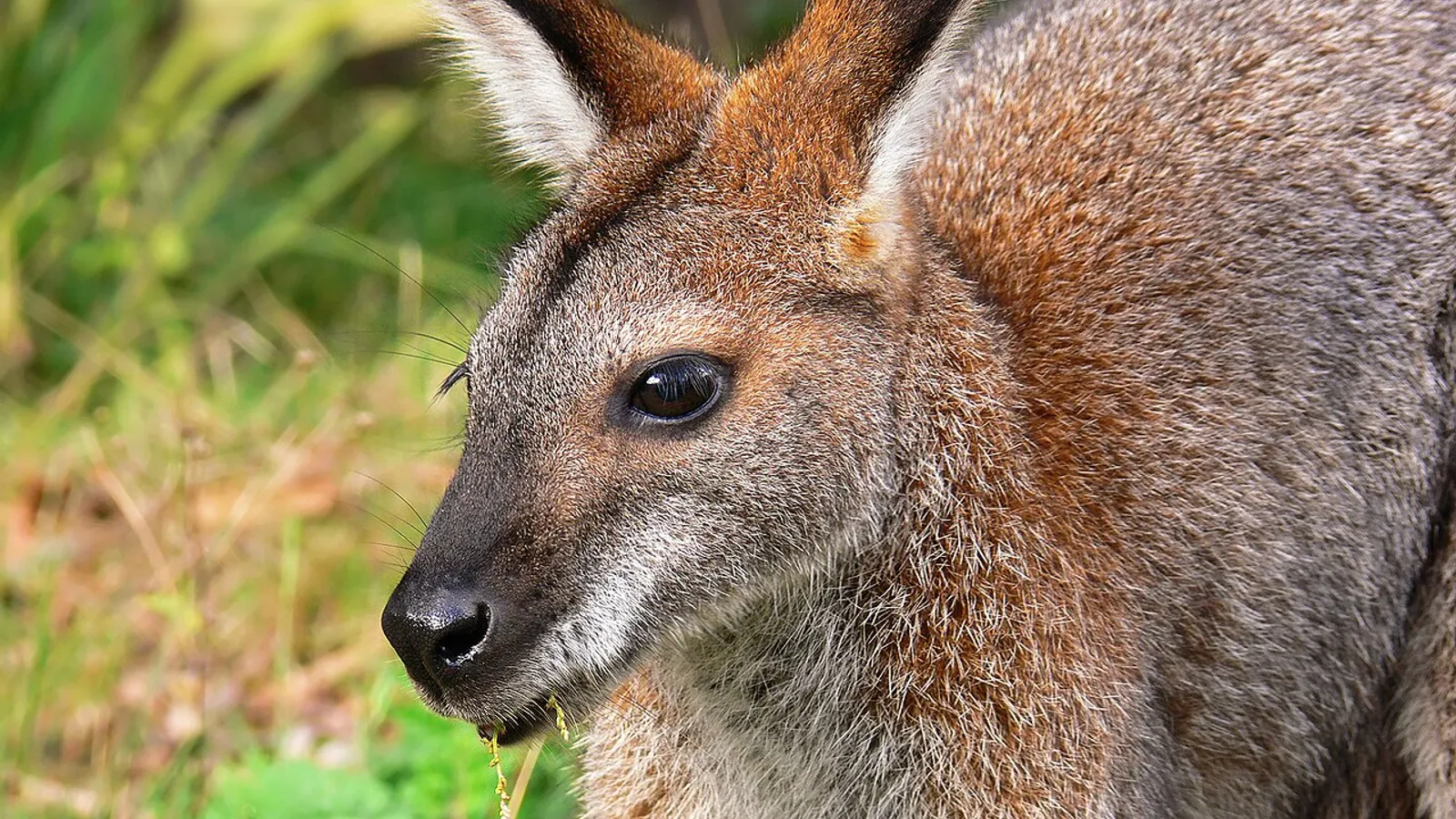
— Where the name comes from
Wallaby comes from the Dharug walabi, the Aboriginal language of the Sydney area, and named the mid-sized kangaroos: there is no sharp zoological difference between kangaroo and wallaby, only a threshold of size fixed by usage. Notamacropus means “marked big-foot”, for the facial stripe; rufogriseus joins the Latin rufus, “red”, and griseus, “grey”, the two colours of the coat.
— Facts
- Group
- Mammals · Mammalia
- Order
- Diprotodont marsupials
- Habitat
- Eucalyptus woodland with dense undergrowth, forest edges
- Range
- Eastern Australia and Tasmania; introduced populations in Britain, France and New Zealand
- Size
- 70–90 cm long plus 70–75 of tail, 11–27 kg
- Diet
- Herbivore — grasses, leaves, shoots
- Lifespan
- 12–15 years
— Characteristics
- 01
Hopping is cheap: elastic tendons give the energy back at every bound, like a spring.
- 02
Above a certain speed it uses less energy than a four-legged animal of the same size.
- 03
A female can have at once a paused embryo, a joey in the pouch and a weaned young at foot.
— What sets it apart
In France a stable colony has lived for decades in the forest of Rambouillet, south of Paris: it began in the 1970s when several animals escaped from a zoological park, and today it numbers about a hundred, seeing out the winters of the Île-de-France without trouble. The same has happened in the English Peak District and in New Zealand. An Australian marsupial grazing in European undergrowth is a reminder of how little it takes for a species to take root where it has never been.
