
Southern viscacha
Lagidium viscacia
— Where the name comes from
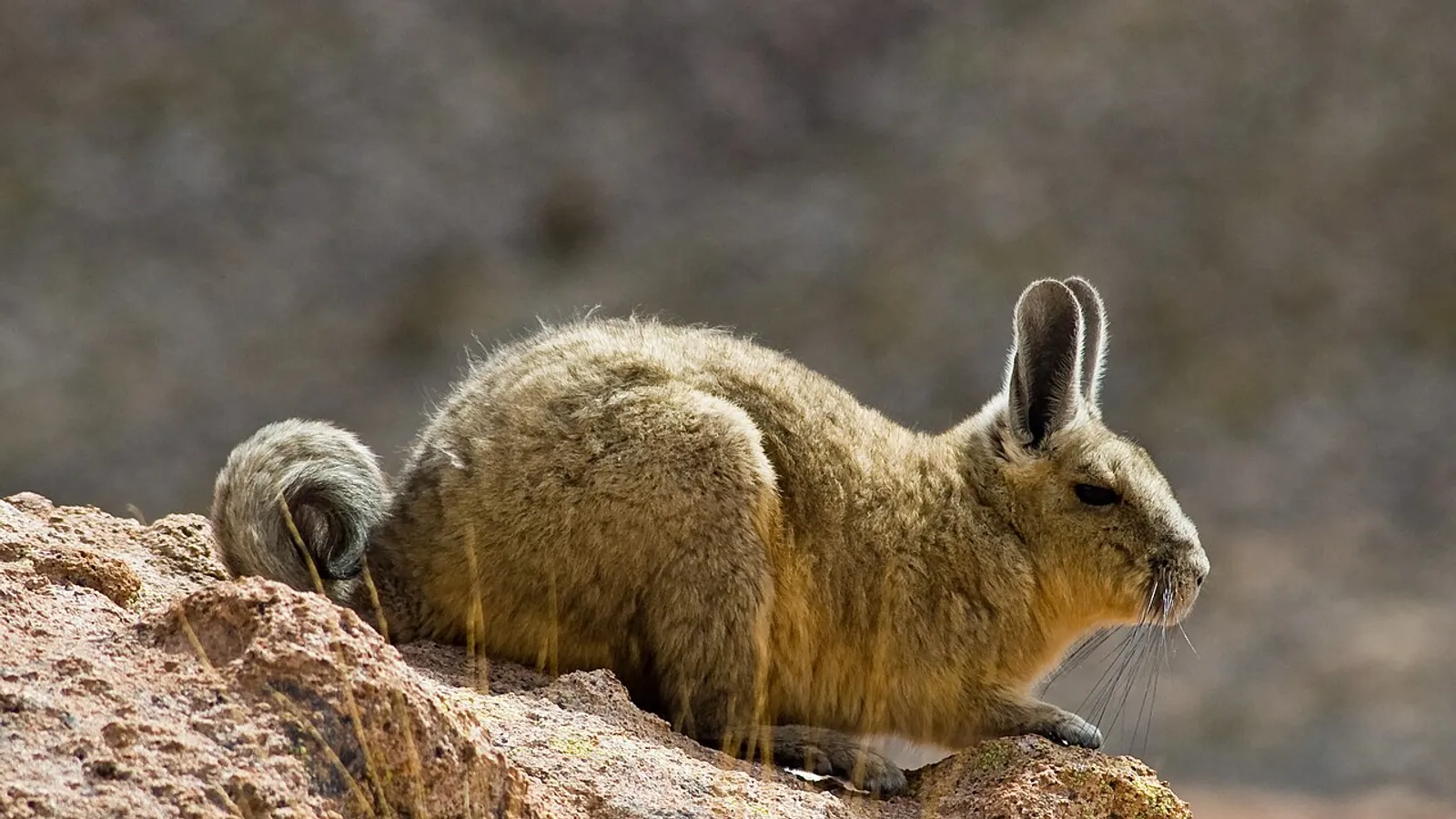
Lagidium is “little hare”, a diminutive of the Greek lagṓs: whoever sees it sitting on a rock with long ears and a curled tail thinks of a rabbit with a squirrel’s tail, and is wrong twice over — it is related to the chinchilla. Viscacia repeats in the epithet the Quechua name wisk’acha.
— Facts
- Group
- Mammals · Mammalia
- Order
- Rodents
- Habitat
- Andean scree and rock faces, between 2,500 and 5,000 m
- Range
- The Andes of Peru, Bolivia, Chile and Argentina
- Size
- 30–45 cm, tail 20–40 cm, 1–3 kg
- Diet
- Tough grasses, mosses, lichens
- Lifespan
- 19 years in captivity
— Characteristics
- 01
It leaps among the rocks with precision, never digging burrows of its own.
- 02
It lives in colonies that spend the middle hours of the day sunbathing.
- 03
Its fur is extremely dense, second only to the chinchilla’s.
— What sets it apart
In the Andes its presence marks a rock face that does not freeze: the colonies occupy only slopes facing the morning sun, where the rock stores heat, and the crevices they choose stay several degrees above the outside air. Anyone looking for viscachas at five thousand metres does not study the vegetation but the aspect of the cliff. It is thermoregulation achieved by choosing an address rather than by insulating the body.
