
Saharan horned viper
Cerastes cerastes
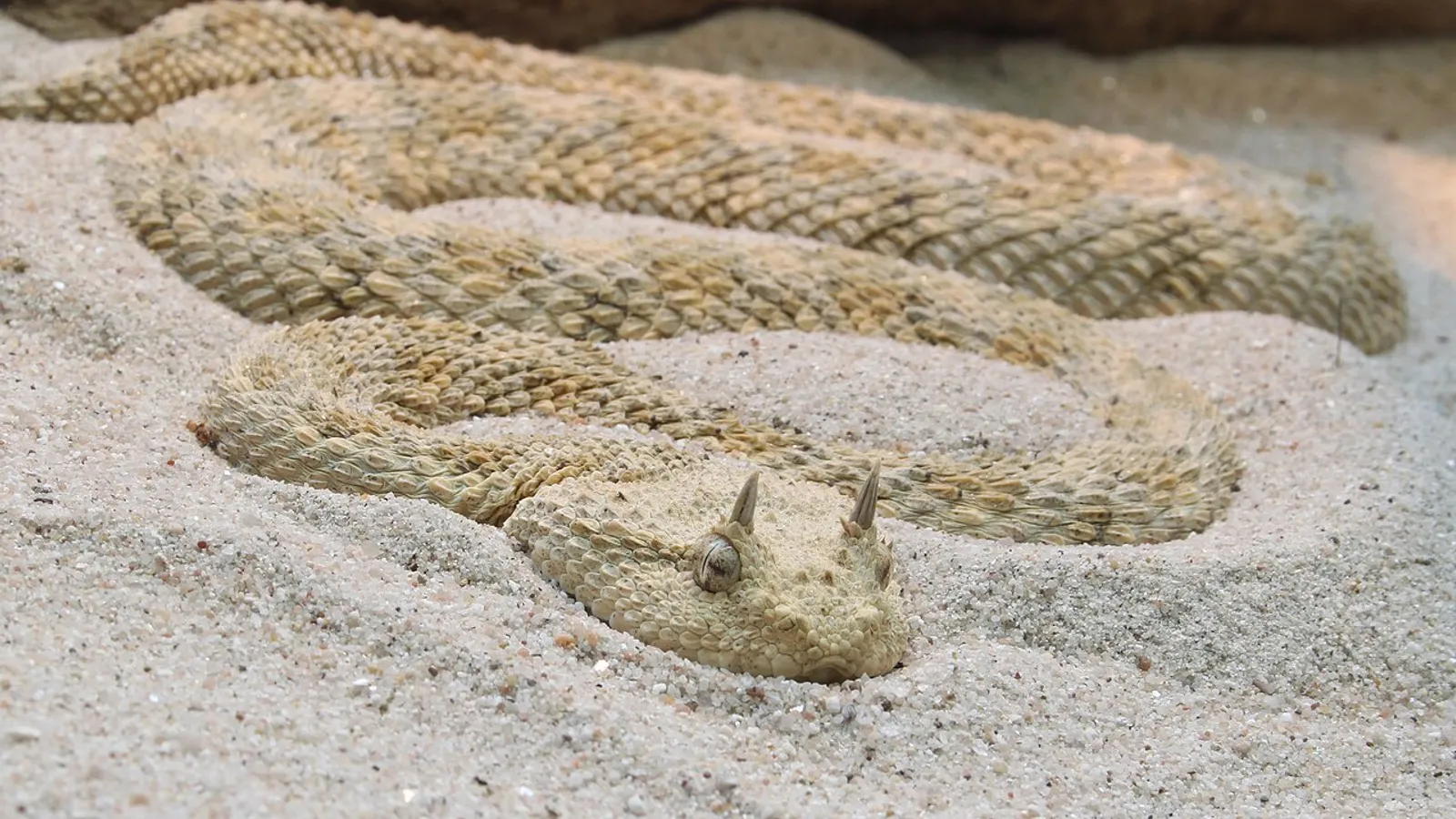
— Where the name comes from
Kerástēs in Greek is “the horned one”, from kéras: above each eye it carries an elongated scale shaped like a horn, present in many individuals and absent in others. This animal’s sign appears in Egyptian hieroglyphs with the phonetic value of the letter f, and it is one of the few characters of Egyptian writing that depicts a species still perfectly recognisable today.
— Facts
- Group
- Reptiles · Reptilia
- Order
- Squamates
- Habitat
- Dunes, sands, dry wadis, stony deserts
- Range
- North Africa and the Arabian Peninsula
- Size
- 30–60 cm, up to 85 cm; 100–500 g
- Diet
- Lizards, rodents, birds
- Lifespan
- 15 years
— Characteristics
- 01
It moves sideways, touching the ground at only two points at a time.
- 02
It shuffles down into the sand until only the head is left showing.
- 03
It waits buried for days along the runs of rodents.
— What sets it apart
Sidewinding, which looks like a bizarre way to travel, solves two problems at once: on loose sand a forward push would only dig a hole, and by resting on few points at a time the snake reduces contact with ground that at midday reaches seventy degrees. The tracks it leaves are a row of parallel bars, as though somebody had walked on a ladder: they are recognisable at a glance, and in the desert they say where and when the animal passed.
