
Tarantula hawk wasp
Pepsis grossa
— Where the name comes from
Pepsis is the Greek pépsis, cooking and then digestion — the same root that gives “peptic” and “dyspepsia”. Grossa names the size. Put together, the two words make a name that seems to speak of the stomach, for an animal whose story is instead digestive in reverse: it is not she who digests the prey but her larva, and with a calculated slowness.
— Facts
- Group
- Insects · Insecta
- Order
- Bees, wasps and ants
- Habitat
- Deserts and dry grassland, wherever large tarantulas live
- Range
- From the south-western United States to Argentina
- Size
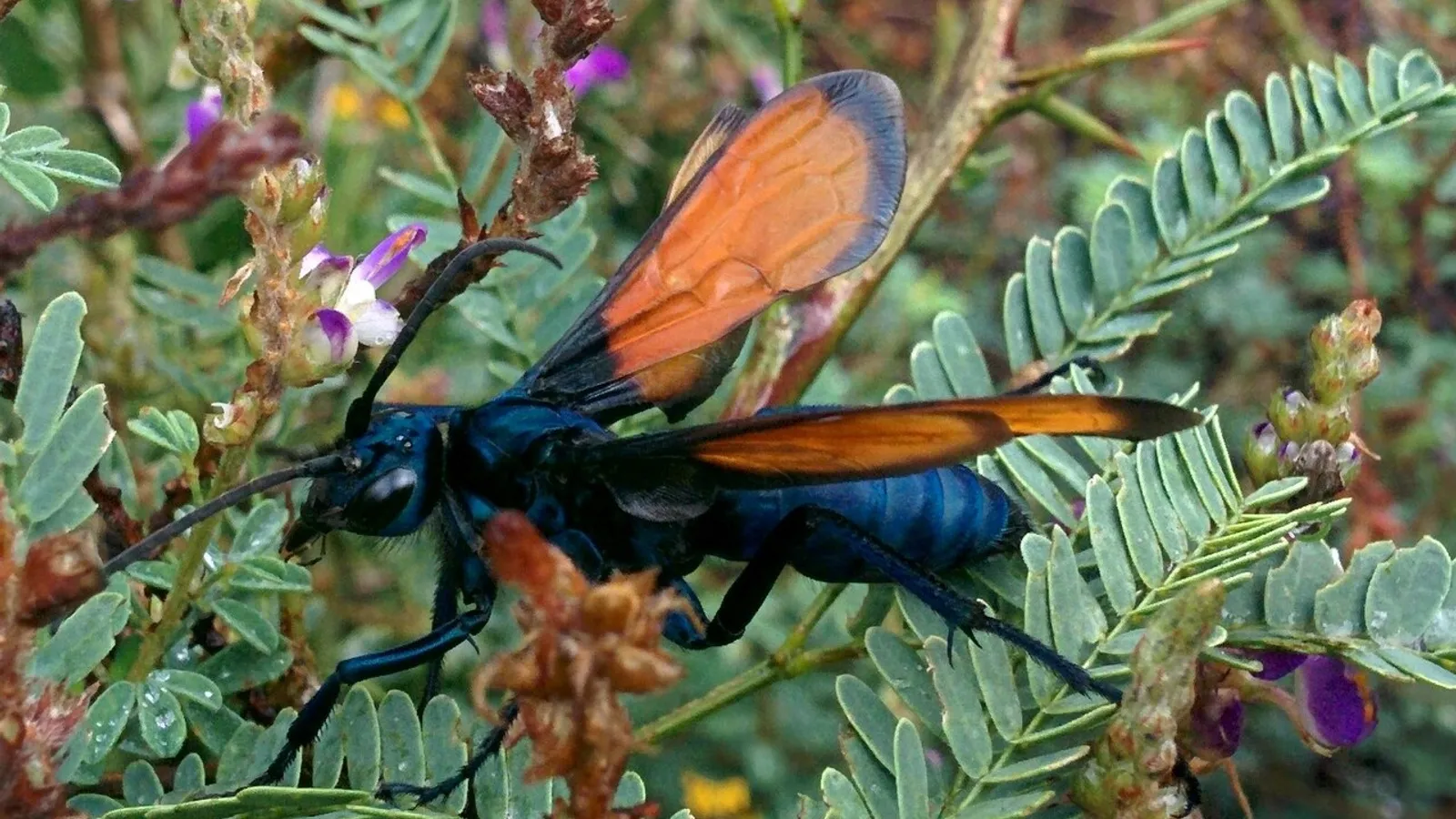
- Up to 5 cm, with orange wings and a blue-black body
- Diet
- Nectar as an adult; a single tarantula for the whole larval life
- Lifespan
- A few weeks as an adult
— Characteristics
- 01
Its sting is the second most painful among all insects.
- 02
The adult feeds only on nectar, and sometimes on fermenting fruit.
- 03
The gaudy colours are a warning: no predator attacks it.
— What sets it apart
The female seeks out a tarantula, provokes it until it rears onto its legs and stings it at a precise point of the thoracic membrane: the venom does not kill, it paralyses. Then she drags it — a spider many times her own weight — into a burrow, lays a single egg on it and seals the entrance. The larva that hatches eats the spider alive for weeks, starting with the non-vital organs and leaving the heart and nervous system for last, so that the flesh stays fresh to the end. The sting, for a human being, hurts for three minutes: entomologists recommend lying down and screaming, because staying upright is not possible.
