
Bearded fireworm
Hermodice carunculata
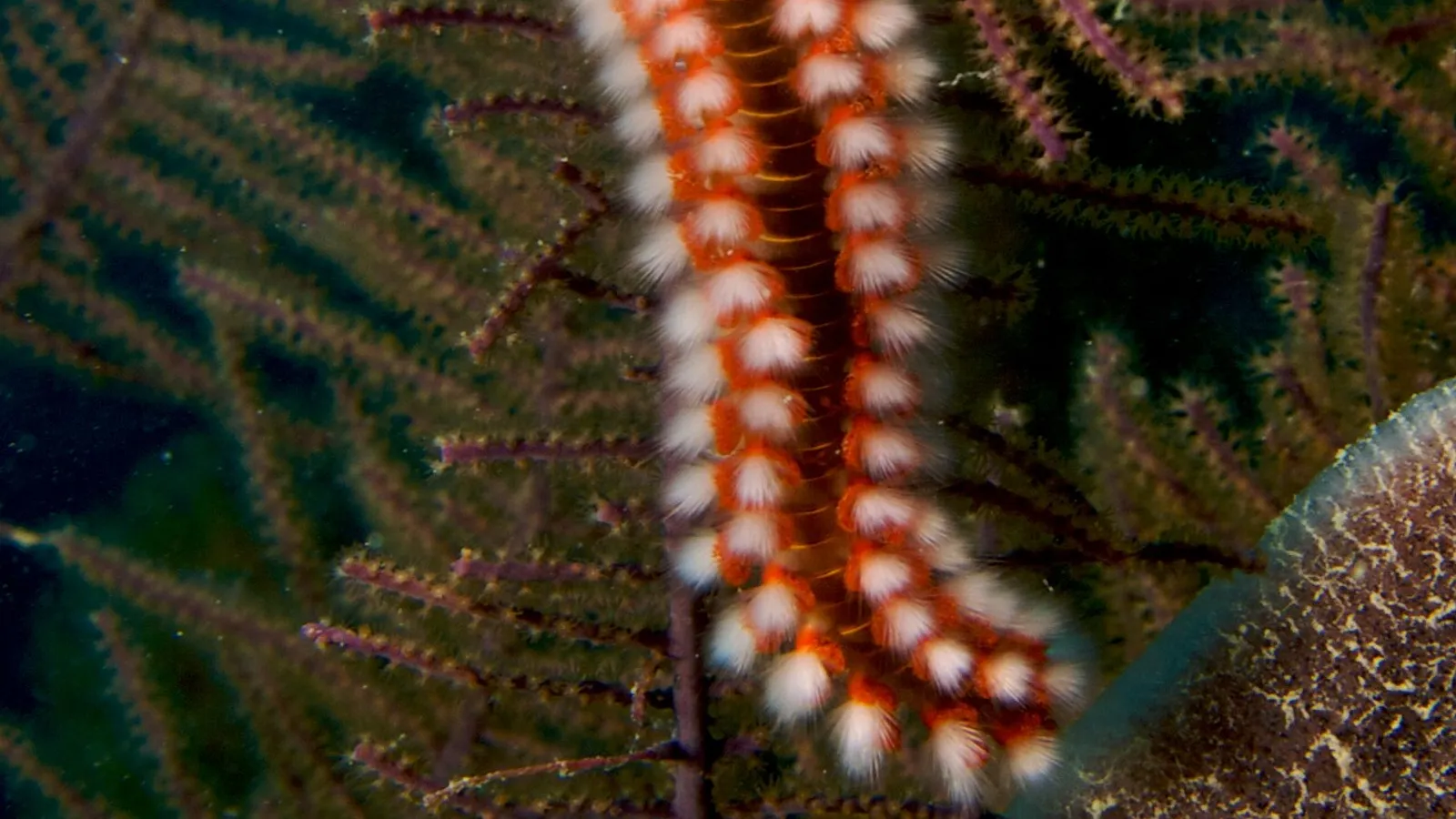
— Where the name comes from
Carunculata refers to the caruncle, the fleshy outgrowth the animal carries on its head. The Italian name is a transparent and ancient compound — worm and dog — and says how it is perceived: a worm that bites. English takes the same idea through fire, fireworm, because contact with the bristles burns for hours.
— Facts
- Group
- Annelids · Annelida
- Order
- Fireworms
- Habitat
- Rocky and coralligenous bottoms, under stones
- Range
- Mediterranean, tropical Atlantic, Caribbean
- Size
- 15–30 cm
- Diet
- Corals, gorgonians, anemones, carrion
- Lifespan
- Several years
— Characteristics
- 01
The white lateral bristles are hollow, brittle and filled with venom.
- 02
They break off in the skin of anyone who touches it and stay there.
- 03
It eats coral, devouring the polyps one by one.
— What sets it apart
The bristles are needles of glass. They are made of calcium carbonate, hollow, and snap the moment they enter the skin, releasing an irritant: they cannot be pulled out with fingers and the burning lasts hours, with tingling and swelling. In recent years it has multiplied in the southern Mediterranean along with the warming water, and has become a real problem for fishermen, who find it clinging to nets and bait. It is one of the clearest biological signals of the tropicalisation of our sea.
