
Giant tube worm
Riftia pachyptila
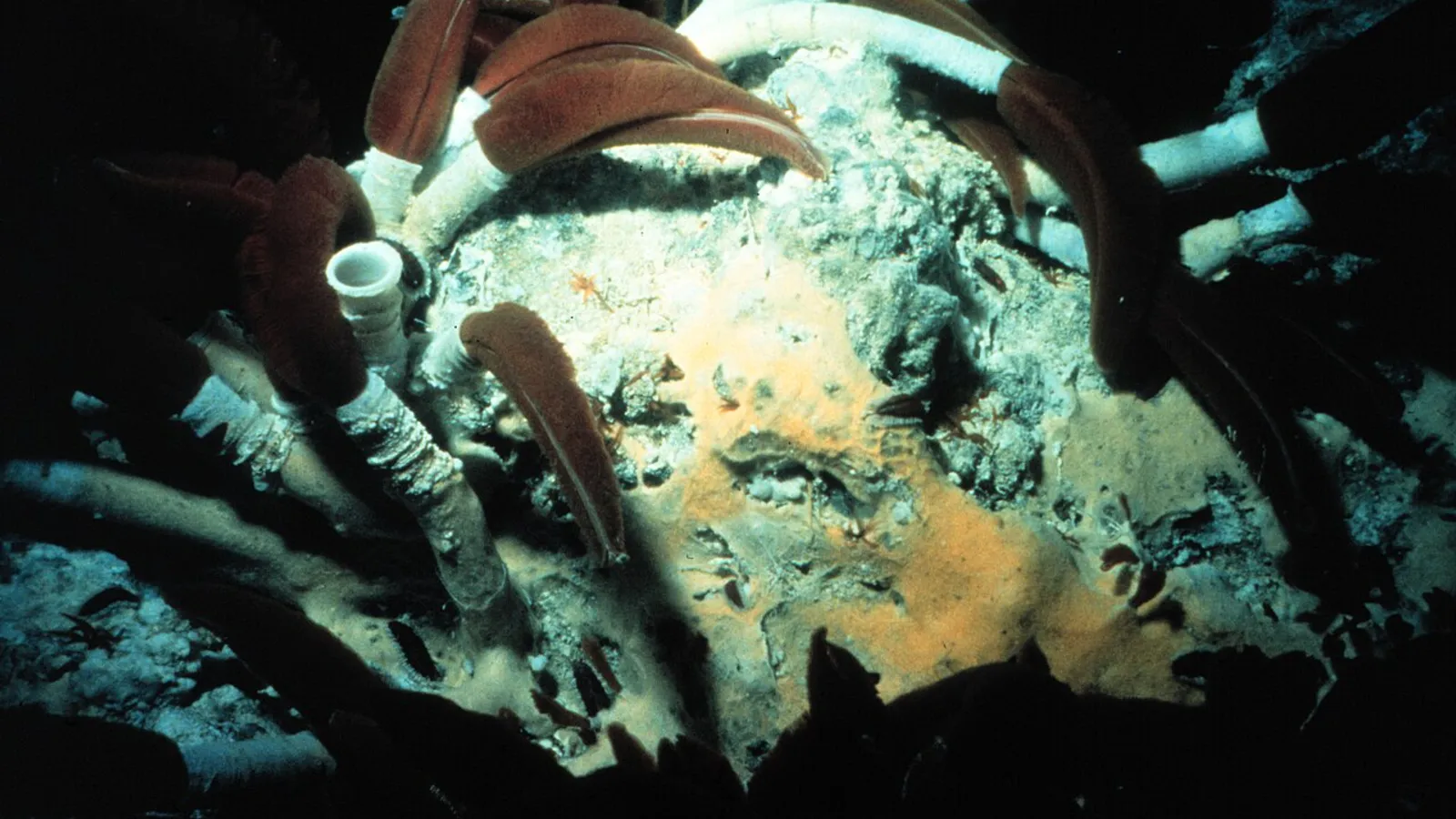
— Where the name comes from
Riftia carries the place of its discovery inside it: the ocean ridges, the rift zones where the earth’s crust opens and boiling water pours from vents. It was found in 1977 on the Galápagos ridge, on an expedition looking for hot springs that found instead a whole ecosystem nobody had predicted. Pachyptila is “thick-plumed”, from pachýs and ptílon, for the red tuft protruding from the tube.
— Facts
- Group
- Annelids · Annelida
- Order
- Fan worms
- Habitat
- Hydrothermal vents between 2,000 and 3,000 metres deep
- Range
- Ocean ridges of the eastern Pacific
- Size
- Tube up to 2.4 metres
- Diet
- None: it lives off the symbiotic bacteria it houses
- Lifespan
- Over 200 years by some estimates
— Characteristics
- 01
As an adult it has no mouth, no gut and no anus.
- 02
The red plume is full of a haemoglobin that binds oxygen and sulphide together.
- 03
It grows up to 85 cm in eighteen months: among the fastest marine invertebrates.
— What sets it apart
It does not eat because it has stopped needing to. As a larva it has a mouth and ingests bacteria; then the mouth closes, the gut turns into an organ packed with those bacteria and the animal becomes a house. The symbionts draw energy by oxidising the hydrogen sulphide pouring from the vents — chemosynthesis, not photosynthesis — and feed their host, which in return brings them oxygen and sulphide with a special haemoglobin able to bind both without poisoning itself. The discovery of these animals in 1977 proved that whole ecosystems exist that depend in no way on sunlight, and changed the assumptions about where life might be possible.
