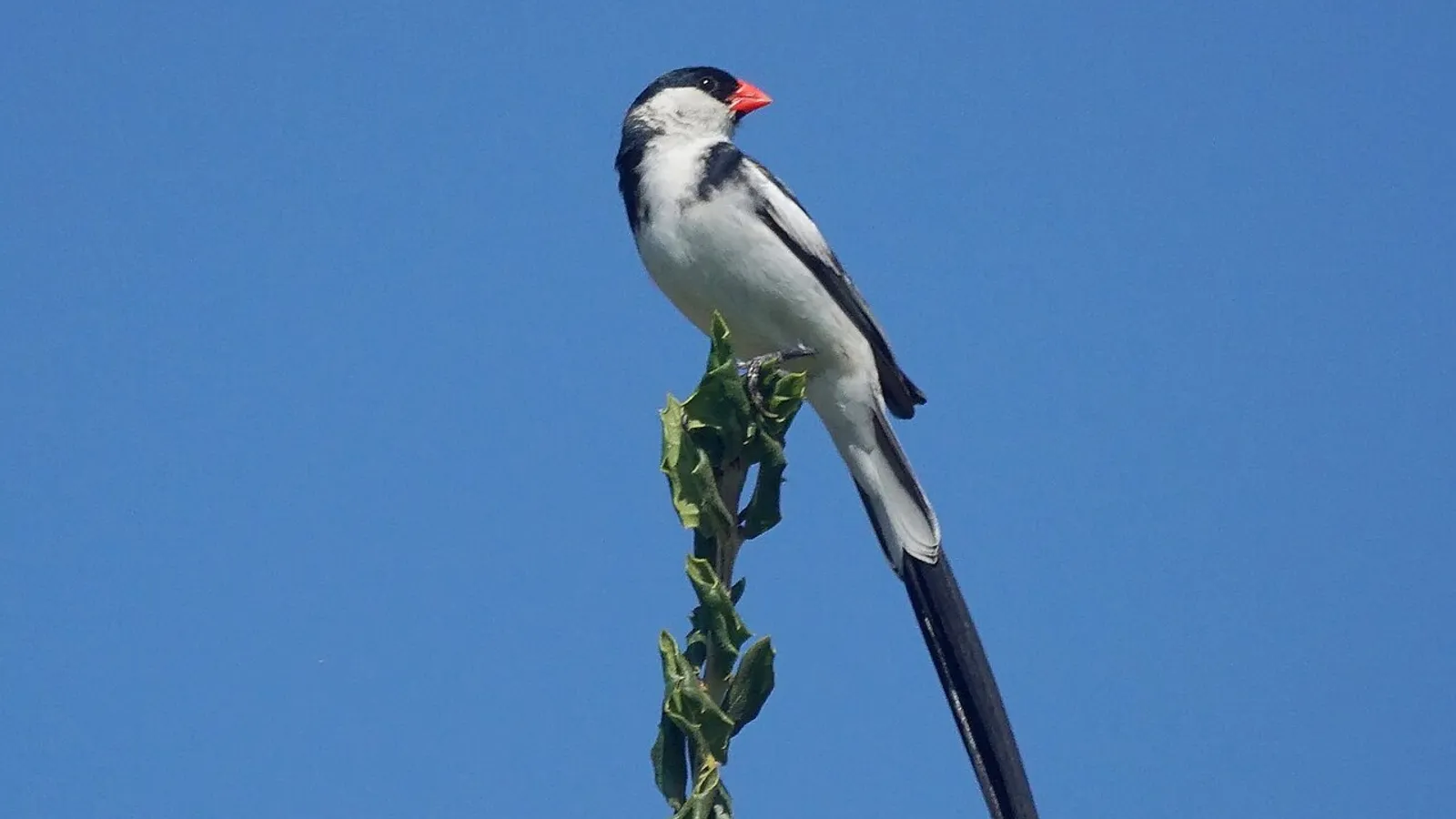
Pin-tailed whydah
Vidua macroura
— Where the name comes from
Vidua in Latin means “widow”, and behind it lies a misunderstanding. The English name whydah comes from Ouidah, a port in today’s Benin from which these birds reached Europe, but the resemblance to widow, and the black tail feathers like a mourning veil, did the rest. Macroura is Greek, “long tail”; the Italian domenicana, “Dominican”, refers to the black and white habit of Dominican friars.
— Facts
- Group
- Birds · Aves
- Order
- Passerines
- Habitat
- Savannah, grassland, gardens and fields
- Range
- Sub-Saharan Africa; introduced to Puerto Rico and California
- Size
- Breeding male up to 30 cm including tail, female 12 cm; 12–19 g
- Diet
- Grass seeds
- Lifespan
- A few years
— Characteristics
- 01
In spring the male grows a black tail twice as long as its body.
- 02
The male displays by hovering above the female with his tail rippling.
- 03
It builds no nest and does not brood its own eggs.
— What sets it apart
It is a brood parasite, but far more discreet than the cuckoo. The female lays her eggs in the nests of small waxbills, above all the common waxbill, and the chick does not get rid of its foster siblings: it grows up alongside them. To be fed, though, it has to pass for one of them, and it manages this remarkably: the inside of its mouth has the same spots and colours as the host’s chicks, which the parents use to recognise their own young. The foster parents feed it without noticing the intruder.