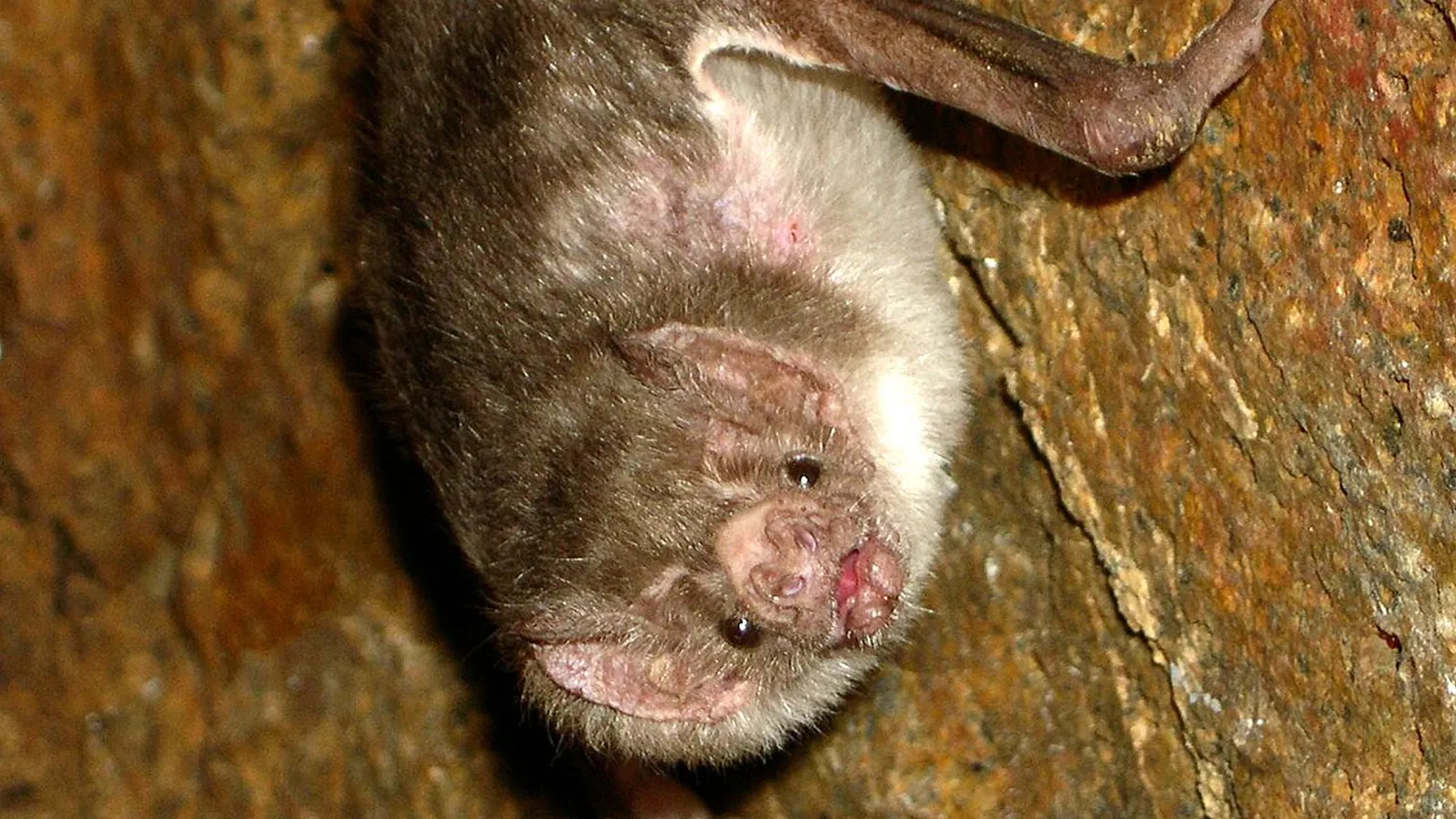
Common vampire bat
Desmodus rotundus
— Where the name comes from
Desmodus joins the Greek desmós, “bond, bundle”, and odoús, “tooth”, for the broad sharp incisors fused at the front of the mouth; rotundus is Latin and describes the compact shape of the body. Curiously the name vampire runs the opposite way to what is usually assumed: the Slavic word already existed in Europe for centuries, and was applied to the South American bat only after the discovery of America. The myth does not come from the animal — the animal was named after the myth.
— Facts
- Group
- Mammals · Mammalia
- Order
- Bats
- Habitat
- Caves, tree hollows, abandoned buildings near pasture and livestock
- Range
- Latin America, from northern Mexico to Argentina and Chile
- Size
- 7–9 cm of body, wingspan 35 cm, 25–40 g
- Diet
- Blood feeder — the blood of mammals, mostly livestock
- Lifespan
- 9–12 years in the wild
— Characteristics
- 01
It does not suck: it opens the skin with its incisors and laps the flowing blood along a groove in its tongue.
- 02
Its saliva holds an extremely powerful anticoagulant, named draculin, which keeps the wound from closing.
- 03
It is the only bat that walks, runs and jumps nimbly on the ground, propped on its wrists.
— What sets it apart
If it goes two nights without feeding it dies, and that happens often. So common vampire bats regurgitate blood for one another: whoever has fed feeds the one that has not. And they do not do it at random — they keep score. An individual gives by preference to those who have given to it in the past, and refuses a meal to one that has received without ever repaying. It is one of the best-documented cases of reciprocity in nature, a credit system based on individual memory in an animal that fits in a hand.