
North American porcupine
Erethizon dorsatum
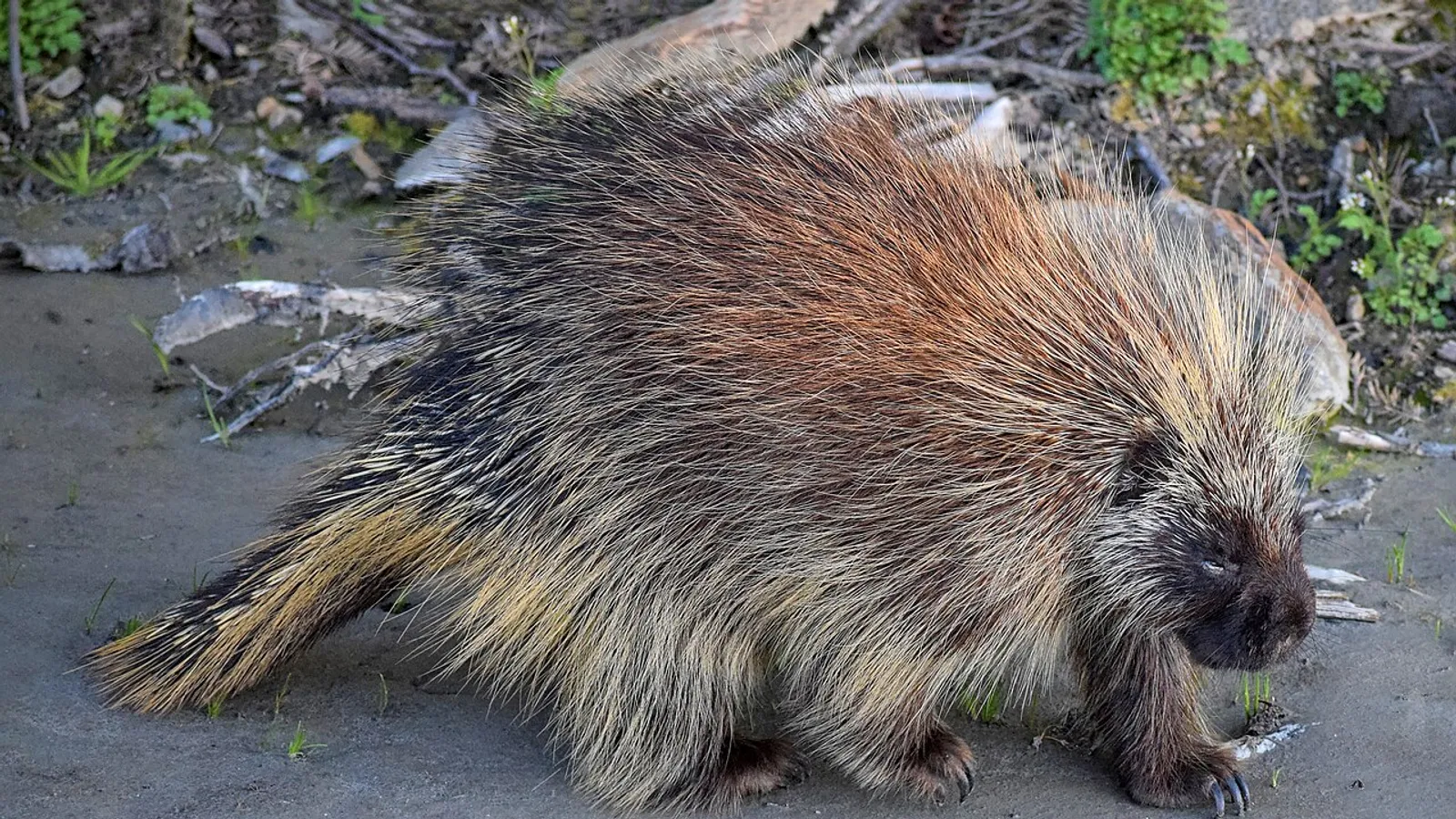
— Where the name comes from
Erethizon comes from the Greek erethízein, “to irritate, to provoke”, and dorsatum from the Latin dorsum: “the one that irritates, on its back”. The Italian common name comes from the Canadian French ourson, “bear cub”, for the squat, ungainly look. It is a New World porcupine, and not closely related to the European and African ones: the quills were invented twice, on two continents.
— Facts
- Group
- Mammals · Mammalia
- Order
- Rodents
- Habitat
- Coniferous and mixed forest, treed tundra, scrub
- Range
- North America, from Alaska to northern Mexico
- Size
- 60–90 cm of body, 5–14 kg
- Diet
- Herbivore — bark, conifer needles, buds, leaves
- Lifespan
- 18 years in the wild
— Characteristics
- 01
It carries some 30,000 quills, each with hundreds of micro-barbs at the tip.
- 02
It does not “shoot” its quills: they detach on contact, because they are only weakly anchored.
- 03
It is an excellent climber and spends much of the winter in trees.
— What sets it apart
The tips of its quills are covered in microscopic backward-facing scales that act as harpoons: they enter flesh with half the force a smooth needle needs and come out with four times the resistance. The mechanism has been studied at Harvard to design surgical needles and sutures that go in more easily and hold better, and it is one of the most cited cases of biomimetics in recent years. The worst outcome for the porcupine — the quill left embedded — is exactly what medicine wanted to copy.
