
Muskrat
Ondatra zibethicus
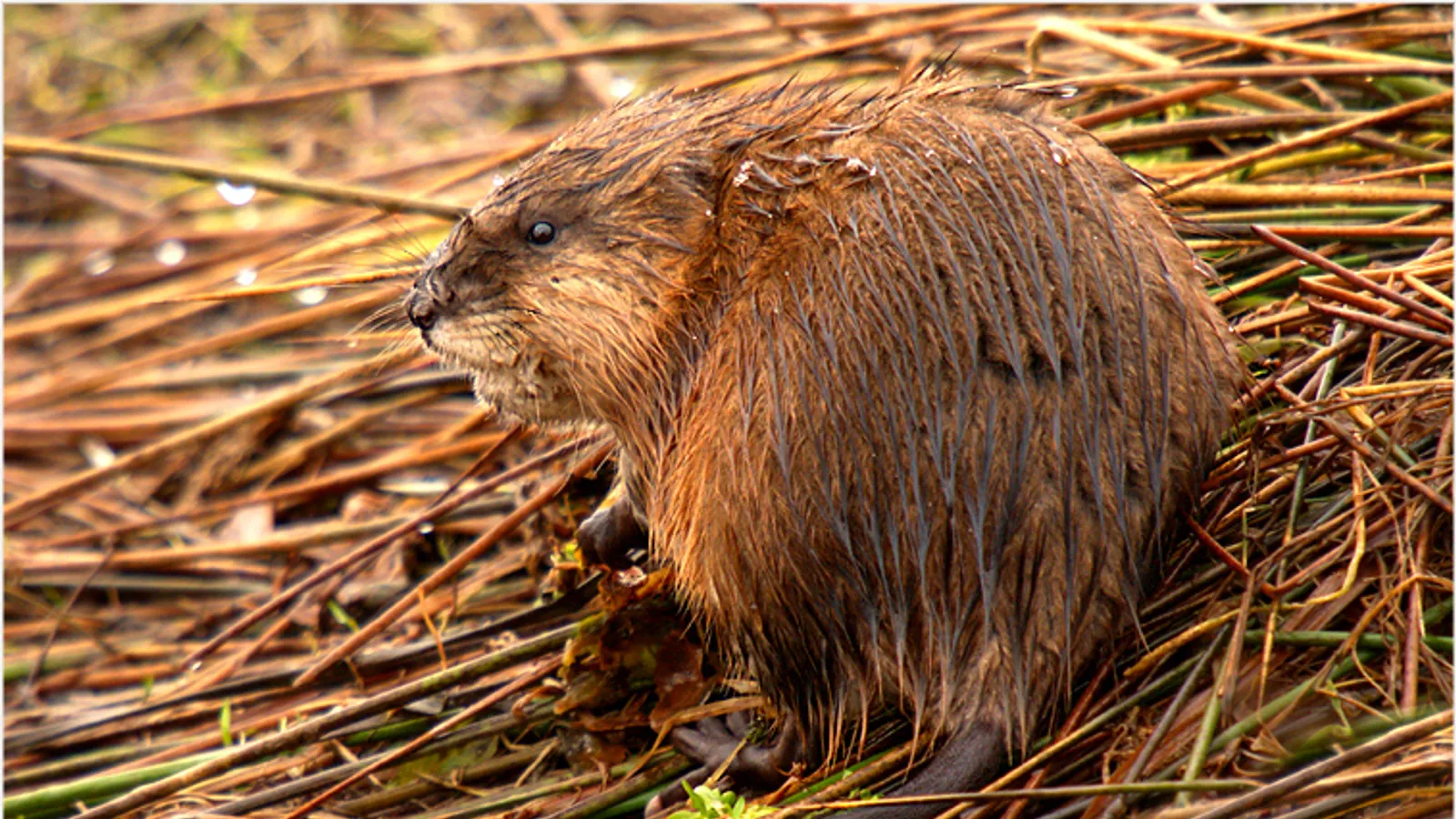
— Where the name comes from
Ondatra is the name the Huron gave it, taken down by the French in Canada. Zibethicus points to the civet, and through it to the Arabic zabād, the perfume drawn from that animal’s glands: this rodent’s perineal glands give off a similar musky smell. It is not a mouse but a vole — the largest in the world.
— Facts
- Group
- Mammals · Mammalia
- Order
- Rodents
- Habitat
- Marshes, ponds, canals, slow river banks with emergent vegetation
- Range
- North America; introduced and now very widespread in Europe and Asia
- Size
- 40–70 cm including tail, 0.7–1.8 kg
- Diet
- Herbivore — cattails, reeds, aquatic roots; occasionally molluscs
- Lifespan
- 3–4 years in the wild
— Characteristics
- 01
The tail is flattened side to side and works as a rudder.
- 02
It stays submerged for up to seventeen minutes, slowing its heartbeat.
- 03
It builds lodges of vegetation up to a metre high above the water.
— What sets it apart
Every muskrat in Europe and Asia — tens of millions of animals, from Belgium to China — descends from five individuals. In 1905 a Bohemian nobleman, Prince Colloredo-Mansfeld, had five released on his estate near Prague so that he could hunt them. Within a century they had colonised half a continent, burrowing into the banks of rivers and canals to the point of becoming a serious hydraulic problem in the Netherlands and Germany, where containment costs tens of millions a year.
