
Common murre
Uria aalge
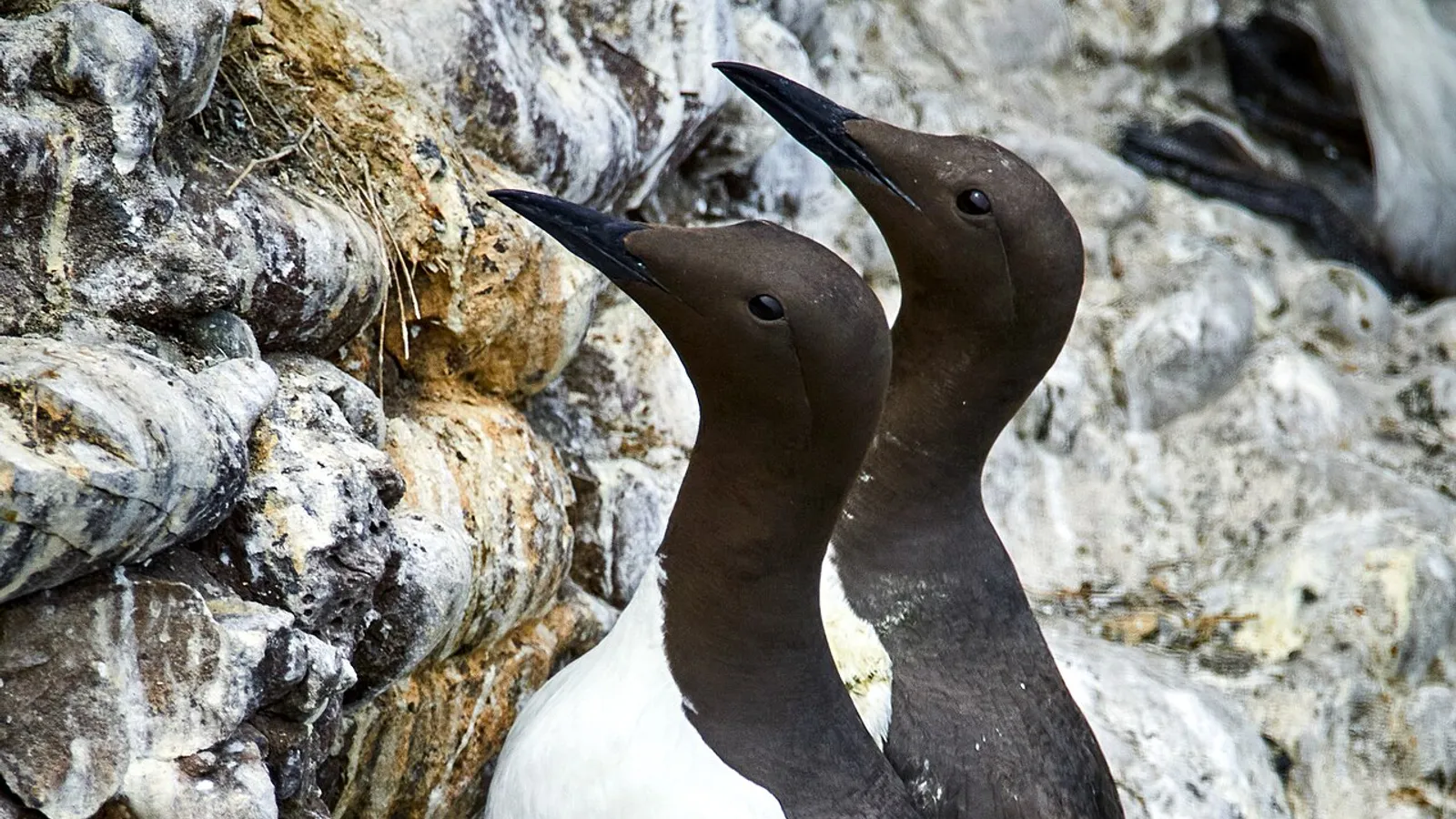
— Where the name comes from
Uria comes from the Greek ouría, the name of a waterbird mentioned by Athenaeus and never confidently identified; aalge is the Danish and Norwegian word for these birds, alke, taken from the speech of the fishermen of the North. It looks like a penguin in miniature and is one of the most cited cases of convergence: two very distant groups that solved the problem of swimming with wings in the same way.
— Facts
- Group
- Birds · Aves
- Order
- Shorebirds
- Habitat
- Sea cliffs for nesting, the open sea for the rest of the year
- Range
- The northern Atlantic and Pacific
- Size
- 38–46 cm, wingspan 61–73 cm, 0.8–1.1 kg
- Diet
- Shoaling fish pursued underwater
- Lifespan
- 30 years in the wild
— Characteristics
- 01
It dives to a hundred and eighty metres, using its wings as flippers.
- 02
It builds no nest: it lays a single egg on the bare rock of the ledge.
- 03
It nests shoulder to shoulder, up to twenty pairs per square metre.
— What sets it apart
The chick throws itself off the cliff before it can fly. At three weeks, when it weighs a quarter of an adult, it launches from heights of up to a hundred metres and glides badly down to the water, followed by its father, who collects it at sea and spends the following weeks with it offshore, feeding it while its feathers grow. The mother stays on the ledge. It is a leap that looks like suicide and is not: on the ledge the food the father can carry is no longer enough, and out at sea the two of them together find far more.
