
Common marmoset
Callithrix jacchus
— Where the name comes from
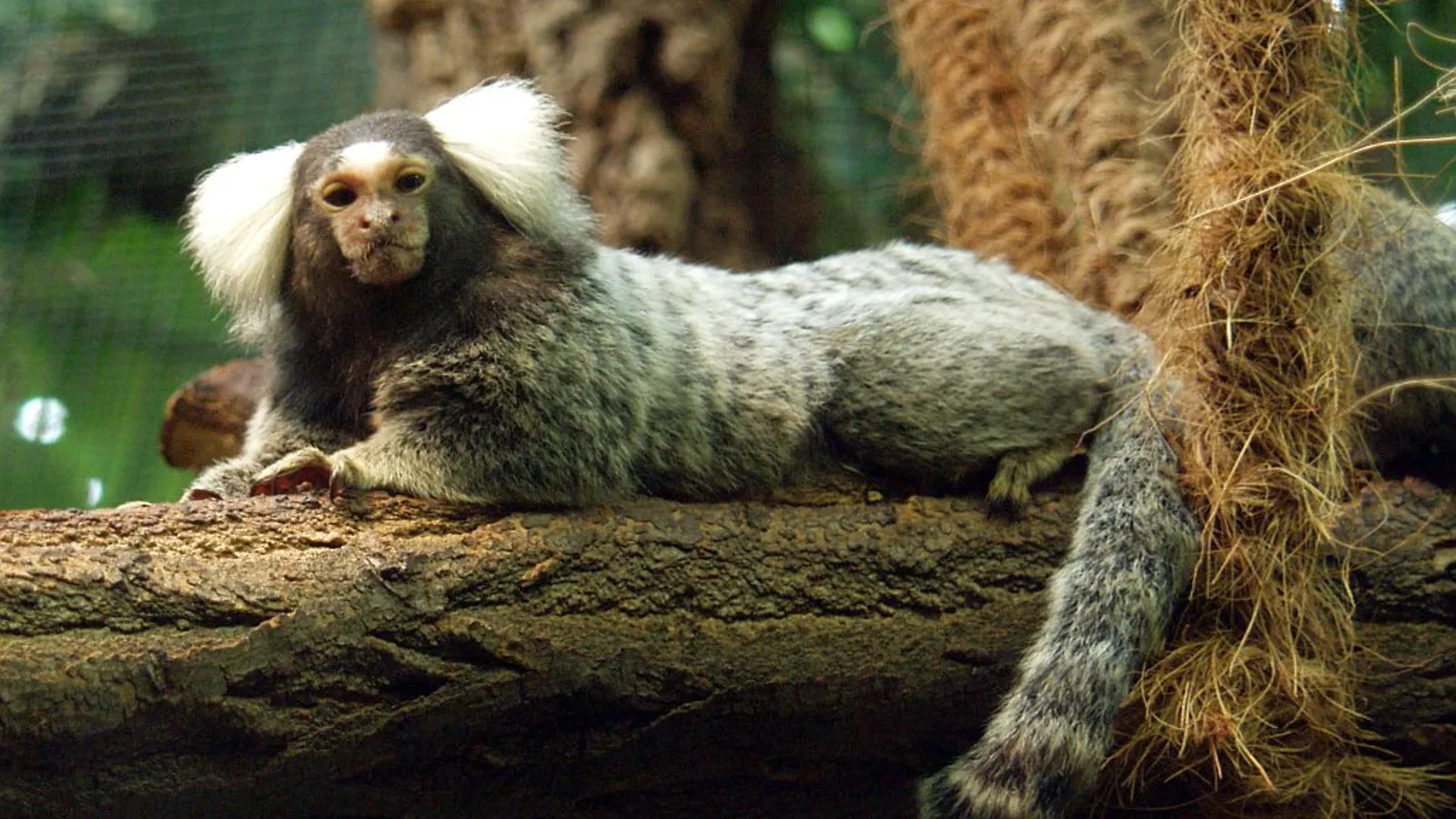
Callithrix is elegant Greek: kallos, “beauty”, and thríx, “hair” — the fine hair, for the white tufts that frame the ears. Jacchus is instead an epithet of Bacchus in the Eleusinian mysteries, one of those mythological names Linnaeus handed out without much explanation. The Italian uistitì is onomatopoeic and comes from the Tupi of Brazil: it reproduces the animal’s sharp, repeated call.
— Facts
- Group
- Mammals · Mammalia
- Order
- Primates
- Habitat
- Dry caatinga forest, coastal scrub, city parks
- Range
- North-eastern Brazil; introduced to Rio de Janeiro and other cities
- Size
- 18–22 cm long plus 30 of tail, 300–400 g
- Diet
- Omnivore — tree gum, insects, fruit, small vertebrates
- Lifespan
- 12–16 years
— Characteristics
- 01
It has chisel-like incisors with which it cuts bark to make the gum it feeds on run.
- 02
It almost always bears twins, and the father and older offspring carry them on their backs.
- 03
It has claws instead of nails on nearly all its digits, for clinging to vertical trunks.
— What sets it apart
The twins exchange stem cells in the womb through a shared placenta, and are born chimeras: each individual carries in its blood and other tissues cells that are genetically its sibling’s. An oddity follows — a marmoset can pass on to its own offspring the genome of its twin rather than its own. In a system of parental care where everyone raises everyone, this makes the accounting of kinship so tangled that biologists have had to rewrite the models of altruism for this family of primates.
