
Philippine tarsier
Carlito syrichta
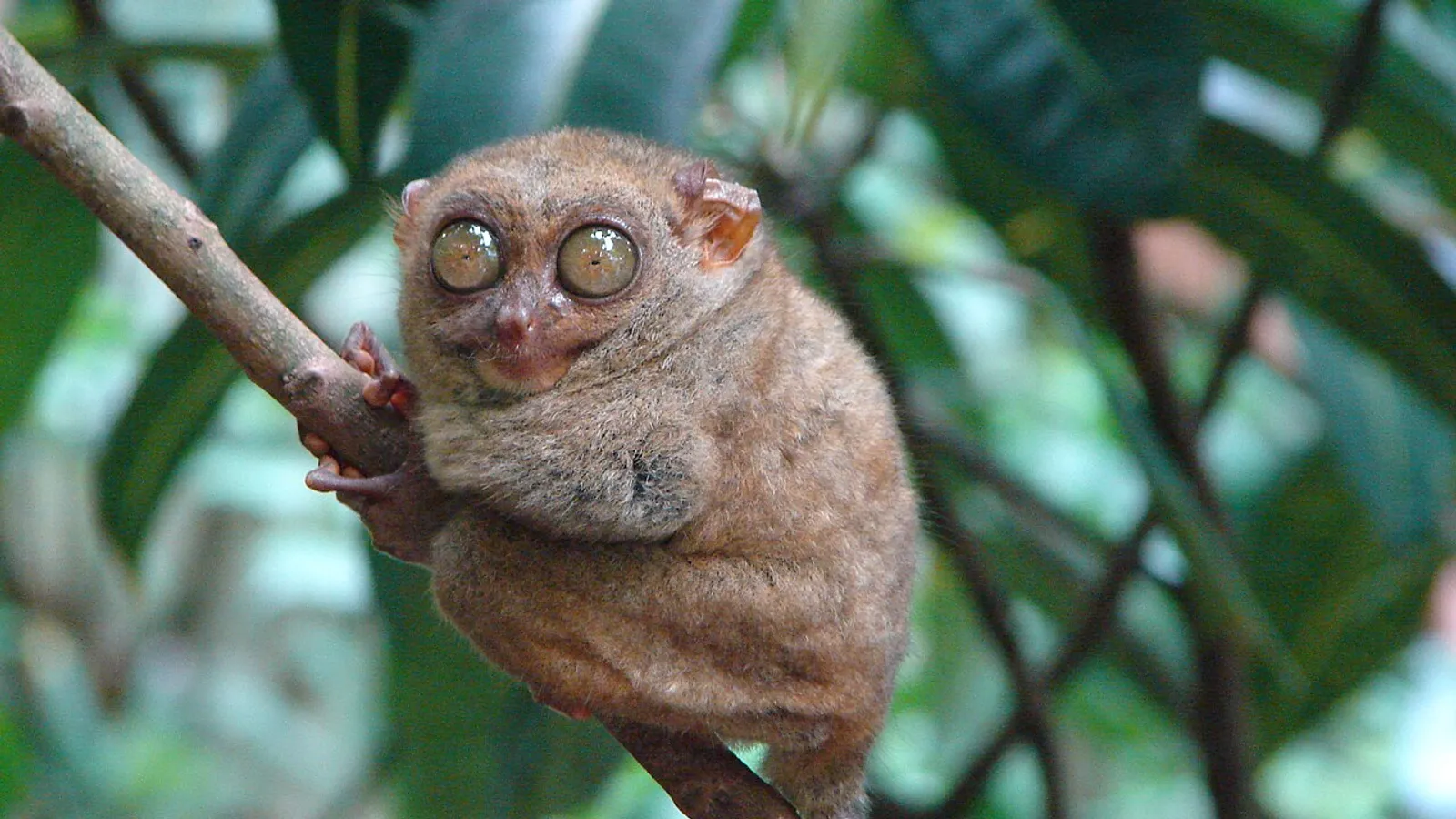
— Where the name comes from
The common name comes from the tarsus, the ankle bone: in this animal the two tarsal bones are enormously elongated and turn the leg into a spring. The genus Carlito, established in 2010, recalls instead Carlito Pizarras, a Filipino who as a boy hunted tarsiers for collectors and then spent his life protecting them. It is one of the very few scientific names dedicated not to a European naturalist but to a local guardian.
— Facts
- Group
- Mammals · Mammalia
- Order
- Primates
- Habitat
- The understorey of secondary rainforest, dense scrub and bamboo
- Range
- The southern Philippines: Bohol, Samar, Leyte, Mindanao
- Size
- 9–16 cm long plus 20–25 of tail, 80–160 g
- Diet
- Insectivore — insects, spiders, small vertebrates
- Lifespan
- 12–20 years
— Characteristics
- 01
Each eye is as large as its brain: the highest eye-to-body ratio of any mammal.
- 02
It cannot move its eyes in their sockets and compensates by turning its head nearly 180 degrees each way.
- 03
It leaps up to five metres between vertical trunks, forty times its own length.
— What sets it apart
It communicates in a band no predator in the Philippines can hear. In 2012 researchers noticed that tarsiers were opening their mouths without giving out any audible sound: recording them with the right equipment they discovered calls around 70 kHz, peaking well beyond human hearing, which stops at 20. It is among the highest-pitched voices known in land mammals, and for decades observers had noted that the animal “yawned” in silence: it was talking, and nobody could hear it.
