
Indri
Indri indri
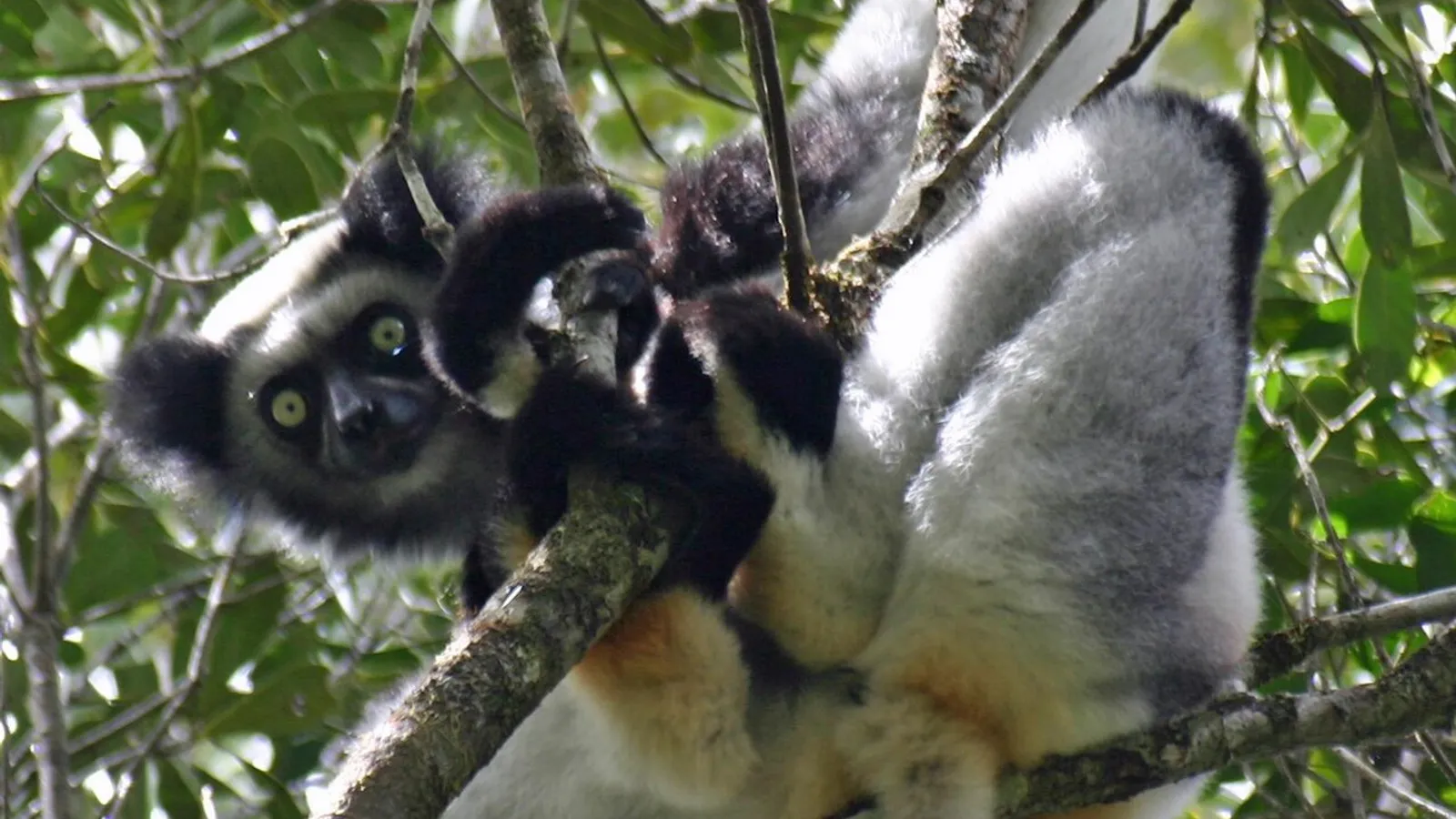
— Where the name comes from
The most famous misunderstanding in zoology. In the 18th century the French naturalist Pierre Sonnerat was travelling the forests of Madagascar with a local guide who at one point pointed at the trees exclaiming indry!, that is “there he is!” or “look!” in Malagasy. Sonnerat wrote the word down as the animal’s name, and ever since this species has carried as its name, repeated twice, a pointing finger. The real name, in Malagasy, is babakoto.
— Facts
- Group
- Mammals · Mammalia
- Order
- Primates
- Habitat
- Montane rainforest of the eastern belt
- Range
- Eastern Madagascar, in an increasingly fragmented area
- Size
- 64–72 cm long, 6–9.5 kg
- Diet
- Herbivore — young leaves, flowers, fruit
- Lifespan
- About 20 years
— Characteristics
- 01
It is the largest living lemur and practically the only one without a tail.
- 02
It moves only by vertical leaps between trunks, and never willingly comes to the ground.
- 03
It has never bred reliably in captivity: it exists only where its forest exists.
— What sets it apart
It sings in chorus, and in 2021 it was found to sing in time. Analysing twelve years of recordings, researchers found precise rhythmic ratios of 1:1 and 1:2 in the intervals between notes — the same proportions on which human music is built. Before that, no mammal other than us had shown categorical rhythm. The duets between male and female carry two kilometres, and families answer one another from valley to valley: a forest tuning itself.
