
Thomson's gazelle
Eudorcas thomsonii
— Where the name comes from
Gazelle is the Arabic ghazāl, which came to Europe with medieval love poetry: in Arabic lyric the beloved’s glance is the gazelle’s, and the word ghazal also names the poem itself. Eudorcas is Greek, eu-, “good”, and dorkás, “gazelle”, from the same root as dérkomai, “to look”, for the large eyes. The epithet recalls the Scottish explorer Joseph Thomson.
— Facts
- Group
- Mammals · Mammalia
- Order
- Even-toed ungulates
- Habitat
- Open grassy savannah, short grassland
- Range
- East Africa: northern Tanzania, southern Kenya, South Sudan
- Size
- 80–110 cm long, 15–35 kg
- Diet
- Herbivore — short grass, shoots, leaves in the dry season
- Lifespan
- 10–15 years
— Characteristics
- 01
It runs at 80 km/h and holds the pace longer than the cheetah, which is spent in under a minute.
- 02
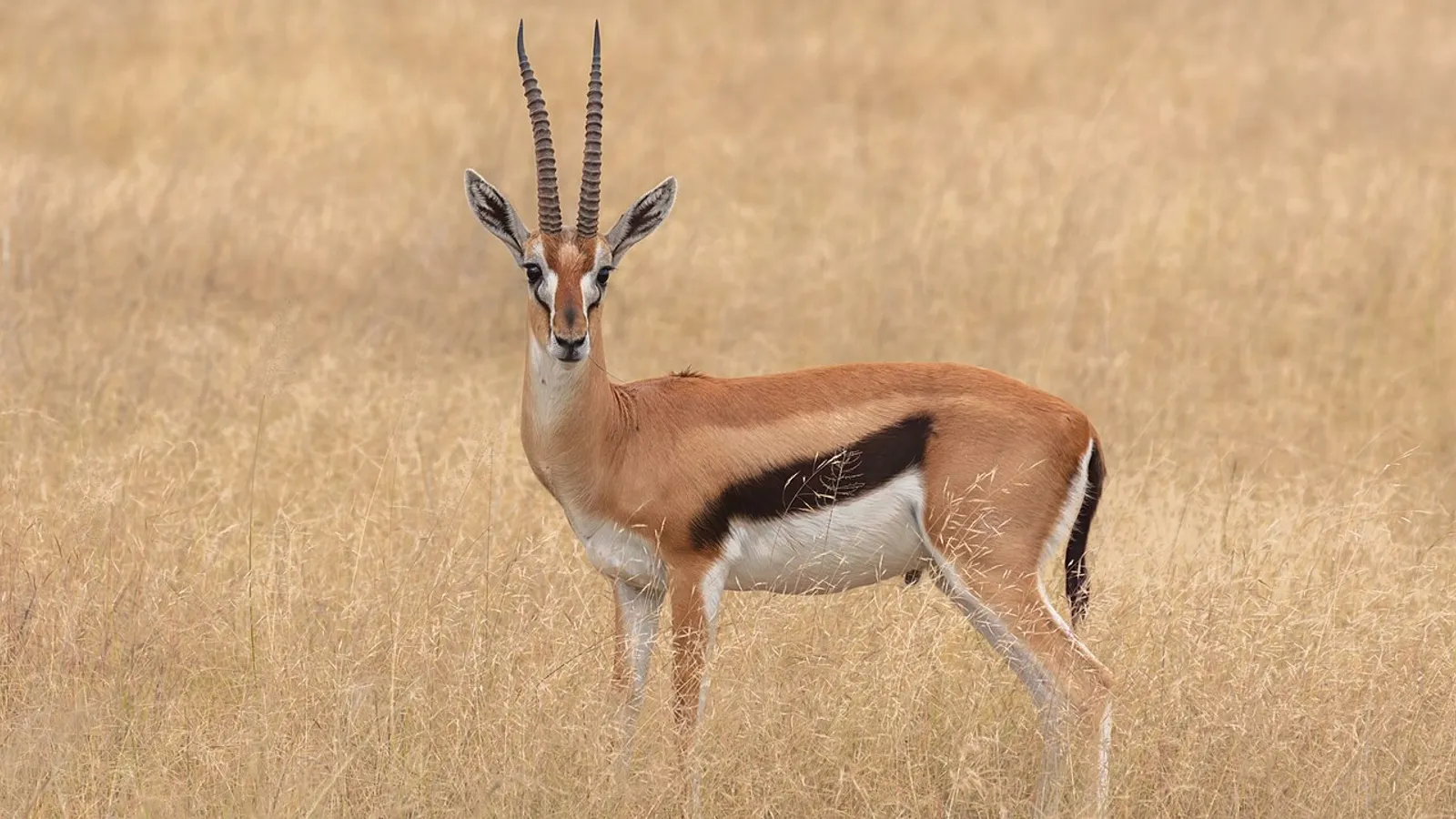
The black band on the flank cuts the tawny back cleanly from the white belly, breaking the outline in the grass.
- 03
It follows the wildebeest herds on the great migration, grazing the short grass they leave behind.
— What sets it apart
Sighting a predator, it begins bouncing on the spot with stiff legs, high and conspicuous: it is called stotting, and for years it looked like suicide. The accepted explanation is that it is a message aimed at the hunter — “I have seen you, and I am fit enough to afford to waste energy like this” — and it works: cheetahs more often give up chasing the ones that jump highest. It is an honest signal precisely because it is costly, the same principle by which the peacock’s train must be cumbersome to be credible.
