
Bald uakari
Cacajao calvus
— Where the name comes from
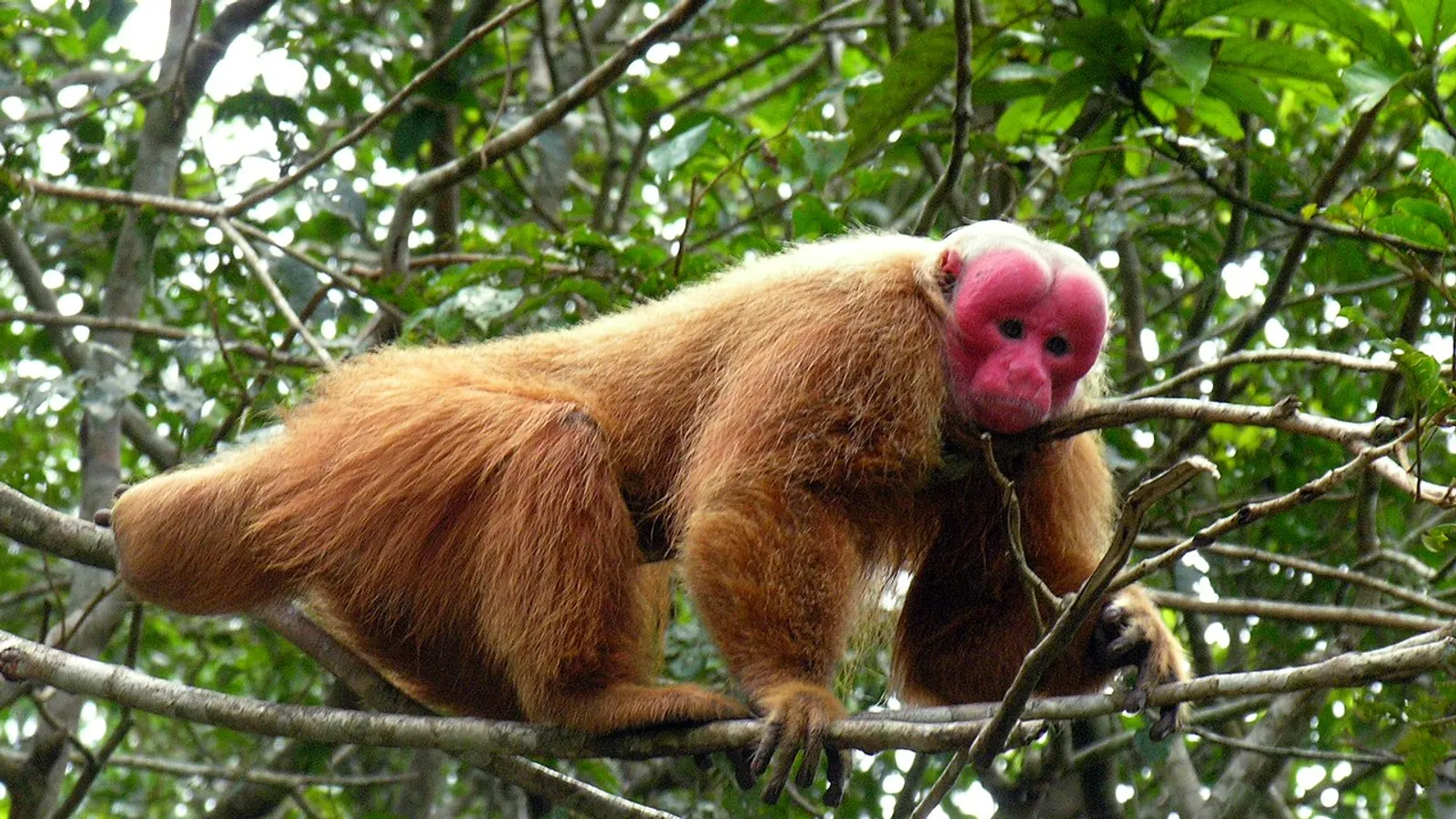
Cacajao reproduces an indigenous Amazonian name; calvus is the Latin for “bald”, from the naked head. The red face and the hairless skull have inspired local names ranging from “English monkey” — apparently for the likeness to sunburnt colonists — to less kindly comparisons. It is one of the rare primates whose face carries no pigment: the red is blood showing through skin that is extremely thin and translucent.
— Facts
- Group
- Mammals · Mammalia
- Order
- Primates
- Habitat
- Várzea, the Amazon forest seasonally flooded by white water
- Range
- Western Amazonia: Brazil, Peru, Colombia
- Size
- 36–57 cm of body, 2.8–4 kg
- Diet
- Seed eater — the seeds of unripe fruit, which it opens with extremely strong incisors
- Lifespan
- About 20 years
— Characteristics
- 01
It has the shortest tail of any New World monkey: a 15-centimetre stump.
- 02
It opens shells so hard that no other Amazonian primate can crack them.
- 03
It lives in flooded forest and for months on end never comes to the ground, because there is no ground.
— What sets it apart
The red face is a medical report. It has no pigment: the colour comes from blood showing through, and it fades when the animal is anaemic — which in Amazonia nearly always means malaria. Females prefer the males with the brightest faces, and in doing so choose, without knowing it, the partners free of the parasite. It is one of the best-documented cases of a sexual ornament that works as a health certificate, and it has the rare virtue of being impossible to forge.
