
Sunda slow loris
Nycticebus coucang
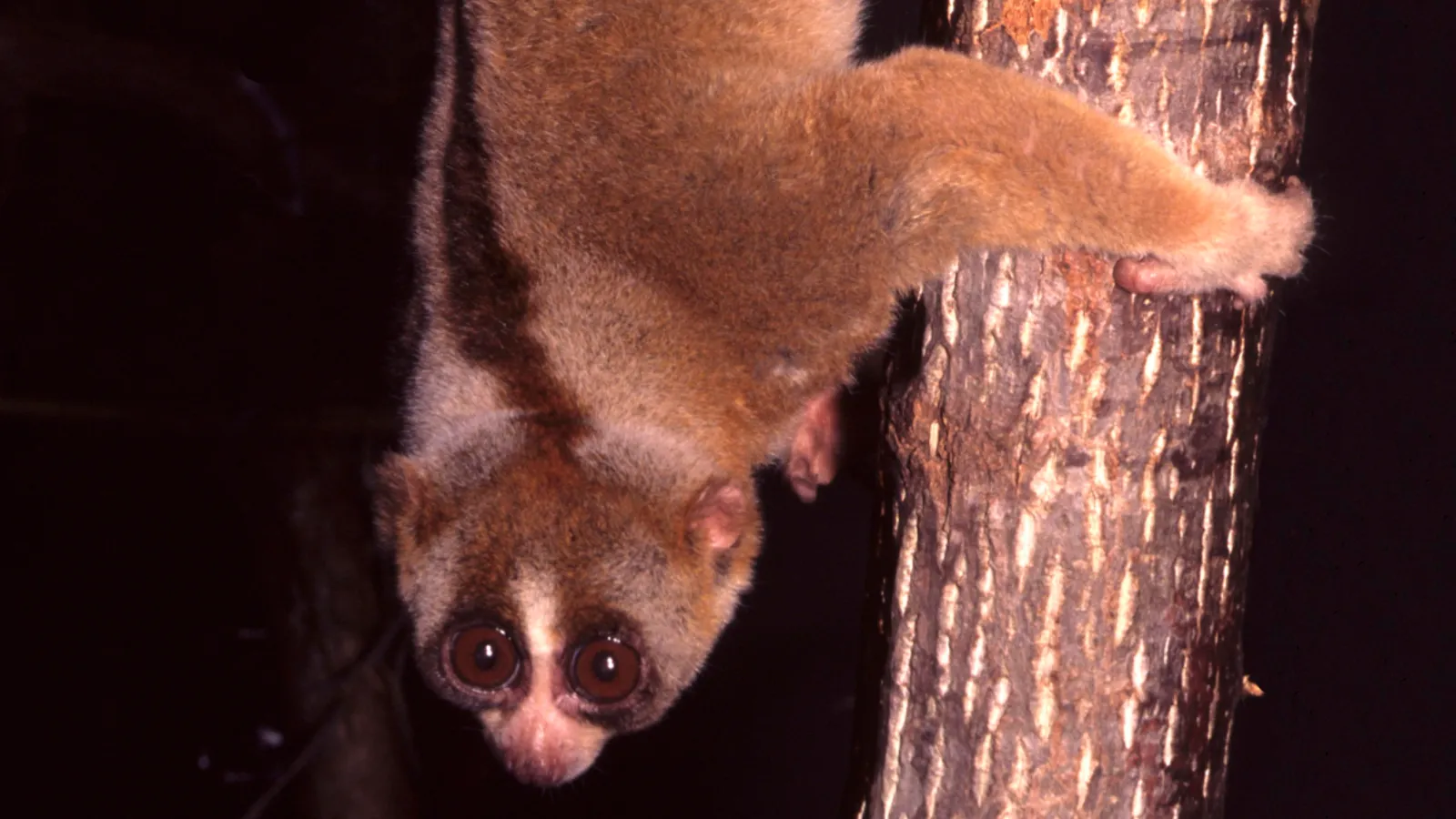
— Where the name comes from
Nycticebus is “monkey of the night”, from the Greek nýx, nyktós, and kêbos. Coucang renders the Malay kukang. The name “loris” comes instead from the Dutch loeris, “clown, fool”, for the fixed expression and the huge eyes — an ungenerous judgement on an animal that is, among other things, the only venomous primate on the planet.
— Facts
- Group
- Mammals · Mammalia
- Order
- Primates
- Habitat
- Rainforest, secondary forest, gardens and plantations
- Range
- The Malay peninsula, Sumatra, southern Thailand, Singapore
- Size
- 26–38 cm, 600–850 g
- Diet
- Omnivore — tree gum, nectar, insects, small vertebrates
- Lifespan
- 20 years in captivity
— Characteristics
- 01
It has a gland on the elbow whose secretion, mixed with saliva, turns toxic.
- 02
It moves extremely slowly and silently: it never jumps and always keeps three holds.
- 03
Its bite can cause anaphylactic shock in humans.
— What sets it apart
It is the only venomous primate, and it makes the venom itself. A gland on the inner side of the elbow produces an oily secretion that is nearly harmless on its own; the animal licks it, and the union with a protein in the saliva creates a toxic compound which it then injects by biting. Mothers also smear it on their infants’ fur before leaving them alone on a branch. The illegal pet trade answers all this by pulling the teeth out of captured animals, with pliers and without anaesthetic.
