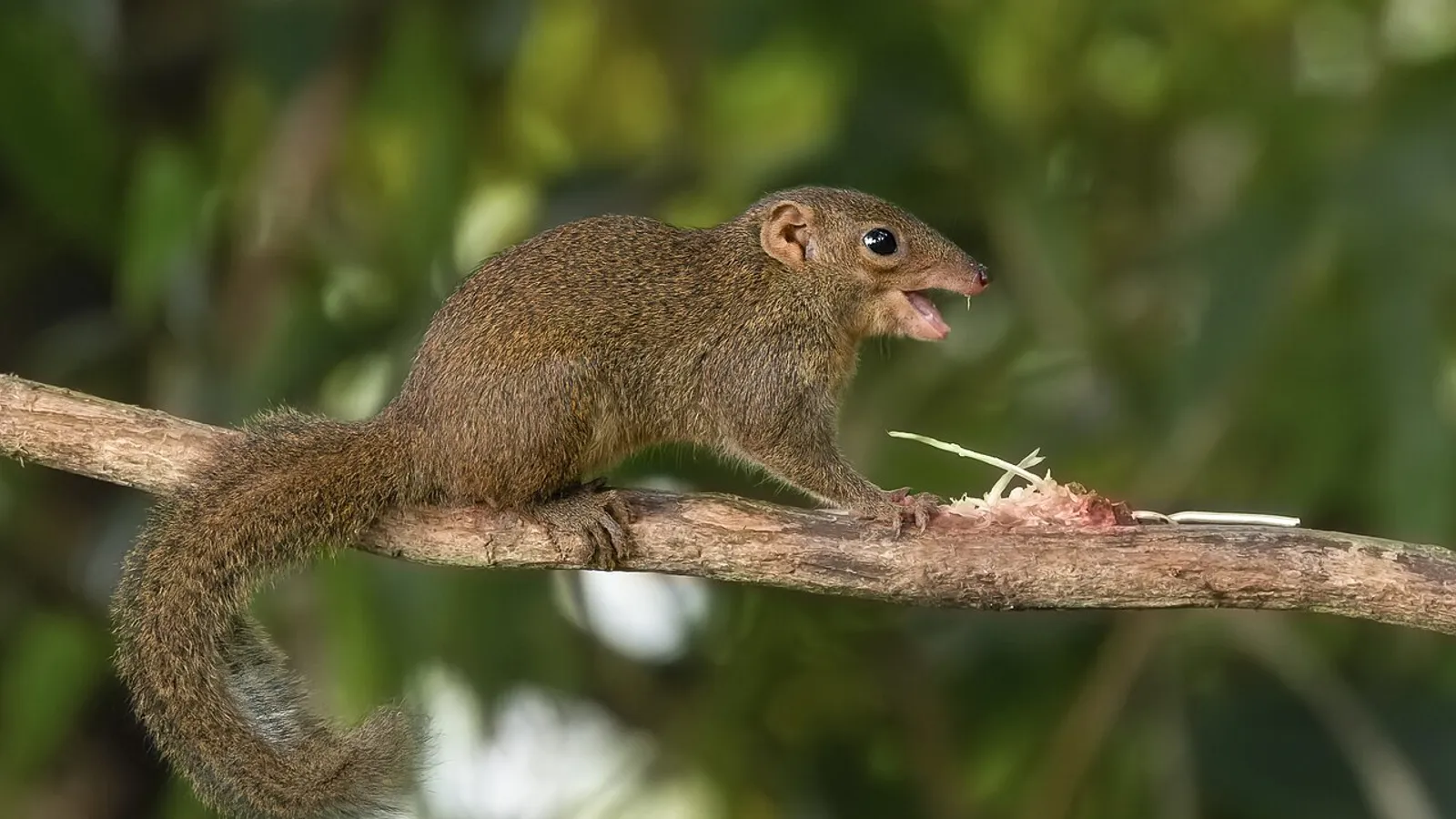
Common treeshrew
Tupaia glis
— Where the name comes from
Tupaia comes from the Malay tupai, which means “squirrel”: it is a squirrel it resembles, and with squirrels that it was long confused. Glis is the Latin for dormouse, so the binomial says “squirrel-dormouse” for an animal that is neither, nor a shrew despite the English name treeshrew. It sits in an order of its own, the Scandentia, and its closest relatives are the primates.
— Facts
- Group
- Mammals · Mammalia
- Order
- Treeshrews
- Habitat
- Primary and secondary rainforest, plantations, gardens
- Range
- The Malay peninsula, Sumatra, southern Thailand and nearby islands
- Size
- 16–21 cm of body plus a nearly equal tail, 100–185 g
- Diet
- Omnivore — insects, fruit, seeds, small vertebrates
- Lifespan
- 2–3 years in the wild, up to 12 in captivity
— Characteristics
- 01
It has the highest ratio of brain mass to body mass of any mammal, humans included.
- 02
It is diurnal, unlike almost every other small tropical mammal.
- 03
It forms an order of its own, related to primates and colugos.
— What sets it apart
The mother visits her young once every forty-eight hours. She bears them in a nest separate from her own, goes there for five or ten minutes, suckles them on milk among the most concentrated of any mammal, and leaves, abandoning them alone for two full days. In all, an infant receives from its mother little more than an hour and a half of attention across a month of nursing. It is the most reduced form of parental care documented in a placental mammal, and it works: infant survival is high.