
Brown trout
Salmo trutta
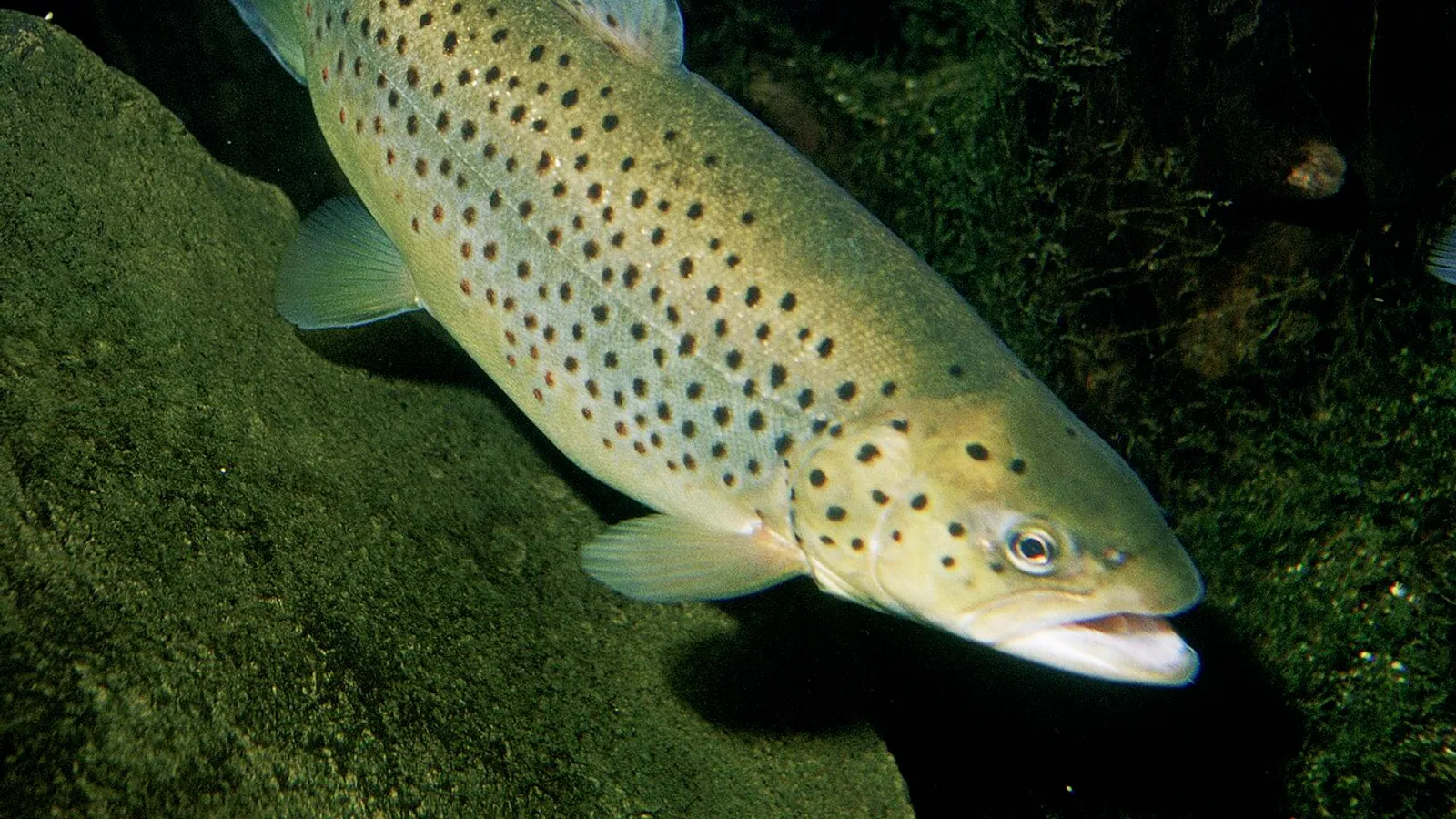
— Where the name comes from
Salmo very probably comes from salire, to leap: it is the fish that climbs waterfalls. Trutta is the Latin name of the trout, of uncertain and perhaps pre-Roman origin. Under this binomial sits a problem that occupied taxonomists for two centuries: the brown trout, the lake trout and the sea trout are the same species, and turn into one another.
— Facts
- Group
- Fish · Actinopterygii · Chondrichthyes
- Order
- Salmonids
- Habitat
- Cold streams, alpine lakes, estuaries, the sea for migratory forms
- Range
- Europe and western Asia; introduced to every continent
- Size
- 25–50 cm in streams, up to 140 cm in sea-run forms; 0.3–20 kg
- Diet
- Insects, crustaceans, fish, eggs
- Lifespan
- 10 years, some over 20
— Characteristics
- 01
The same population can produce both resident and migratory individuals.
- 02
It spawns in nests dug in gravel with the tail, called redds.
- 03
Its colour changes radically with the surroundings: from brown to nearly silver.
— What sets it apart
It is one of the most transplanted fish in history. In the nineteenth century its eggs travelled in the holds of British imperial ships to New Zealand, Patagonia, Kashmir and Kenya, because settlers wanted to fish as they had at home, and today the brown trout is among the hundred most damaging invasive species in the world: in southern-hemisphere rivers it has displaced endemic fish that had never seen a predator like it. The same animal is protected in Europe and fought in New Zealand.
