
Sockeye salmon
Oncorhynchus nerka
— Where the name comes from
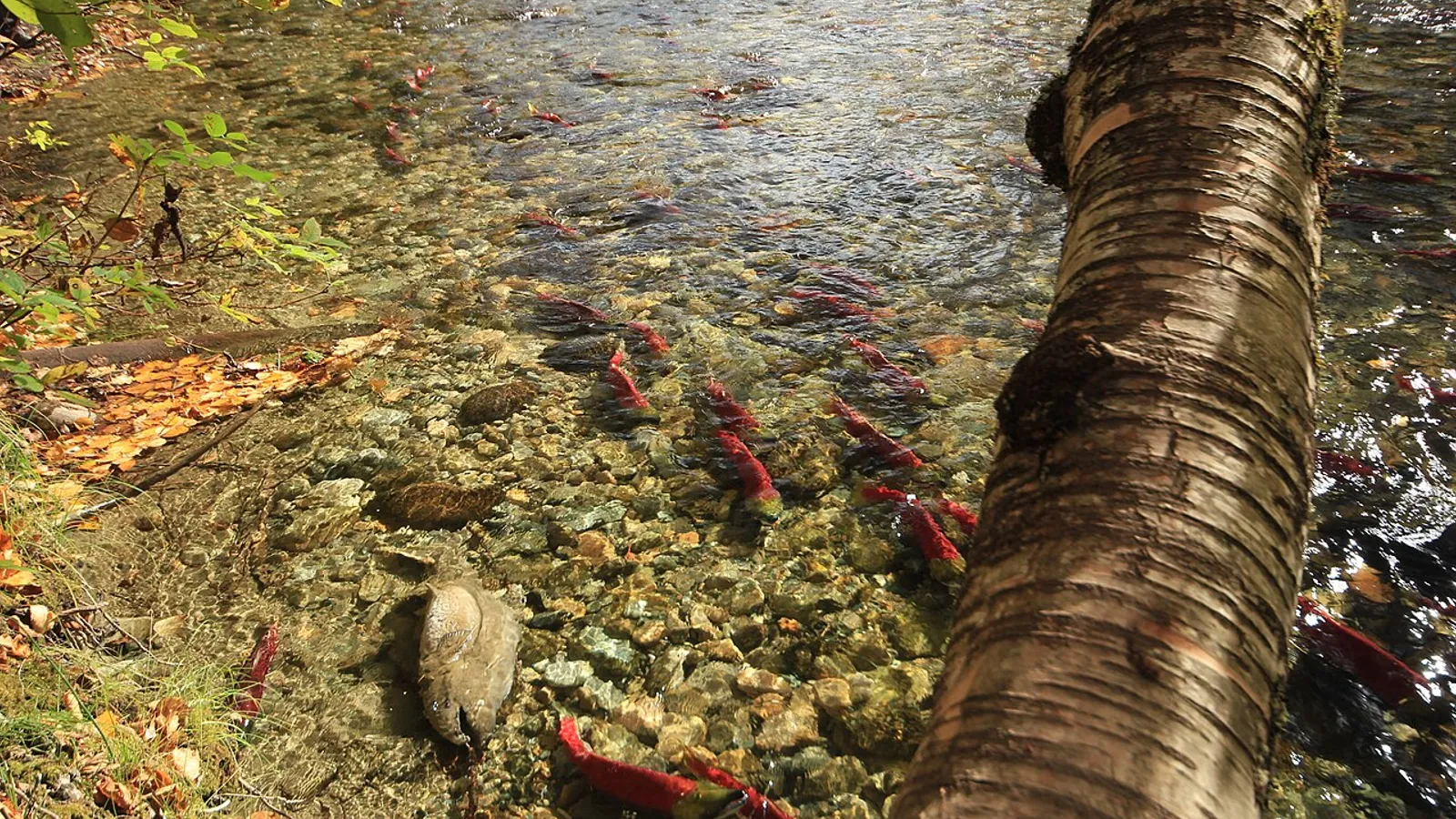
Oncorhynchus is “hooked snout”, from ónkos and rhýnchos: in breeding males the jaw lengthens and curves into a spectacular hook. Nerka is a Russian word, collected in Kamchatka. The common name looks at the colour the animal takes on running upriver: from silver it turns bright red with a green head.
— Facts
- Group
- Fish · Actinopterygii · Chondrichthyes
- Order
- Salmonids
- Habitat
- The northern Pacific; rivers and lakes to spawn
- Range
- The coasts and rivers of the northern Pacific, from Japan to California
- Size
- 60–80 cm, 2.5–7 kg
- Diet
- Zooplankton, krill, small fish
- Lifespan
- 5 years
— Characteristics
- 01
It dies a few weeks after spawning.
- 02
It finds its native river by smell, after years at sea.
- 03
Unlike other salmon it needs a lake in which to raise its young.
— What sets it apart
Its death fertilises the forests. Millions of salmon run upriver, spawn and die, and their bodies are dragged onto the banks by bears, eagles and otters: the nitrogen in their tissue carries an unmistakable marine isotopic signature, and it is found in the needles of spruces growing hundreds of metres from the water. Trees in valleys with a salmon run grow faster than those in valleys without. It is the ocean, by way of a fish and a bear, ending up inside wood.
