
Giant triton
Charonia tritonis
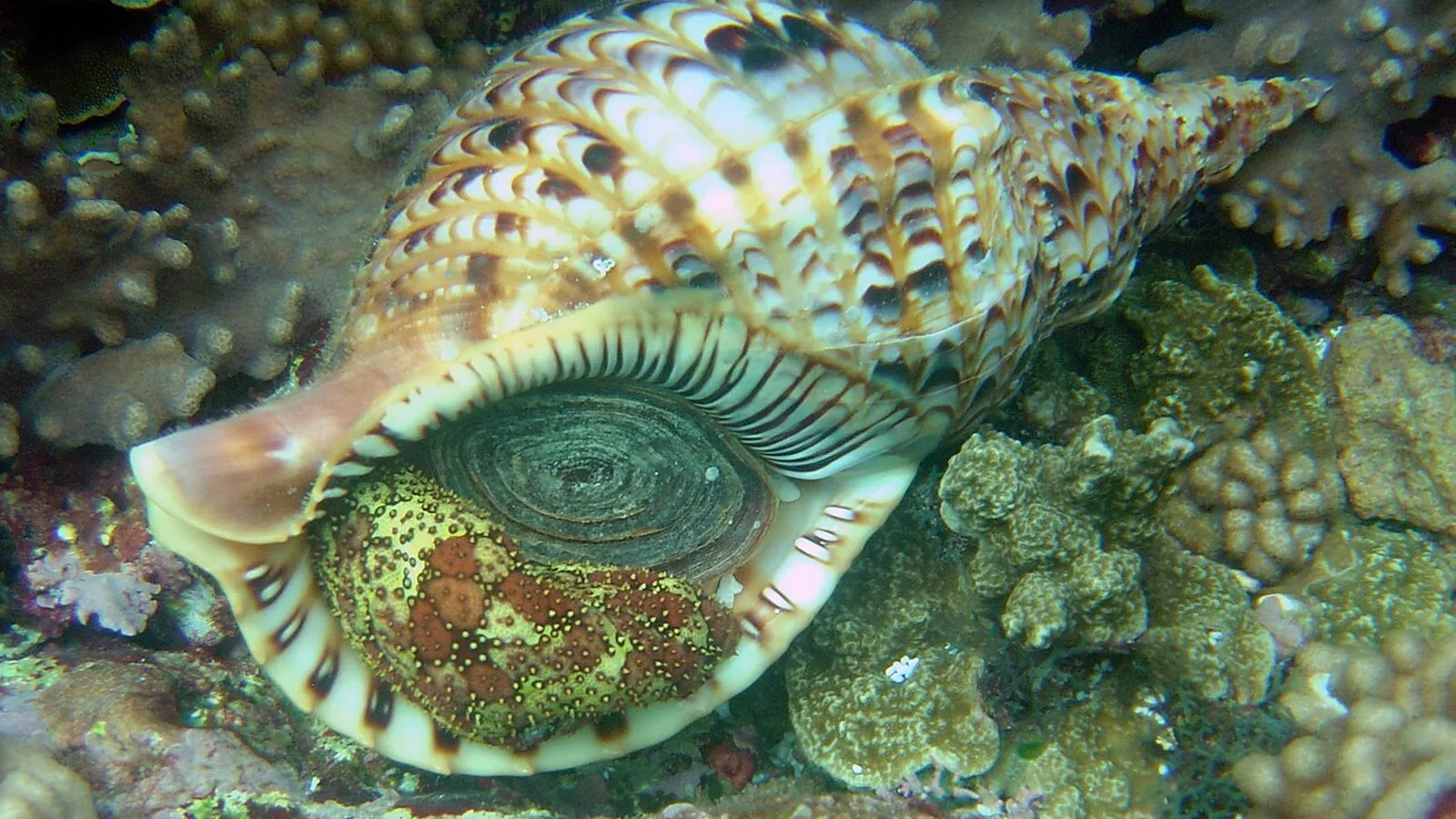
— Where the name comes from
Tritonis is Triton, the son of Poseidon who calmed and raised the waves by blowing into a shell: it is one of the rare cases of an animal named after the musical instrument it became. Shells of this species, pierced at the apex, have served as horns for millennia — in the Pacific islands, in Tibet, in Japanese processions — and the sound they make is why the ancients imagined a god who played them.
— Facts
- Group
- Molluscs · Mollusca
- Order
- Sea snails
- Habitat
- Coral reefs and tropical sandy bottoms
- Range
- Indo-Pacific, from the Red Sea to Polynesia
- Size
- Shell up to 50 cm
- Diet
- Starfish, above all the crown-of-thorns
- Lifespan
- Over 10 years
— Characteristics
- 01
It is one of the largest living marine gastropods.
- 02
It immobilises prey with saliva containing sulphuric acid.
- 03
It eats the crown-of-thorns, which almost no other predator touches.
— What sets it apart
It is one of the few animals that eats the crown-of-thorns, the starfish that devours coral and that in population outbreaks can strip whole stretches of reef. The shell, however, has been collected for centuries as a souvenir and an instrument, and on the Great Barrier Reef the scarcity of the triton is one of the proposed explanations for the frequency of those outbreaks: a predator collected for the beauty of its shell, and a reef paying the bill. It is now protected in Australia and in many Pacific countries.
