
Money cowrie
Monetaria moneta
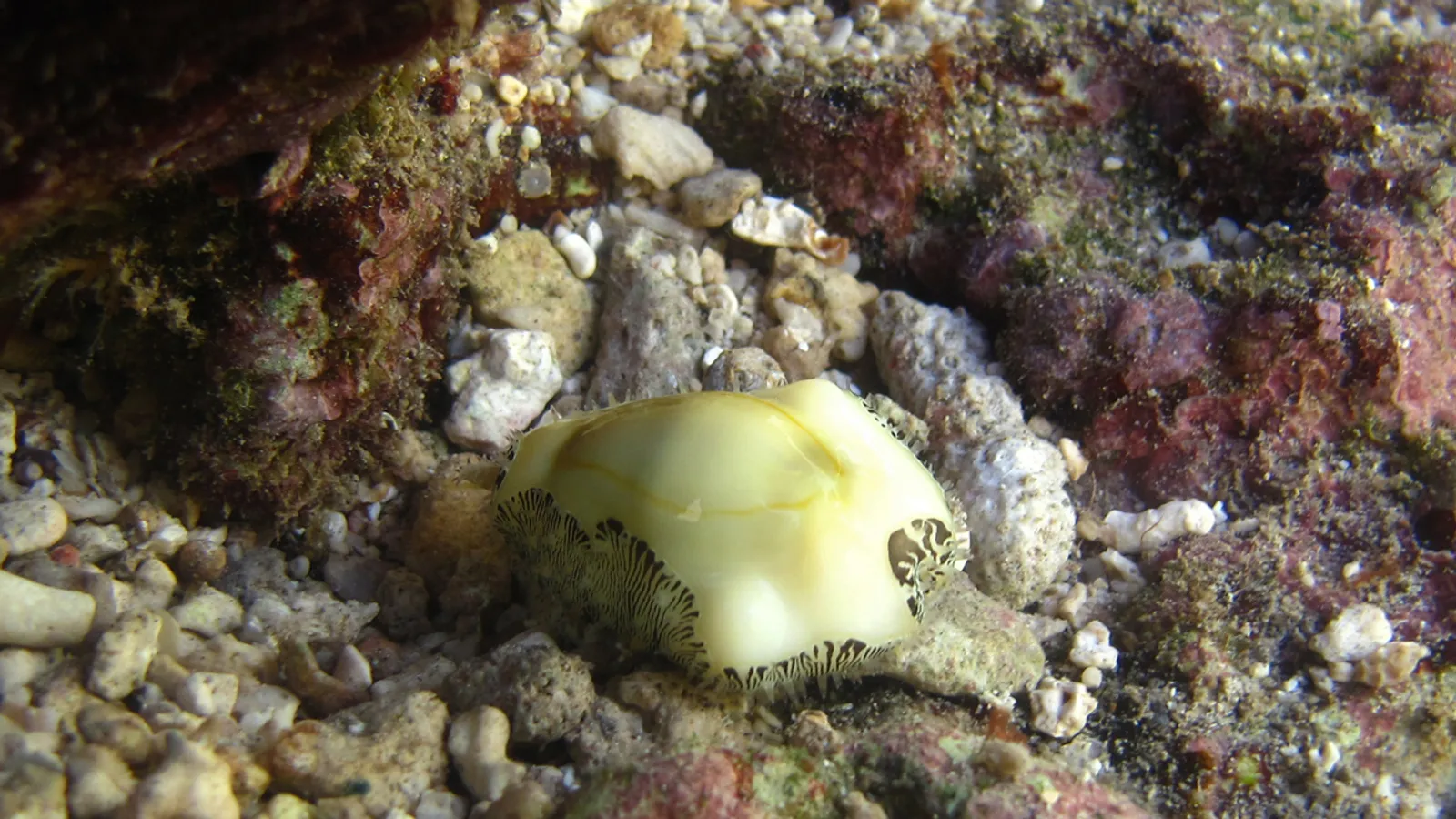
— Where the name comes from
The name is repeated twice and says one thing: money. The Latin word comes from Juno Moneta, “she who warns”, in whose temple at Rome coin was struck; and this shell was for centuries, literally, money. The Italian ciprea comes instead from Cyprus, the island of Aphrodite, for a shape ancient naturalists likened to the female sex — the same image that gives English cowrie and, in many African languages, a ritual use tied to fertility.
— Facts
- Group
- Molluscs · Mollusca
- Order
- Sea snails
- Habitat
- Sand and coral rubble flats, in shallow water
- Range
- Indo-Pacific, from East Africa to Hawaii
- Size
- 1.5–3 cm
- Diet
- Algae and detritus rasped from the substrate
- Lifespan
- 1–2 years
— Characteristics
- 01
The mantle folds up over the shell and keeps it polished.
- 02
The gloss is not nacre: it is enamel laid down from outside.
- 03
It was collected in billions in the Maldives for world trade.
— What sets it apart
It was the most geographically widespread currency in human history: gathered almost entirely in the Maldives, where it was fished with sunken palm fronds and then left to rot on the beach, it travelled by ship to Bengal, China, the Sahel and West Africa, where it bought everything — including, in the eighteenth century, human beings destined for the Atlantic trade. It could not be counterfeited, did not wear out and could not be farmed: its quantity depended on a single archipelago. When Europeans began importing it by the tonne, the resulting inflation helped destroy the economies that ran on it.
