
Sea hare
Aplysia depilans
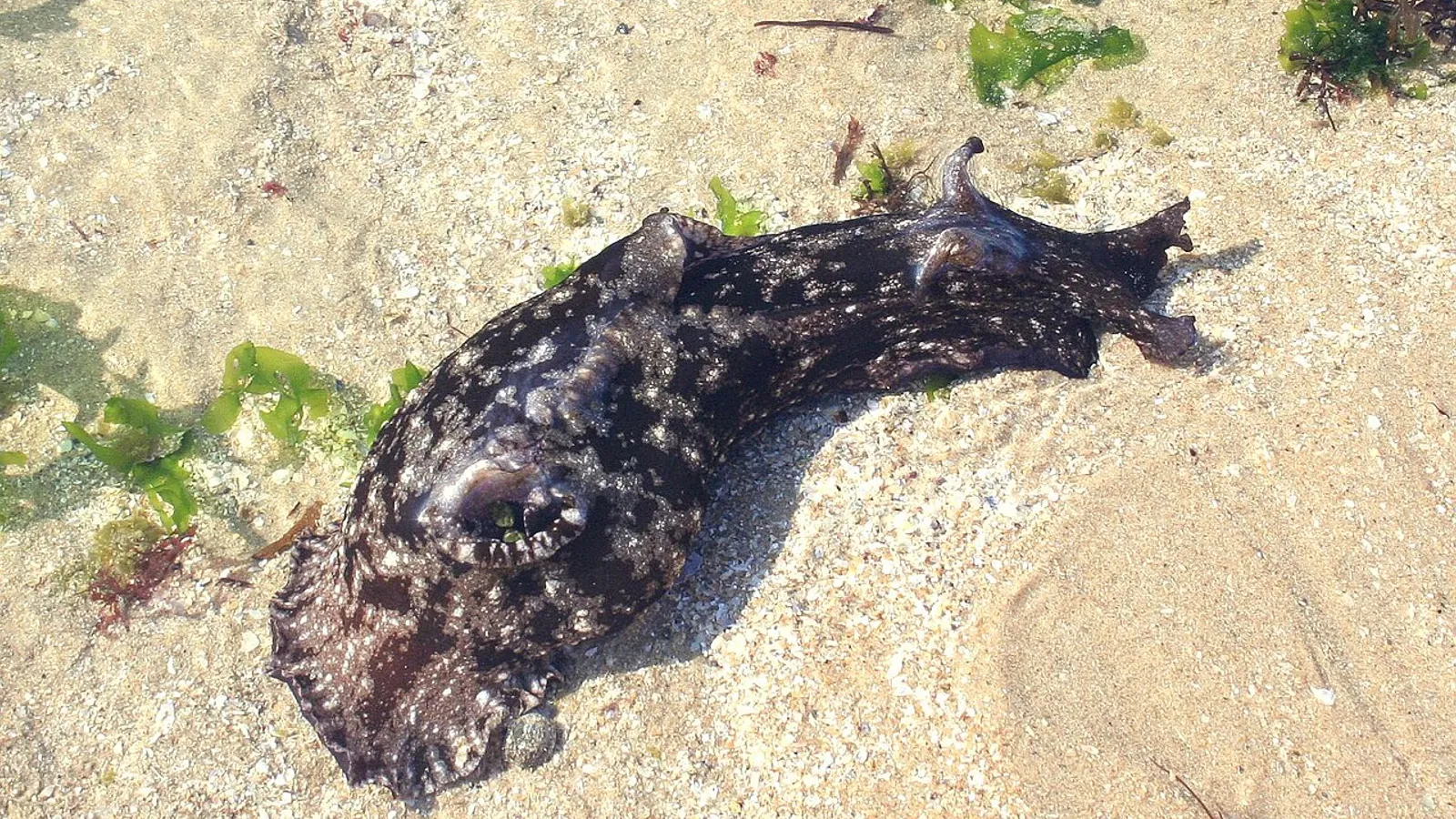
— Where the name comes from
Depilans means “that makes hair fall out”, and preserves an ancient belief: Pliny writes that this animal, touched, causes baldness, and for centuries it was feared as poisonous. Aplysía in Greek meant a filthy sponge, “that which cannot be washed”. The Italian name looks instead at the two erect tentacles on the head, which resemble a hare’s ears — the same image gives the English sea hare and the German Seehase.
— Facts
- Group
- Molluscs · Mollusca
- Order
- Sea hares
- Habitat
- Shallow rocky bottoms with algae
- Range
- Mediterranean and eastern Atlantic
- Size
- 20–30 cm
- Diet
- Green and red algae
- Lifespan
- 1 year
— Characteristics
- 01
It releases a cloud of purple ink when disturbed.
- 02
It has an internal shell, reduced to a transparent plate.
- 03
It is hermaphrodite and mates in chains of several individuals at once.
— What sets it apart
On a Californian relative of this animal it was worked out what memory is. The sea hare’s neurons are very large, few, and the same in every individual, which allows them to be followed one at a time: in the 1960s and 1970s Eric Kandel showed that when the animal learns to ignore a harmless stimulus, or conversely to react more strongly after a shock, what changes are the synapses between two cells identified by name — short-term memory alters the strength of the contact, long-term memory switches on genes and builds new synapses. It won him the Nobel prize in 2000, and it had all begun with a sea slug withdrawing its gill.
