
Northern crested newt
Triturus cristatus
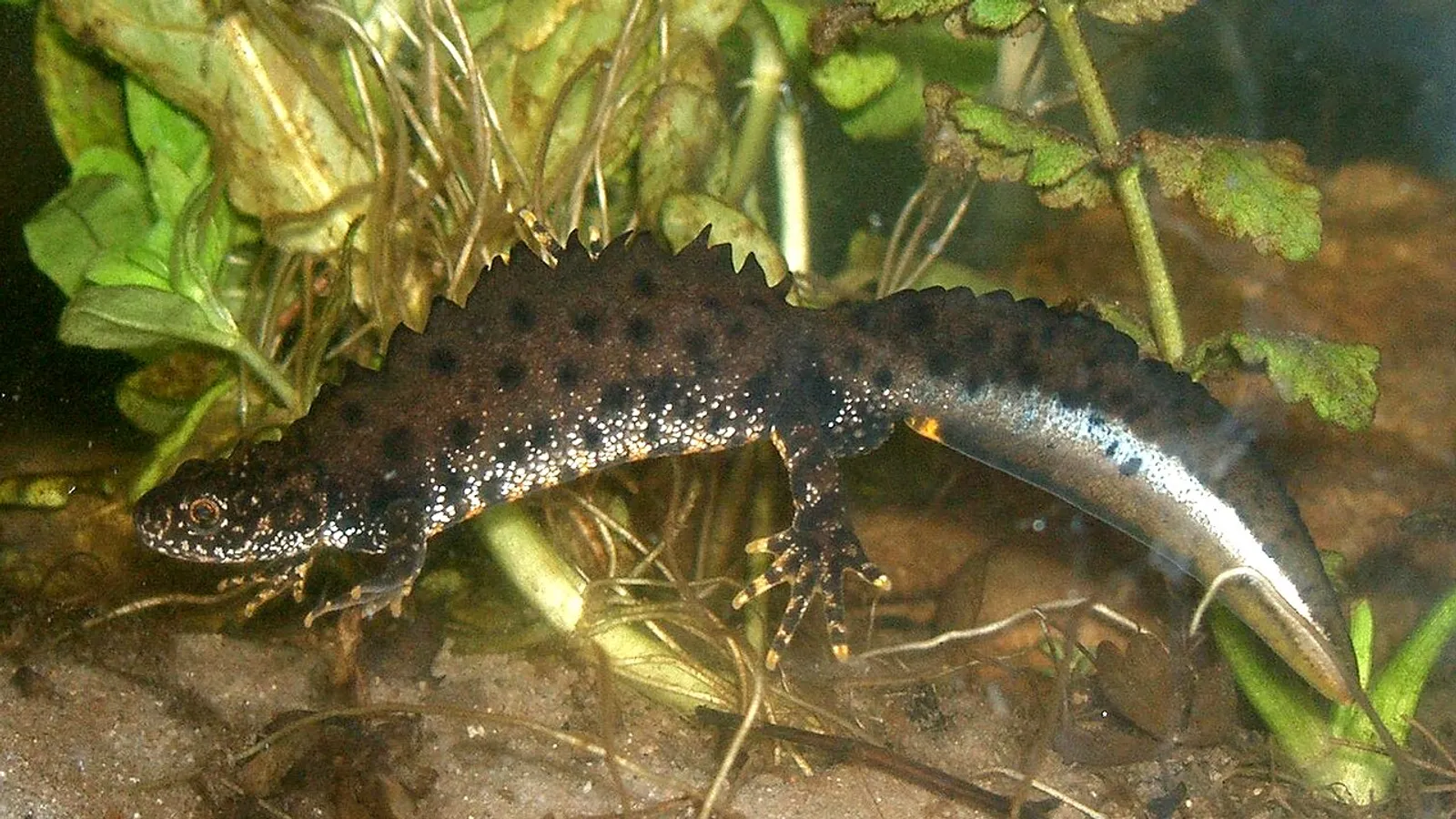
— Where the name comes from
Triturus comes from Triton, the son of Poseidon who blew his conch to calm the waves, with a tail — ourá — added on. Cristatus refers to the crest that grows on the male’s back and tail in spring, more than a centimetre high and toothed, and that is entirely reabsorbed when the season ends.
— Facts
- Group
- Amphibians · Amphibia
- Order
- Salamanders
- Habitat
- Permanent ponds with vegetation, woods and meadows around them
- Range
- Europe, from Britain to the Urals
- Size
- 13–16 cm, 6–12 g
- Diet
- Tadpoles, insect larvae, slugs, other newts
- Lifespan
- 16 years
— Characteristics
- 01
The belly is orange with black blotches, different in every individual.
- 02
The male dances in front of the female without ever touching her.
- 03
It spends the winter on land, under stones and logs far from water.
— What sets it apart
Half its embryos die, always, and it is not a disease. Every individual of this species carries two different versions of one chromosome, and any that inherits two identical copies does not survive development: it means every clutch loses exactly half its young to a condition no parent can escape, because the carriers are the only viable combination. It is one of the few known cases of a lethal defect that has become a stable and obligatory feature of an entire species.
