
Eurasian wryneck
Jynx torquilla
— Where the name comes from
Iynx was a nymph who bewitched Zeus and was turned by Hera into this bird; the Greeks then tied it to a wheel that they spun in love rituals, and the wheel too was called an iynx. From the same word comes the English jinx. Torquilla is “little twister”, and hence the Italian name, which describes what it does when picked up.
— Facts
- Group
- Birds · Aves
- Order
- Woodpeckers and toucans
- Habitat
- Orchards, gardens, open woodland, tree lines, meadows with anthills
- Range
- Europe and Asia; winters in Africa and southern Asia
- Size
- 16–18 cm, wingspan 25–27 cm, 30–45 g
- Diet
- Ants and their pupae, gathered on the ground
- Lifespan
- 6 years in the wild
— Characteristics
- 01
It is a woodpecker that neither excavates nor drums: it uses existing holes.
- 02
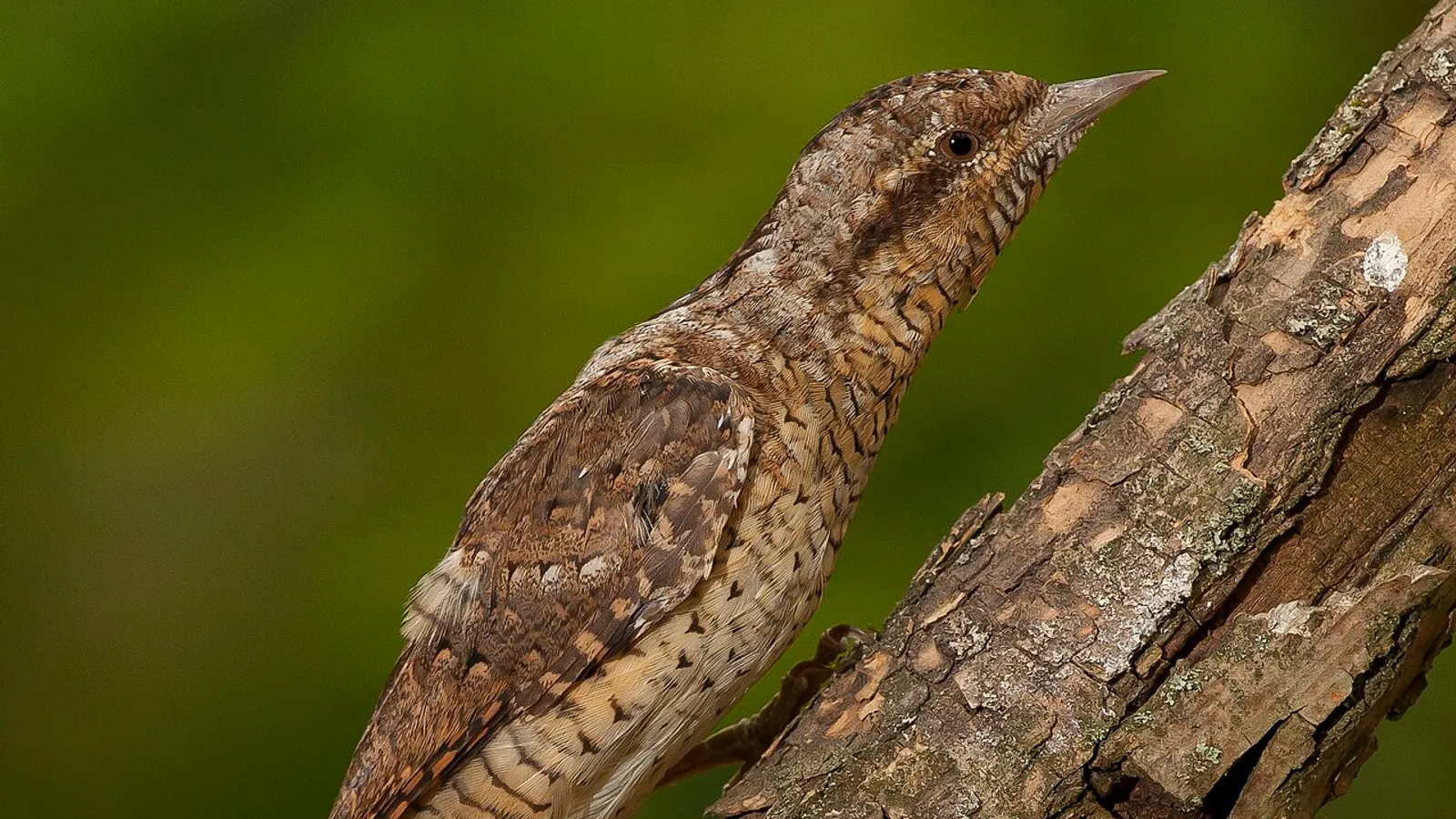
The plumage reproduces bark and makes it invisible on a branch.
- 03
It has a very long sticky tongue that it pushes into anthills.
— What sets it apart
Picked up, or discovered on the nest, it swells its throat, hisses and slowly rotates its neck backwards into positions that look impossible, eyes half shut: the performance imitates a snake so convincingly that predators — and people — back away. That is where both the Italian name and the Greek magic come from: the wheel of the Athenian love charms was made with a live wryneck tied by the wings, and it turned because the movement looked supernatural.
