
Karoo round-eared sengi
Macroscelides proboscideus
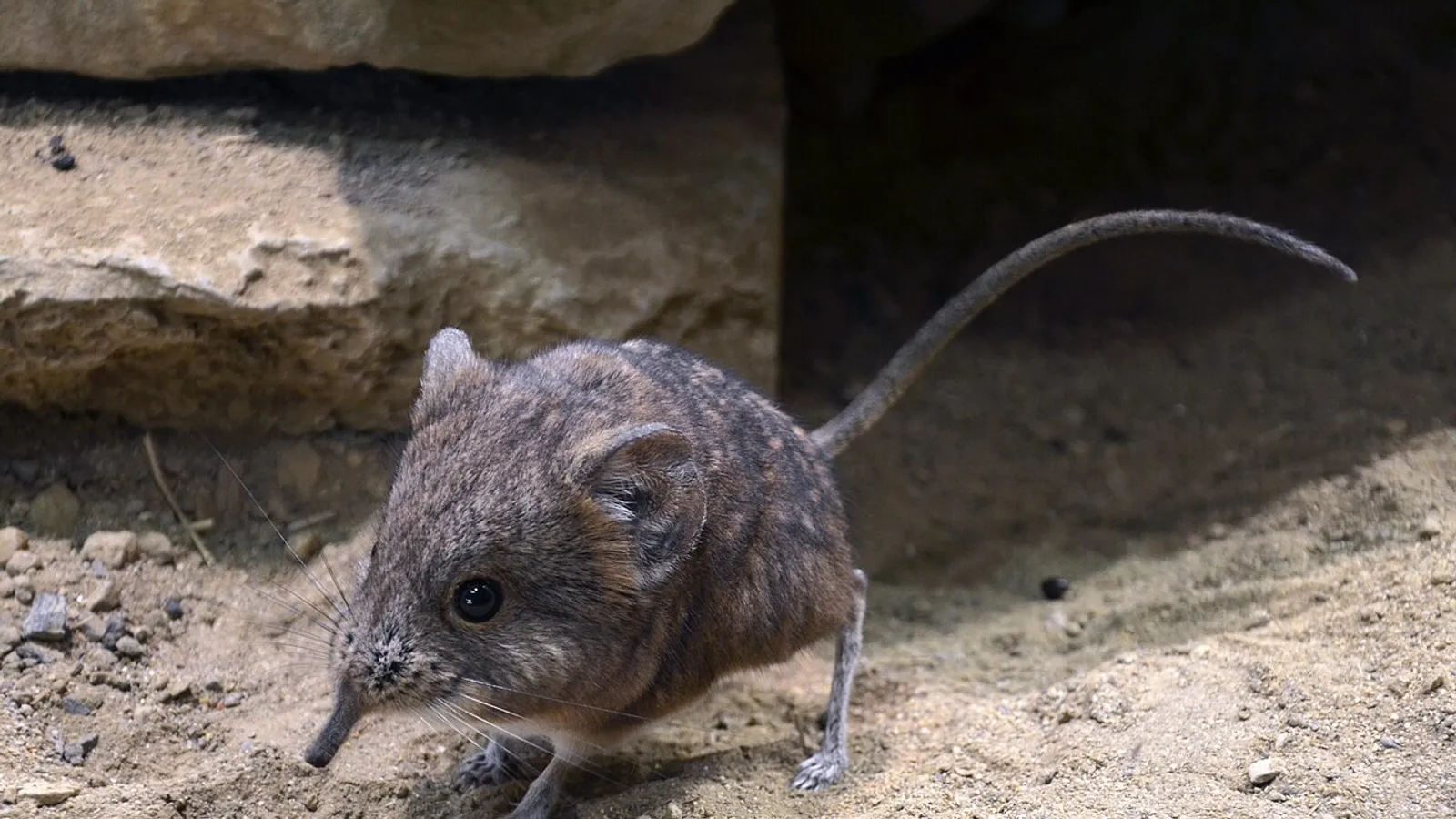
— Where the name comes from
Macroscelides is Greek, makrós, “long”, and skélos, “leg”: the long legs. Proboscideus is Latin and points to the proboscis, the mobile little snout the animal uses to rummage among stones. The Italian and English names call it both a shrew and an elephant, and are wrong on both counts: today it is preferred to call it a sengi, a Bantu word that does not claim to relate it to anyone.
— Facts
- Group
- Mammals · Mammalia
- Order
- Sengis
- Habitat
- Sandy deserts and semi-deserts with sparse shrubs
- Range
- Southern Africa: Namibia, Botswana and western South Africa
- Size
- 9–12 cm long plus 10–14 of tail, 30–50 g
- Diet
- Insectivore — ants, termites, small invertebrates
- Lifespan
- 2–4 years
— Characteristics
- 01
It builds and keeps clear fixed trails between the bushes, which it runs along at speed when fleeing.
- 02
It lives in monogamous pairs that defend a common territory but spend the day apart.
- 03
The proboscis moves in every direction and is used to probe the sand for insects.
— What sets it apart
For two centuries it was classed beside the shrews, then the rodents, then the lagomorphs. DNA, in the 1990s, gave an answer nobody expected: it belongs to the Afrotheria, the great African stock that takes in elephants, aardvarks, hyraxes and manatees. That “elephant” put into the name half in jest, for the long snout, turned out to be the only accurate part of the classification — a case in which a superficial resemblance guessed at a real kinship sixty million years old.
