
Lesser blind mole-rat
Nannospalax leucodon
— Where the name comes from
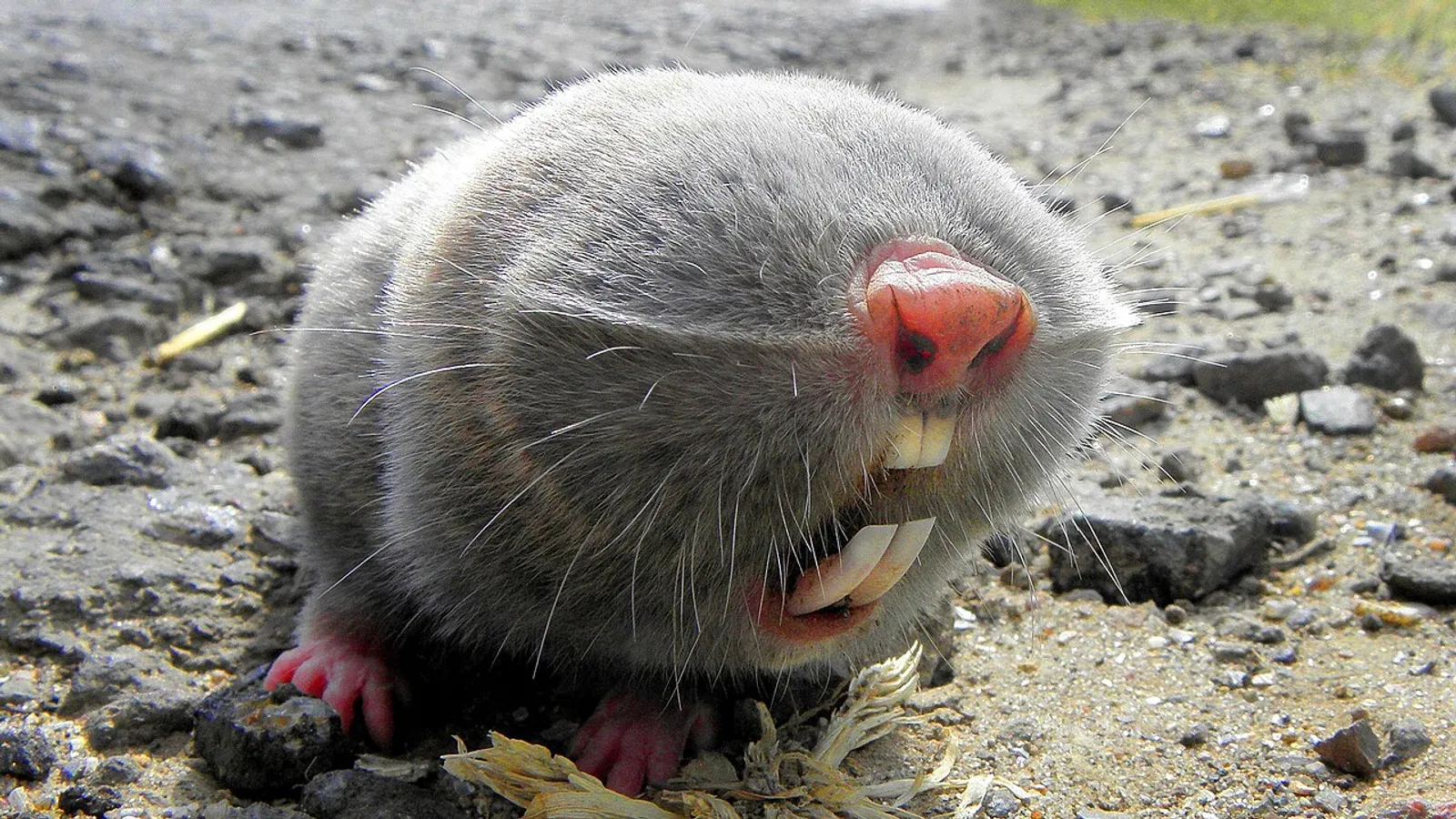
Nannospalax is “little spalax”, from the Greek nânos, dwarf, and spálax, which was the ancient Greek name of the mole — the same root as sphalássō, “to ruin, to dig”. Leucodon is “white tooth”. The name says everything except the most striking thing: this animal has neither working eyes nor external ears, and is a cylinder of muscle with two incisors at the front.
— Facts
- Group
- Mammals · Mammalia
- Order
- Rodents
- Habitat
- Steppe, pasture, deep unploughed soils
- Range
- The Balkans and south-eastern Europe, from Hungary to Greece
- Size
- 15–24 cm, no tail, 100–220 g
- Diet
- Roots, bulbs, tubers
- Lifespan
- 4 years
— Characteristics
- 01
The eyes are reduced to specks buried under the skin and covered with fur.
- 02
It communicates by knocking its head against the roof of the tunnel: neighbours feel the vibrations.
- 03
It never comes to the surface unless forced.
— What sets it apart
It does not get cancer, and it lives in air that would kill us. Its tunnels hold very low oxygen and very high carbon dioxide, and to withstand them it has evolved cellular mechanisms which, as a side effect, leave its cells nearly incapable of turning cancerous: in experiments, spalax cells exposed to carcinogens destroy themselves en masse instead of proliferating. It is one of the three or four mammals in the world studied for this reason, along with the naked mole-rat.
