
Hermann's tortoise
Testudo hermanni
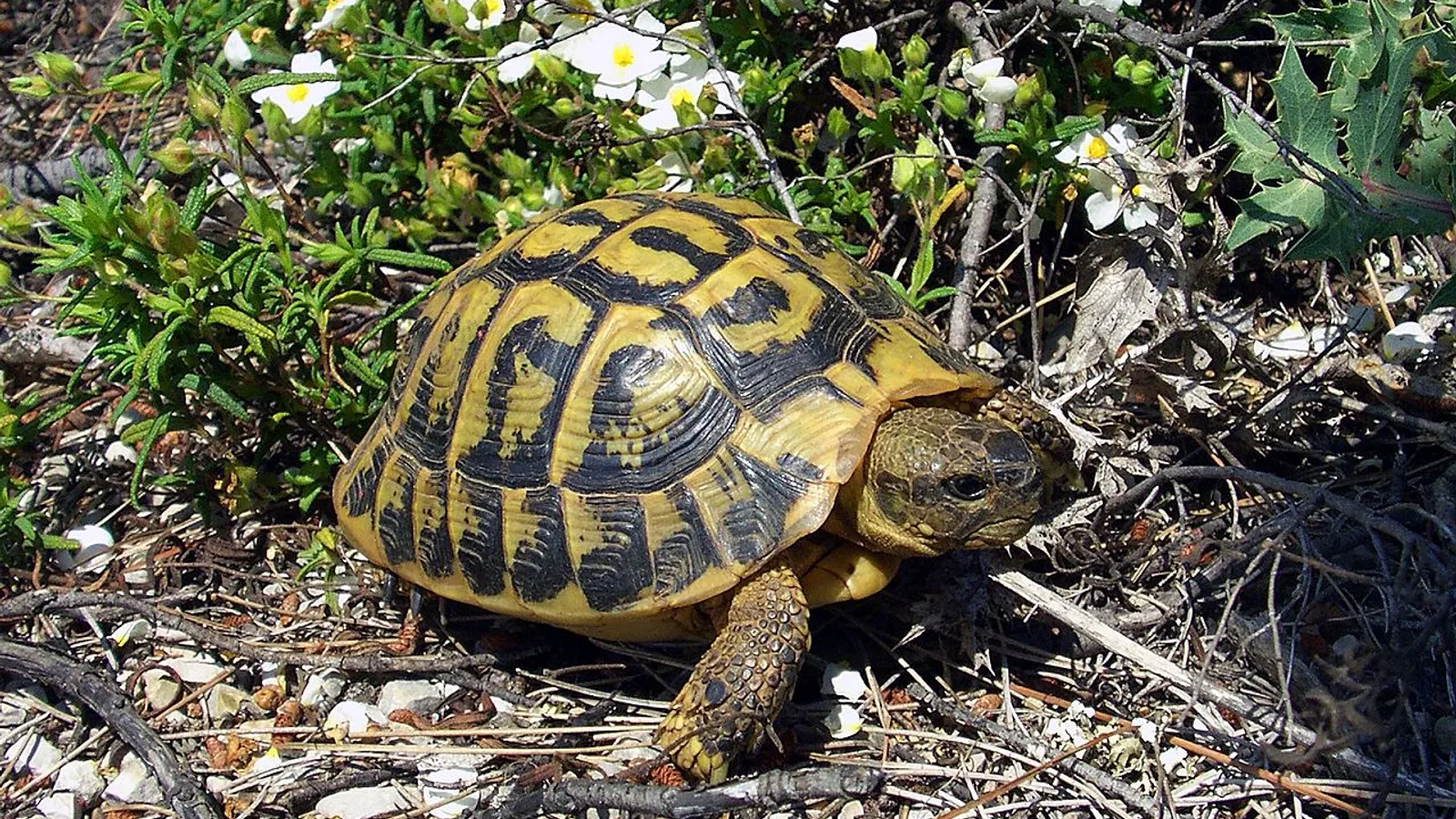
— Where the name comes from
Testudo comes from testa, which in Latin was the potsherd, the earthenware vessel: the shell looked like an upturned pot. From the same word comes the military testudo, the formation in which legionaries covered themselves with their shields. Hermanni recalls Johann Hermann, an eighteenth-century naturalist of Strasbourg.
— Facts
- Group
- Reptiles · Reptilia
- Order
- Turtles and tortoises
- Habitat
- Mediterranean scrub, garrigue, open woodland, olive groves
- Range
- Italy, the Balkans, eastern Spain, southern France
- Size
- 15–25 cm of carapace, 1–3 kg
- Diet
- Grasses, leaves, flowers, fallen fruit, the occasional snail
- Lifespan
- over 60 years
— Characteristics
- 01
It has a pointed horny sheath at the tip of the tail.
- 02
It hibernates buried from November to March.
- 03
It lays its eggs in a hole dug with the hind feet.
— What sets it apart
The sex of the young is not written in the chromosomes but in the temperature of the hole: below thirty degrees males hatch, above thirty-one and a half females, and in between a mixture of both. It holds for nearly all turtles and tortoises, and in a warming world it is a problem nobody yet knows how to solve: in some marine populations more than ninety of every hundred hatchlings are already female.
