
Village weaver
Ploceus cucullatus
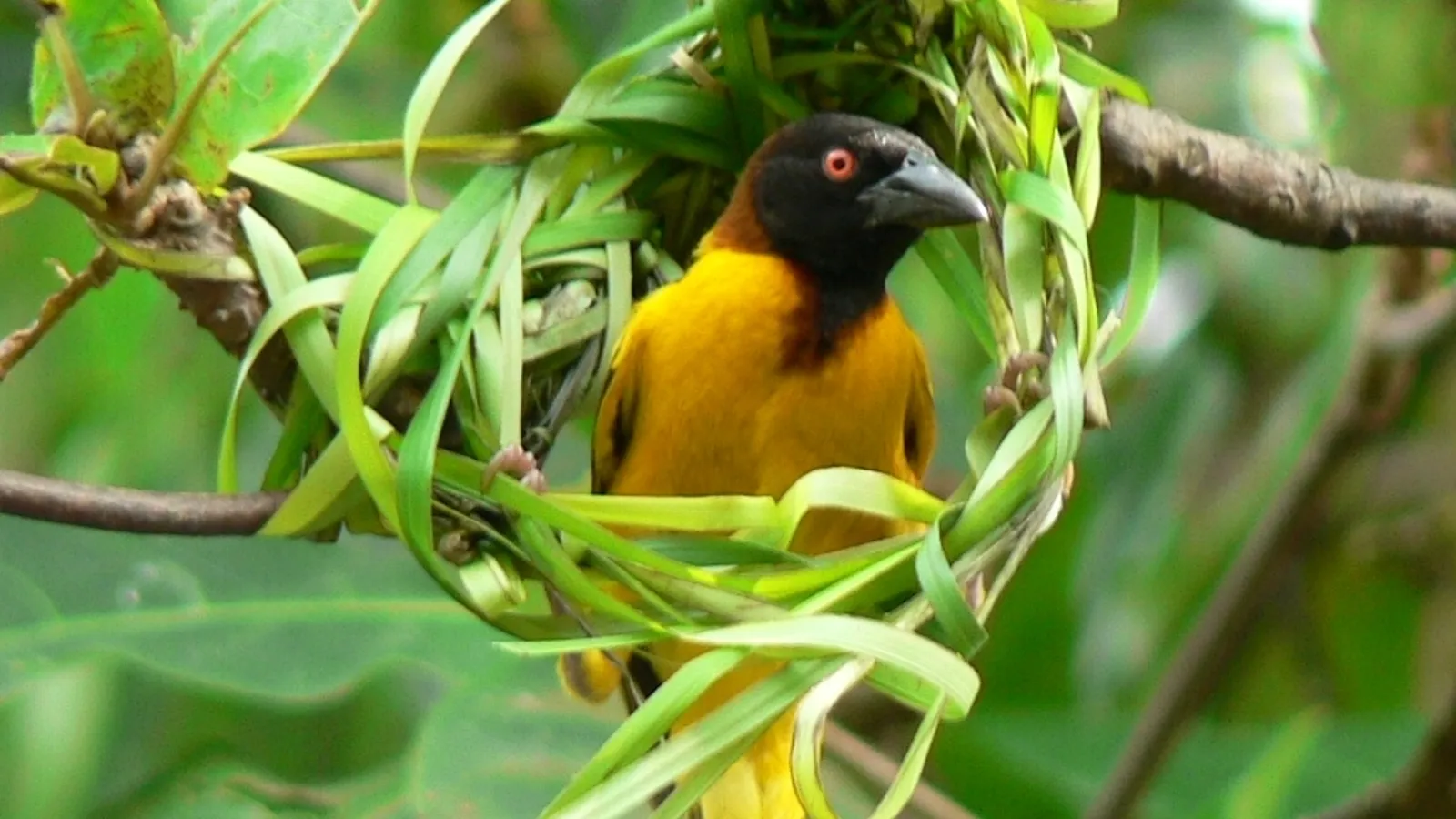
— Where the name comes from
Ploceus comes from the Greek plokeús, the weaver, from plékō, to plait — the same root as “plexus” and “complex”. Cucullatus is “hooded”, for the male’s black head. The common name in half the world’s languages describes the trade: this bird knots strips of leaf one over another with real knots, not with saliva or mud.
— Facts
- Group
- Birds · Aves
- Order
- Passerines
- Habitat
- Villages, wooded savannah, forest edges, farmland
- Range
- Sub-Saharan Africa; introduced to the West Indies
- Size
- 15–17 cm, 30–45 g
- Diet
- Seeds, grain, insects, nectar
- Lifespan
- 14 years in captivity
— Characteristics
- 01
It nests in colonies: a hundred nests can hang from a single tree.
- 02
The nest opens downwards through an entrance tube, against snakes.
- 03
The male hangs beneath the finished nest and beats his wings to be noticed.
— What sets it apart
The male builds, the female inspects. When the nest is done she goes inside, examines it, pulls at the strands, and if it does not convince her he takes it apart and starts again: in one season a single male may build and dismantle twenty nests. Filming the same individuals over time showed that the technique improves with practice — young males drop more strips, tie their knots worse, and only become good by getting it wrong. It is the oldest craft in the world, learned the way we learn ours.
