
Honey badger
Mellivora capensis
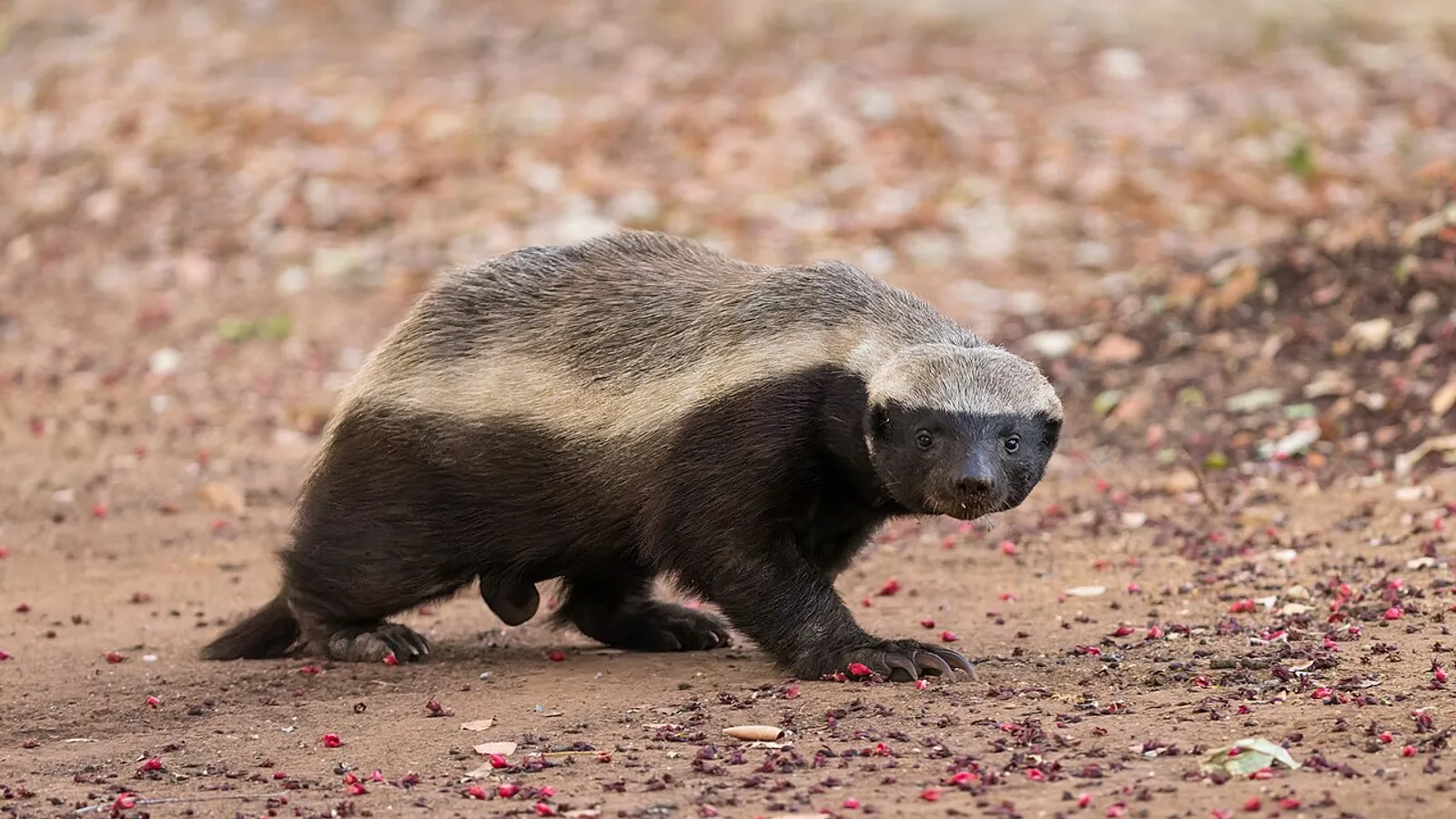
— Where the name comes from
Mellivora is transparent Latin: mel, mellis, “honey”, and vorare, “to devour”. The epithet capensis points to the Cape of Good Hope, whence came the specimen Schreber described in 1776. The Afrikaans name ratel, by which it is known across half of Africa, derives perhaps from the Dutch raat, “honeycomb”, or from the verb ratelen, for the animal’s rattling call. The Italian name betrays a kinship that does not exist: it is no badger, but the only living member of a subfamily of its own, closer to the martens.
— Facts
- Group
- Mammals · Mammalia
- Order
- Carnivores
- Habitat
- Savannah, arid steppe, bushland and semi-desert
- Range
- Sub-Saharan Africa, Morocco, the Arabian Peninsula, the Middle East and south-western Asia as far as India and Nepal
- Size
- 55–77 cm of body plus 12–30 cm of tail, 6–16 kg
- Diet
- Carnivore — rodents, snakes, scorpions, tortoises, bee larvae and honey
- Lifespan
- 7–8 years in the wild, up to 24 in captivity
— Characteristics
- 01
The skin of the neck is up to six millimetres thick and so loose that it can turn inside it and bite whatever holds it.
- 02
It withstands bites from cobras and puff adders that would kill far larger animals, coming round after some hours of torpor.
- 03
It digs with front claws up to four centimetres long, and in captivity has repeatedly used objects as levers and stools to escape.
- 04
An eversible anal pouch releases a suffocating secretion, used in defence and perhaps to stupefy bees.
— What sets it apart
The most famous mutualism attributed to it is also the least proven. The greater honeyguide, an African bird, genuinely does lead people to wild hives: the experiment has been repeated and filmed, and Mozambican hunters answer its calls with agreed whistles. That the same bird also guides the honey badger has been told since the 18th century and has found its way into every handbook, but fieldwork has produced almost nothing but second-hand testimony and no convincing direct observation. Its tolerance of snake venom, by contrast, comes from a mutation in the nerve receptors the neurotoxins target, which has appeared independently in the hedgehog and the mongoose as well. The honey badger, in short, is more extraordinary in the things that have been measured than in those that have been told.
