
Caracal
Caracal caracal
— Where the name comes from
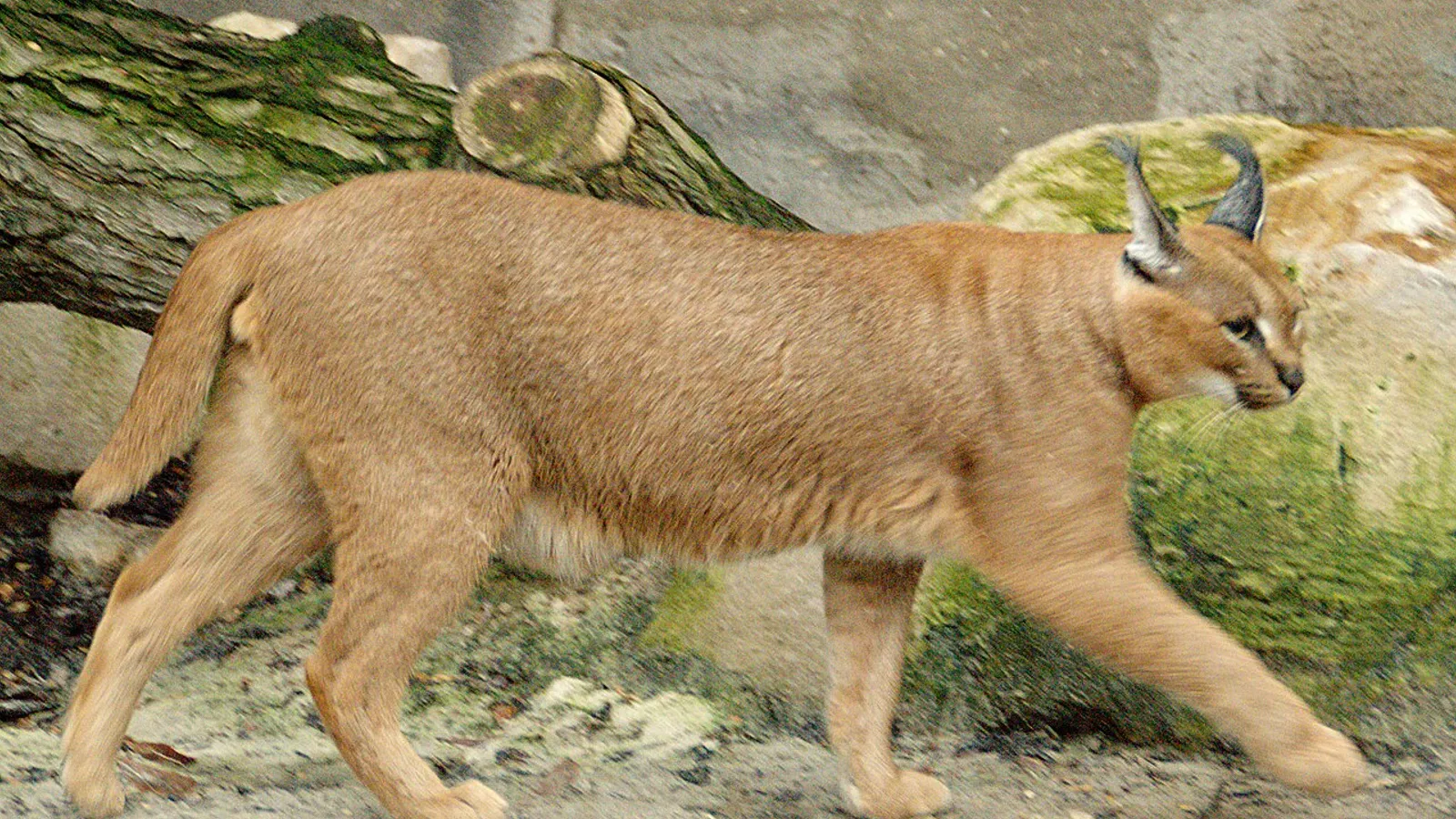
Caracal, repeated as genus and epithet, comes from the Turkish karakulak: kara, “black”, and kulak, “ear”. The same image returns in the Persian siyah-gush, which means the same and is the name by which the animal has been known for centuries in Iran and India. All of them describe the one detail nobody forgets: the long black tufts at the tips of the ears. In Italian it was long called the “desert lynx”, a name that complicates matters, since it is not closely related to lynxes at all.
— Facts
- Group
- Mammals · Mammalia
- Order
- Carnivores
- Habitat
- Arid savannah, steppe, bushland and desert margins
- Range
- Africa, excepting the central Sahara and the equatorial forest; the Arabian Peninsula, the Middle East and Central Asia to north-western India
- Size
- 60–105 cm of body plus 20–34 cm of tail, 8–20 kg
- Diet
- Carnivore — rodents, hyraxes, hares, birds and small antelope
- Lifespan
- 10–12 years in the wild, up to 19 in captivity
— Characteristics
- 01
It leaps over three metres straight up and knocks birds out of the air with a blow of the paw.
- 02
Each ear is governed by some twenty muscles, which aim the pinna independently.
- 03
It is not a lynx: its closest relatives are the serval and the African golden cat.
- 04
It brings down prey two or three times its own weight, young antelope included.
— What sets it apart
In Persia and India the caracal was trained for hunting like the cheetah, but for a speciality all its own: flocks of pigeons. The chronicles of the Mughal princes describe wagers on how many birds a single animal could bring down in one leap into a rising flock, with figures running into double digits. The English expression for uproar, “to put a cat among the pigeons”, is often traced to those contests, though the etymology is unproven. The feat, by contrast, is real and still to be seen in the wild, where the caracal plucks bustards and guineafowl out of the air. It is a cat that hunts higher than its own height.
