
Green sea turtle
Chelonia mydas
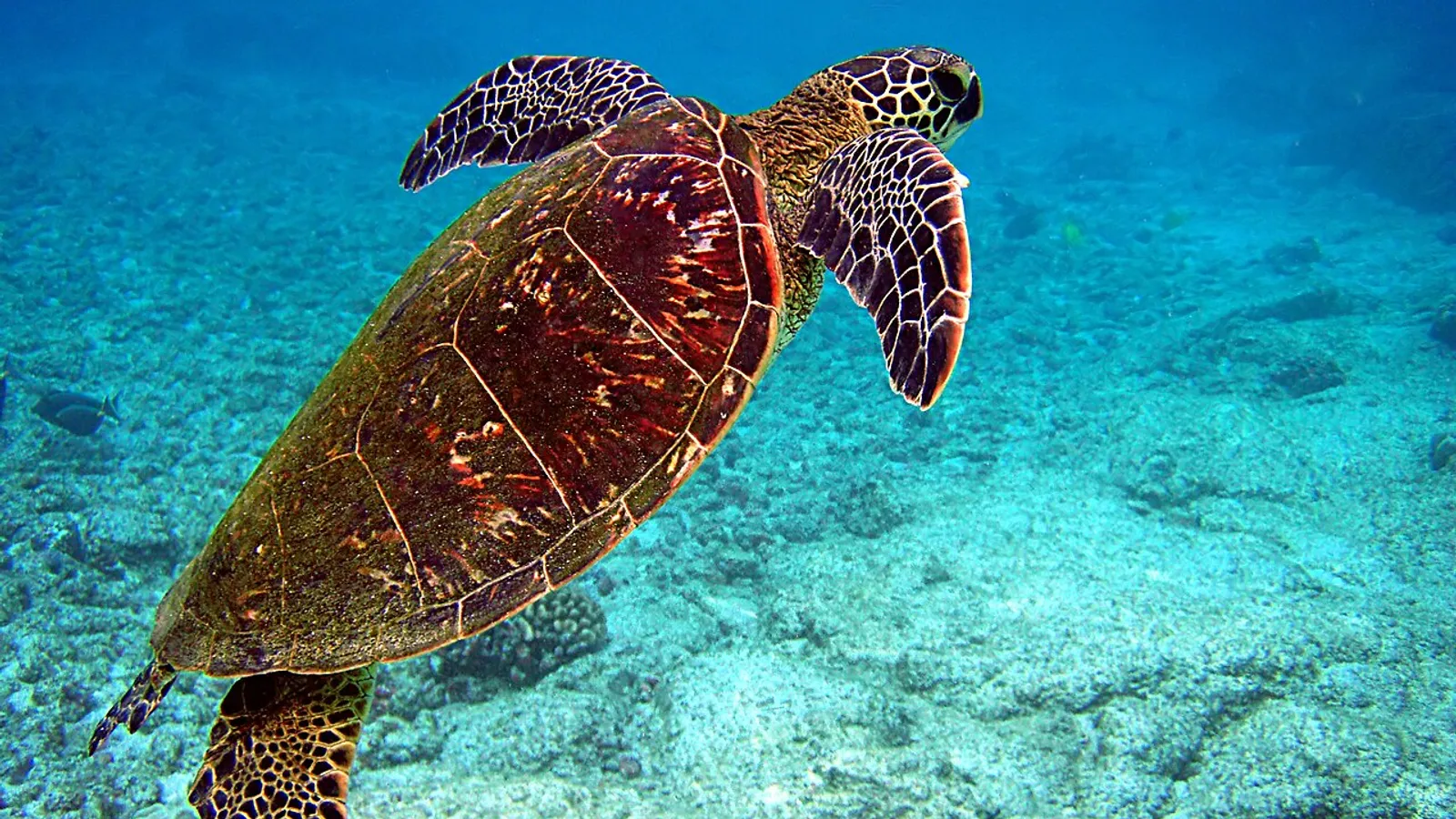
— Where the name comes from
Chelonia is from the Greek chelṓnē, turtle; mydas is an old Greek name for a large sea turtle. The “green” is not the shell but the fat, coloured by the vegetable diet: hence, once, its use in the famous soup. It is one of the great sea turtles that cross every warm ocean.
— Facts
- Group
- Reptiles · Reptilia
- Order
- Turtles and tortoises
- Habitat
- Seagrass meadows, coral reefs, open sea
- Range
- Tropical and subtropical seas worldwide
- Size
- 80–150 cm of shell, 110–190 kg
- Diet
- Herbivorous as an adult — algae and sea plants; carnivorous when young
- Lifespan
- 60–80 years
— Characteristics
- 01
It is the only sea turtle that is mainly herbivorous as an adult.
- 02
The female returns to lay her eggs on the same beach where she hatched, years before.
- 03
Tear glands expel surplus salt: it looks as though she is weeping.
— What sets it apart
The green turtle returns to lay on the exact beach where it hatched, after decades and thousands of kilometres of wandering the oceans. It navigates by reading the Earth’s magnetic field: every stretch of coast has a slightly different magnetic “signature”, and the turtle memorises it as a hatchling in order to find it again as an adult. It is an internal compass so exact that it brings her back, after a lifetime at sea, within a few steps of where she broke out of the shell.
