
Leatherback sea turtle
Dermochelys coriacea
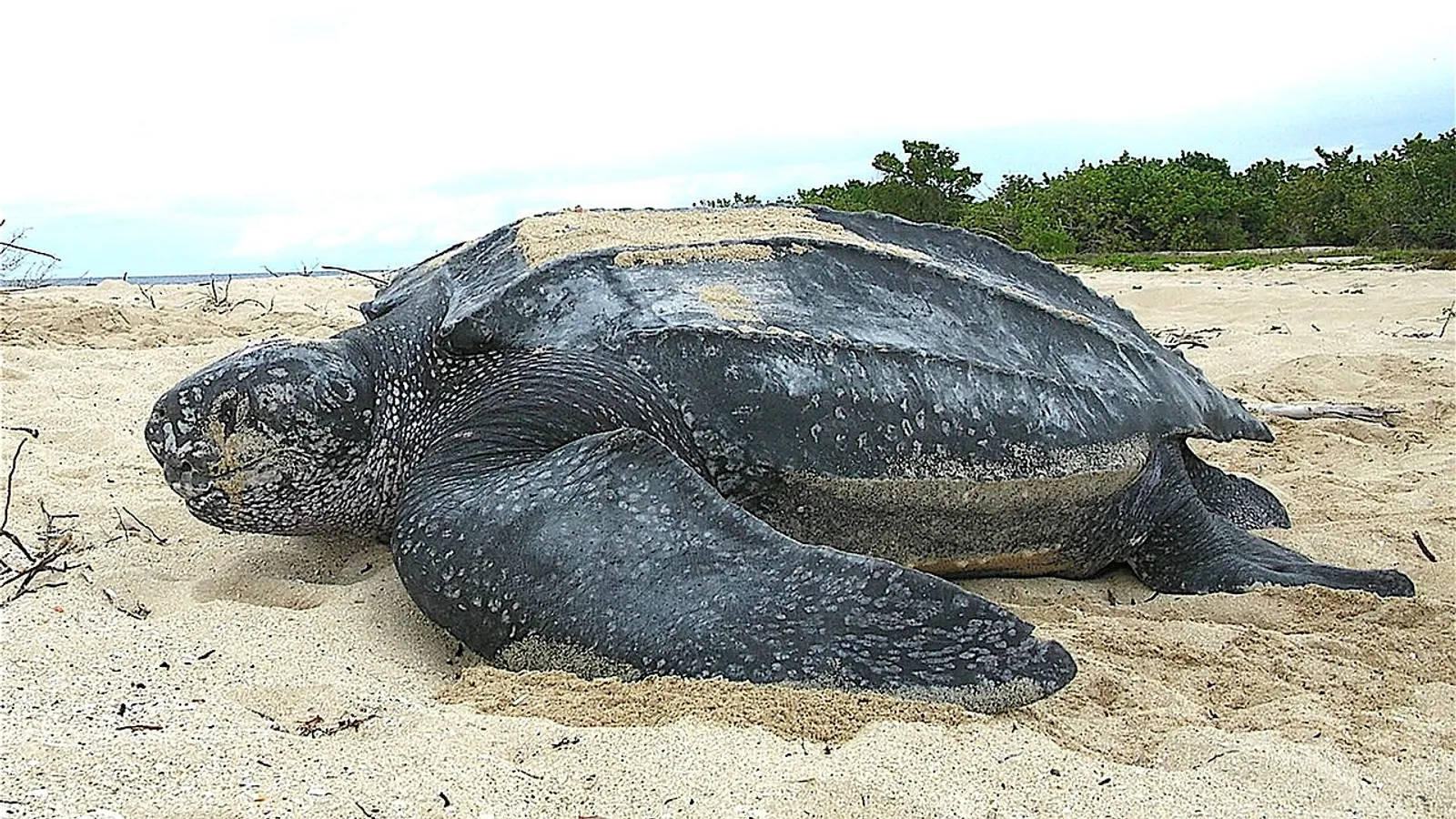
— Where the name comes from
Dermochelys is Greek for “skin turtle”, from dérma, skin, and chelṓnē: it has no horny shell but a leathery covering. Coriacea, from the Latin corium, leather, says it again. “Leatherback” in English; the Italian liuto, lute, comes from the seven ridges along the back, which recall its strings. It is the largest living turtle.
— Facts
- Group
- Reptiles · Reptilia
- Order
- Turtles and tortoises
- Habitat
- The open ocean; it nests on tropical beaches
- Range
- Every ocean, from the tropics to cold subpolar seas
- Size
- 130–180 cm of shell, 250–700 kg
- Diet
- Carnivore — almost exclusively jellyfish
- Lifespan
- 45–50 years
— Characteristics
- 01
It has no rigid bony shell but thick leathery skin over a mosaic of small bones.
- 02
It keeps its body warmer than the surrounding water: almost an exception to cold-bloodedness.
- 03
The throat is lined with backward-pointing spines, to hold slippery jellyfish.
— What sets it apart
The leatherback lives on jellyfish, a food made almost entirely of water, and to survive must eat enormous quantities every day. That drives it to dive past a thousand metres and to push north into cold seas, which ought to be impossible for a cold-blooded reptile: but it generates heat by its metabolism and holds it in thanks to its bulk and a dense network of vessels, staying warmer than the water. It is the closest thing to a warm-blooded reptile in the oceans. Sadly it mistakes plastic bags for jellyfish, and this kills it.
