
Malayan tapir
Tapirus indicus
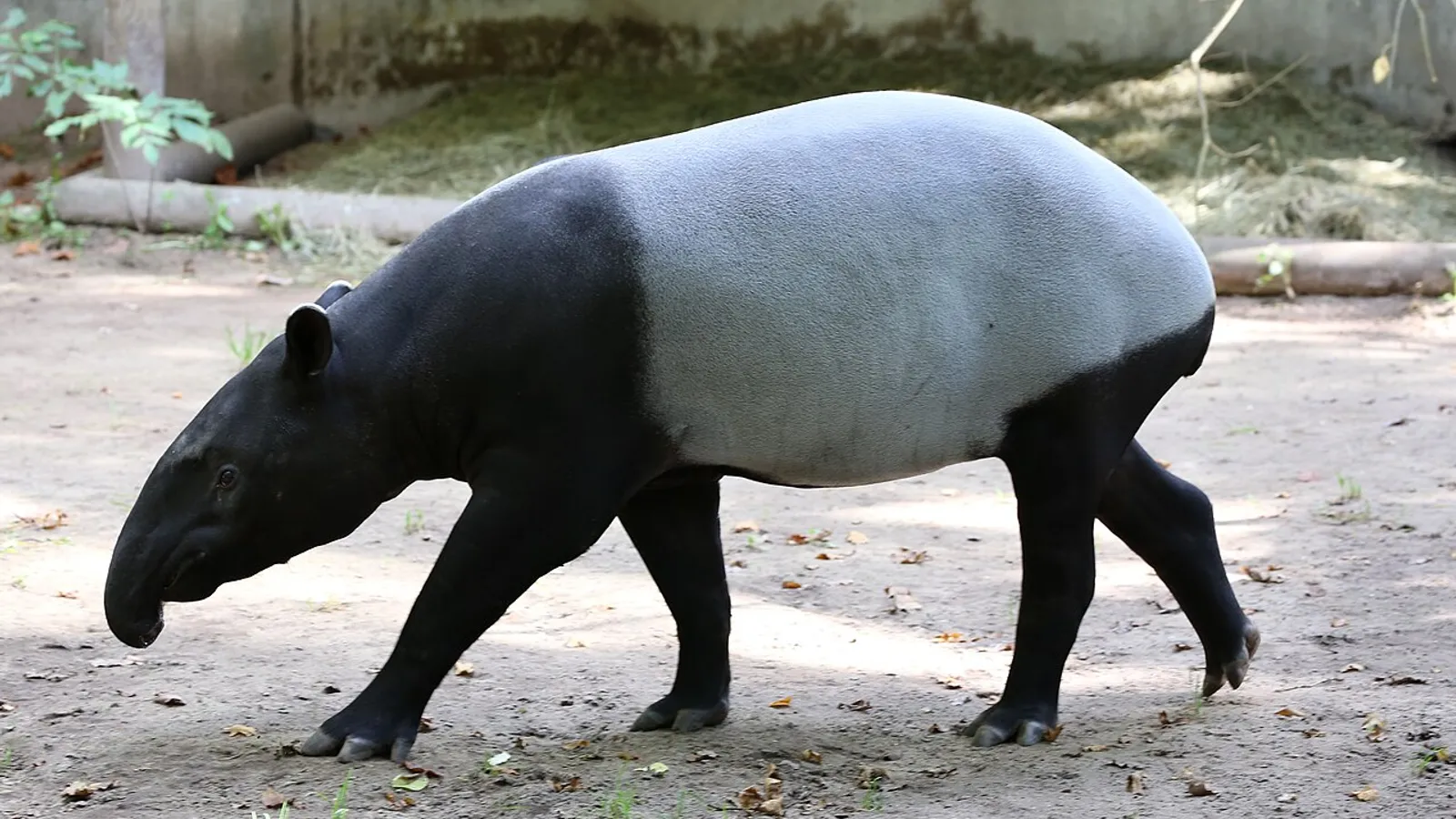
— Where the name comes from
Tapir comes from the Tupi tapi’ira, a South American name later applied to the Asian species as well: an animal of Brazil has lent its name to a relative living seventeen thousand kilometres away. The epithet indicus points loosely to the East Indies. It is the only tapir of the Old World, and the remaining four all live in the Americas — a distribution that is the remnant of a range once continuous.
— Facts
- Group
- Mammals · Mammalia
- Order
- Odd-toed ungulates
- Habitat
- Primary lowland rainforest, near watercourses
- Range
- South-East Asia: southern Myanmar, Thailand, Malaysia, Sumatra
- Size
- 180–250 cm long, 250–540 kg
- Diet
- Herbivore — leaves, shoots, fallen fruit
- Lifespan
- 25–30 years
— Characteristics
- 01
The short proboscis is prehensile and formed by the nose and upper lip fused together.
- 02
It swims well and walks along riverbeds, using the proboscis as a snorkel.
- 03
The young are born brown with pale stripes and spots, and turn black and white at six months.
— What sets it apart
That conspicuous black-and-white pattern is in fact camouflage. In the night forest moonlight falls in patches and the outline of the body vanishes: the predator’s eye sees a pale patch and a dark one, separate, not a half-tonne animal. It is called disruptive coloration and it is the same principle as the warships painted in dazzle stripes in the First World War — not to hide the object, but to make its shape impossible to read.
