
Greater horseshoe bat
Rhinolophus ferrumequinum
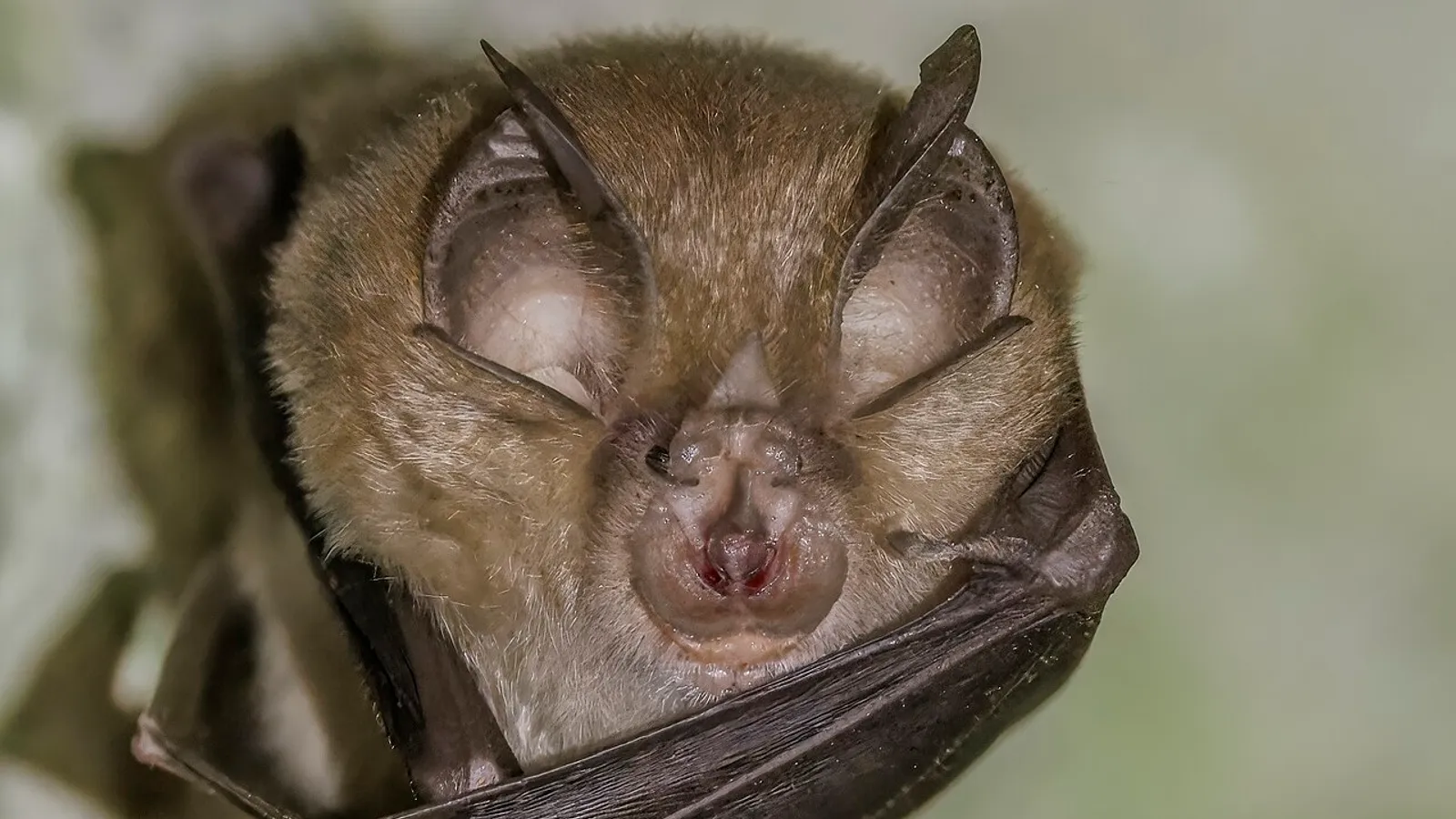
— Where the name comes from
Rhinolophus is Greek: rhís, rhinós, “nose”, and lóphos, “crest” — the nasal crest. Ferrumequinum is Latin and translates what that crest looks like: a horseshoe. It is not an ornament but an aerial — the animal sends its ultrasound out through the nostrils, not the mouth, and that leaf of skin serves to aim the beam like the reflector of a torch.
— Facts
- Group
- Mammals · Mammalia
- Order
- Bats
- Habitat
- Caves, attics, warm ruins; it hunts over woodland and pasture with hedges
- Range
- Southern and central Europe, North Africa, Asia as far as Japan; found throughout Italy
- Size
- 5.7–7.1 cm of body, wingspan 35–40 cm, 17–34 g
- Diet
- Insectivore — large moths and beetles
- Lifespan
- 20–30 years
— Characteristics
- 01
It wraps itself completely in its wings when at rest, as in a closed cloak.
- 02
It emits ultrasound through the nose with the mouth shut, rare among European bats.
- 03
It often hunts hanging from a branch, waiting for prey to pass and dropping on it.
— What sets it apart
It has solved a problem human engineering met with Doppler radar: when it flies towards prey, the returning echo comes back at a higher frequency than the call, and would risk falling outside the narrow band where its ear is most sensitive. So the animal lowers the frequency of its own call by exactly the amount needed to compensate, in real time, so the echo always lands in the right window. It is called Doppler shift compensation, and bats were using it millions of years before we worked it out.
