
South American tapir
Tapirus terrestris
— Where the name comes from
Tapirus latinises the name the animal carries in the Tupi languages of Brazil, tapiira, gathered by the first Portuguese chroniclers and passed almost intact into the Italian tapiro. The epithet terrestris, “of the land”, is the fossil of an illustrious mistake: in 1758 Linnaeus classified the animal as Hippopotamus terrestris, convinced he was looking at a hippopotamus that had chosen dry land. The genus was corrected a few years later, but the adjective stayed. The tapir carries in its own name the memory of how Europe misread it.
— Facts
- Group
- Mammals · Mammalia
- Order
- Odd-toed ungulates
- Habitat
- Rainforest and scrub along watercourses
- Range
- South America east of the Andes, from Venezuela and Colombia to southern Brazil, Paraguay and northern Argentina
- Size
- 180–250 cm long, 77–108 cm at the shoulder, 150–250 kg
- Diet
- Herbivore — fruit, leaves, shoots and water plants
- Lifespan
- 25–30 years in the wild, up to 35 in captivity
— Characteristics
- 01
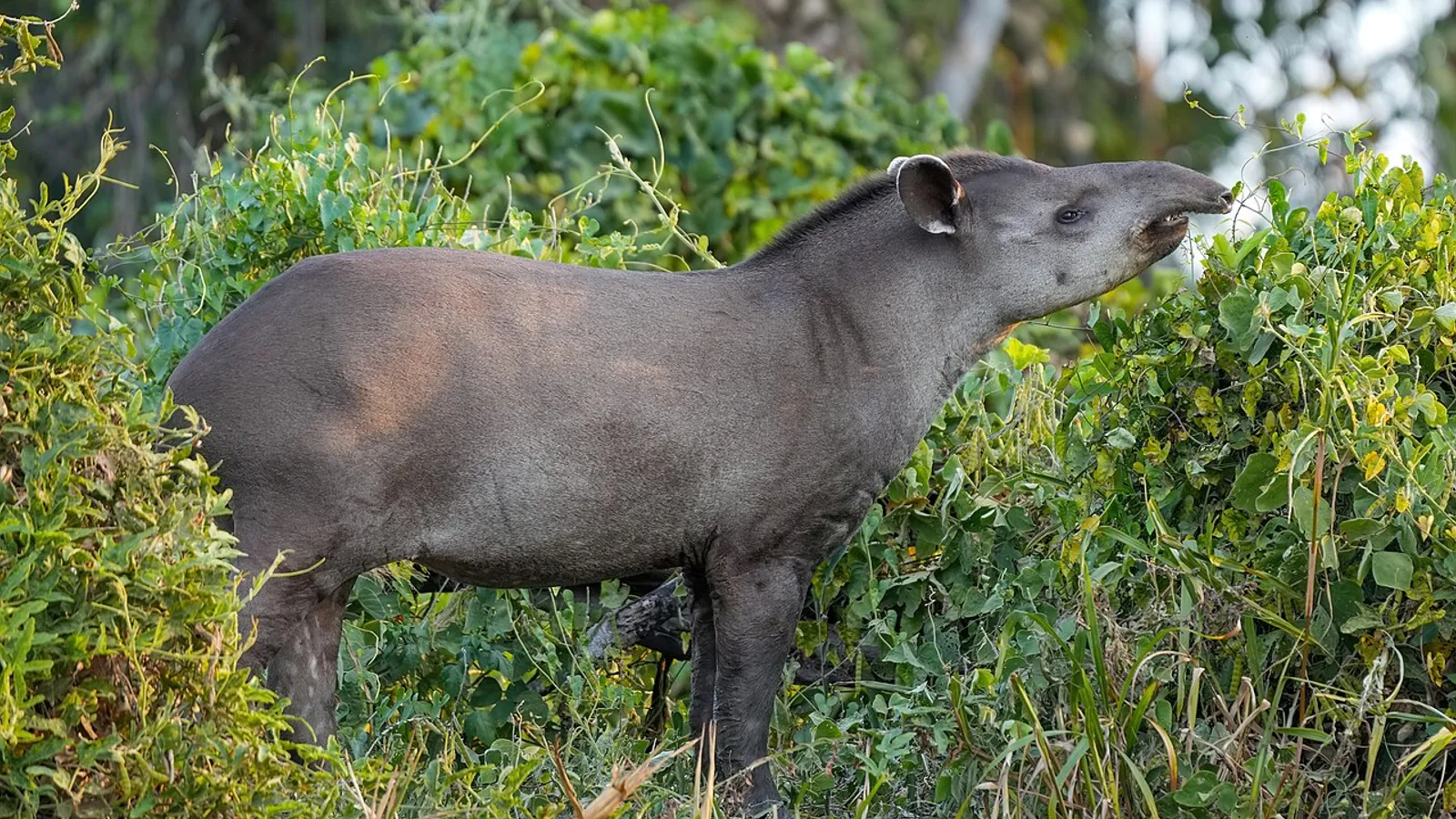
The short prehensile proboscis is formed by the fusion of nose and upper lip, and serves to grasp leaves and fruit.
- 02
It swims confidently and walks along riverbeds, where it takes refuge when pursued.
- 03
The young are born with a brown coat striped and flecked with white, which fades within the first year.
— What sets it apart
The tapir is the most effective seed disperser of the Neotropical forest: it swallows fruit whole, even the largest, which no other animal of the region can get down, and releases the seeds intact kilometres away, often in degraded ground. Studies in Amazonia have counted thousands of seeds in a single dung pile, belonging to dozens of different tree species. Where the tapir disappears, the very composition of the forest changes within a few generations of trees. It is a herbivore that, simply by walking, replants the forest that hides it.
