
Black rhinoceros
Diceros bicornis
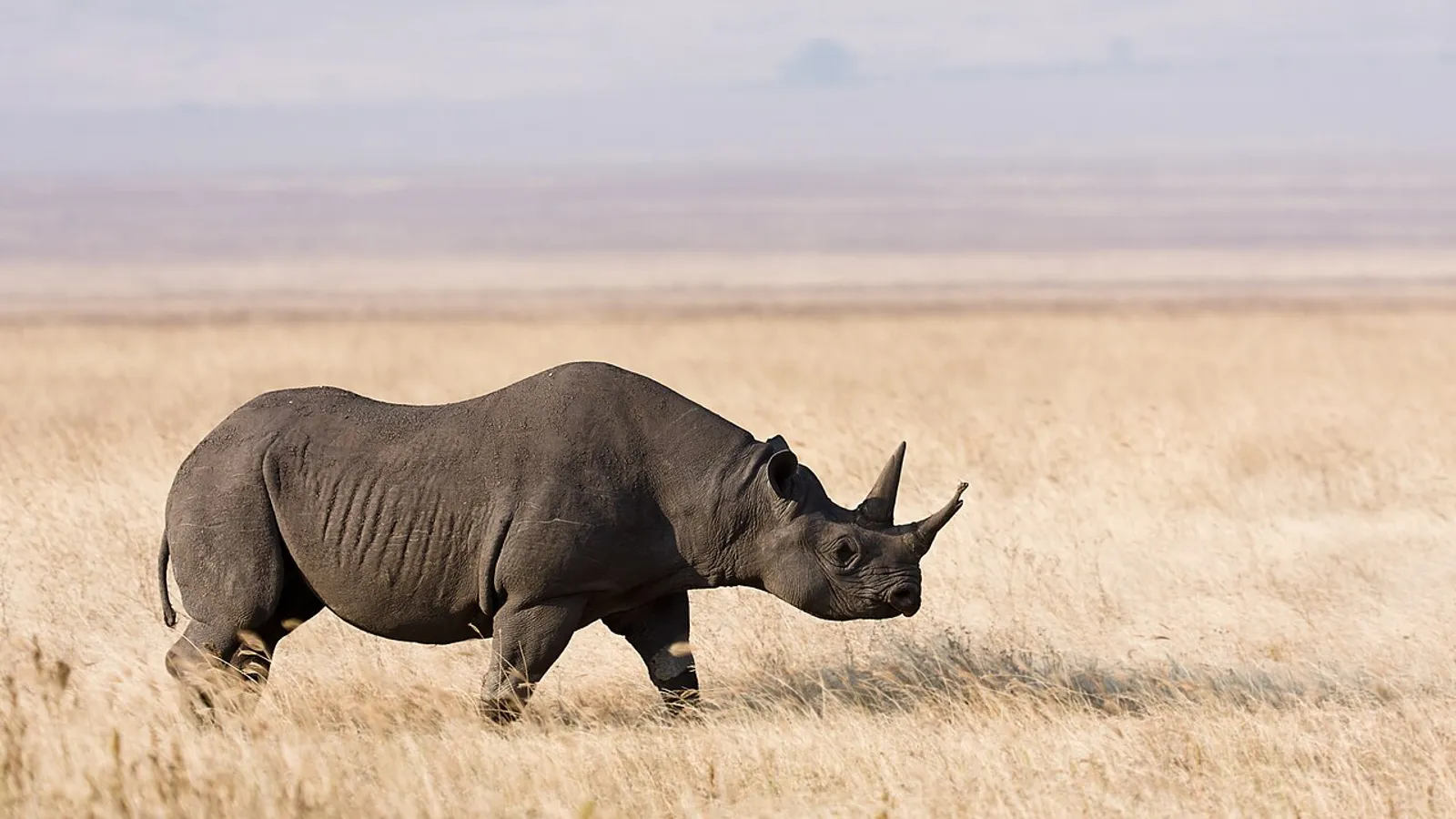
— Where the name comes from
Diceros joins the Greek di-, “two”, and kéras, “horn”; bicornis says exactly the same in Latin. The scientific name therefore repeats twice, in two classical languages, the one feature that struck 18th-century naturalists as decisive. The adjective “black” describes no real colour: the hide is grey like the white rhino’s, and the name arose only in opposition to that one, which was itself perhaps a misreading of the Afrikaans wyd, “wide”, describing its cousin’s square lip — a widespread explanation, though never firmly documented. What remains is two animals told apart by a colour contrast that does not exist.
— Facts
- Group
- Mammals · Mammalia
- Order
- Odd-toed ungulates
- Habitat
- Shrubby savannah and semi-arid thorn bush
- Range
- Eastern and southern Africa: Namibia, South Africa, Zimbabwe, Kenya and Tanzania, in mostly fenced and guarded populations
- Size
- 300–375 cm long, 140–180 cm at the shoulder, 800–1,400 kg
- Diet
- Herbivore — leaves, twigs and woody shrubs, browsed rather than grazed
- Lifespan
- 35–40 years in the wild, up to 45 in captivity
— Characteristics
- 01
The upper lip is pointed and prehensile, made to grip twigs among acacia thorns.
- 02
Its eyesight is so poor that it cannot make out a motionless person at thirty metres, while smell and hearing are exquisite.
- 03
Though it passes a tonne, in a charge it reaches 55 km/h and turns on the spot in almost no space.
— What sets it apart
The horn for which this species has been all but erased is neither bone nor ivory: it is a compacted bundle of keratin, the same protein as hair and nails, with no root in the skull. It regrows about six centimetres a year, and for that very reason Namibia and South Africa have taken to sawing the horns off wild animals pre-emptively, returning them to the savannah disarmed and less tempting. The Asian market, however, goes on paying its weight in gold for it as a medicine. Whoever buys it is buying, chemically speaking, their own fingernails.
