
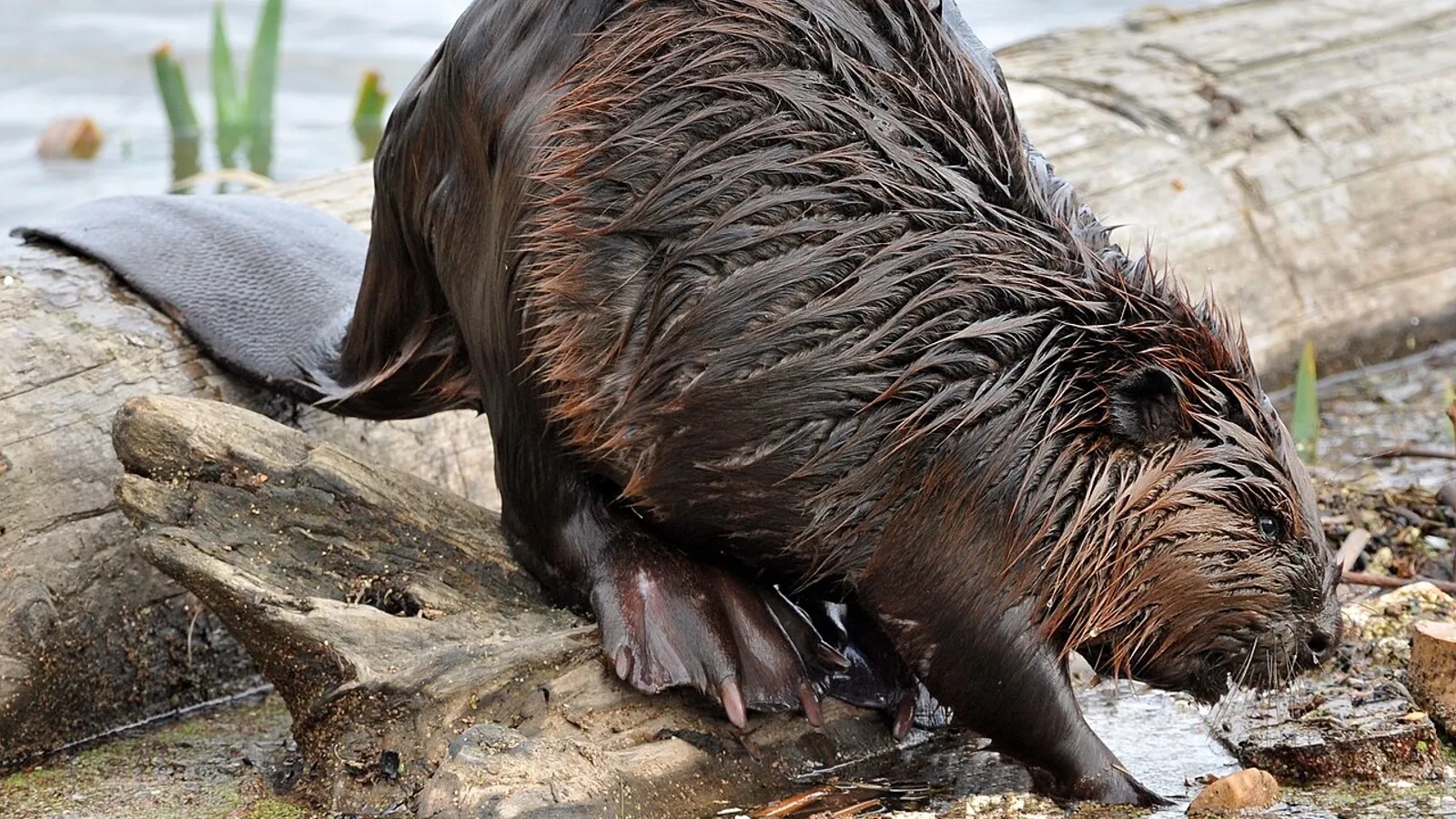
North American beaver
Castor canadensis
— Where the name comes from
Castor reaches Latin from the Greek kástōr, of uncertain origin and perhaps related to Indo-European words for musk and scent, on account of the castoreum the animal secretes. The ancients instead connected it by sound to Kastor, the divine twin of the Dioscuri, and later Isidore of Seville derived it from castrare: it was believed, as Pliny already reports, that a hunted beaver would geld itself to leave the hunters the one part they wanted. The epithet canadensis is plain and recent, “of Canada”. A name built on an anatomical fable that lasted fifteen centuries.
— Facts
- Group
- Mammals · Mammalia
- Order
- Rodents
- Habitat
- Rivers, streams and lakes fringed with broadleaf woodland
- Range
- North America, from Alaska and Canada to northern Mexico; introduced to Finland, north-western Russia and Tierra del Fuego
- Size
- 74–90 cm of body plus 20–35 cm of tail, 11–32 kg
- Diet
- Herbivore — bark and cambium of poplar and willow, twigs, water plants
- Lifespan
- 10–12 years in the wild, up to 20 in captivity
— Characteristics
- 01
The incisors, orange from iron laid down in the enamel, grow all life long and sharpen themselves on wood.
- 02
The flat scaly tail works as a rudder in water and as an alarm when slapped on the surface.
- 03
It can stay submerged for up to fifteen minutes and enters its lodge only through underwater doorways.
— What sets it apart
In 2007 a researcher examining satellite images of Wood Buffalo National Park, in Alberta, noticed a dark line some eight hundred and fifty metres long at the edge of a marsh. It was a beaver dam, grown over decades and probably the work of several generations of the same colony: the largest ever documented, twice the length of the Hoover Dam. The site was first reached on foot only in 2014, after days of walking through peat bog. No land mammal other than ourselves has built anything recognisable from orbit.
