
Takin
Budorcas taxicolor
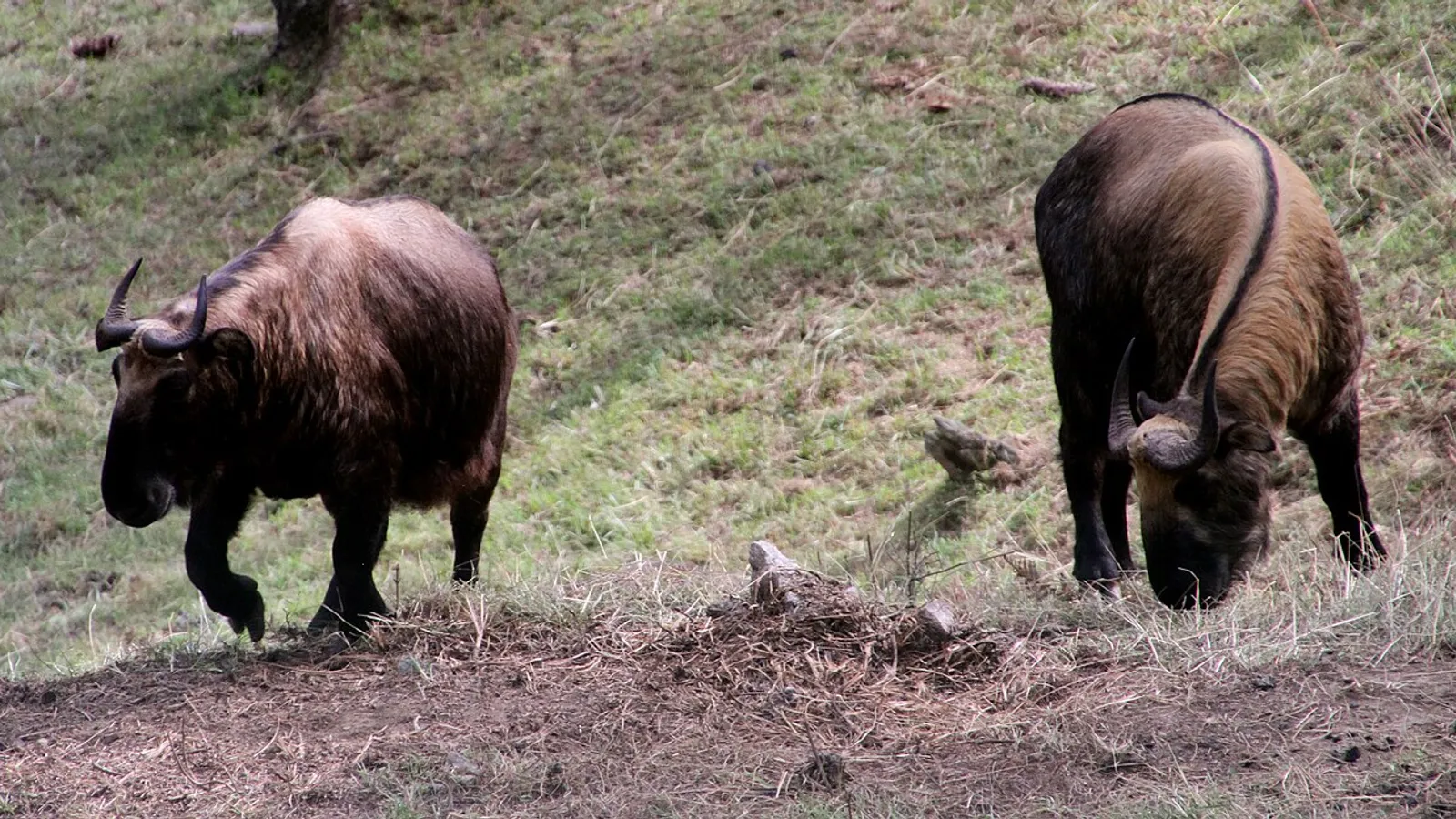
— Where the name comes from
Budorcas is “ox-gazelle”, from the Greek boûs and dorkás — another nominal chimera, like the hartebeest and the musk ox, born of the embarrassment of someone with nothing to compare the animal to. Taxicolor means “the colour of the badger”, from the Latin taxus: the mottled coat recalls the European badger’s. Takin is the local name, from the languages of Bhutan and Arunachal Pradesh, where it is the national animal.
— Facts
- Group
- Mammals · Mammalia
- Order
- Even-toed ungulates
- Habitat
- High-altitude bamboo and rhododendron forest, between 1,000 and 4,500 m
- Range
- The eastern Himalaya, Bhutan, western China, northern Myanmar
- Size
- 160–220 cm of body, 250–350 kg
- Diet
- Herbivore — bamboo, leaves, shoots, bark
- Lifespan
- 16–20 years
— Characteristics
- 01
Its skin secretes an oil that waterproofs it in the perpetual mists of its forest.
- 02
Despite three hundred kilos it moves surefootedly on rocky slopes.
- 03
In summer it climbs in herds of over a hundred, in winter it descends and scatters.
— What sets it apart
Bhutanese legend credits it to a saint: Drukpa Kunley, the “Divine Madman”, is said to have eaten a goat and a cow at a feast, then set the goat’s skull on the cow’s skeleton and ordered the animal to get up and graze. The takin got up. It is a mythological explanation that describes the beast better than any scientific name, and it catches exactly the same embarrassment that produced “ox-gazelle” in Greek: nobody knows what it resembles.
