
Western jackdaw
Corvus monedula
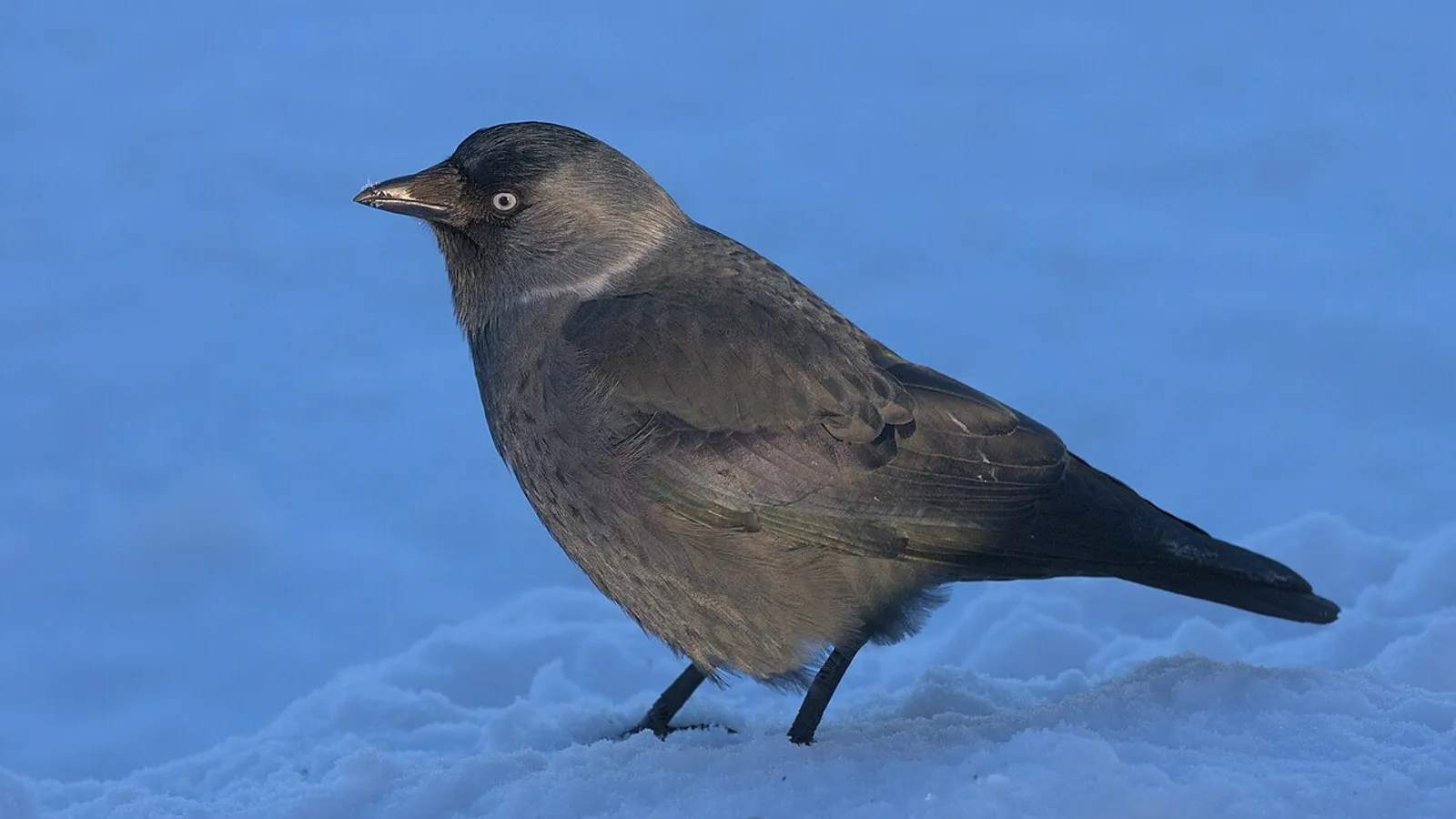
— Where the name comes from
Monedula was explained by the ancients through moneta: the bird that carries off your money, for its reputation as a thief. The real etymology is uncertain and probably duller, but the misunderstanding has survived two thousand years. The Italian taccola is onomatopoeic instead, from the sharp repeated call — the same word that names idle chatter.
— Facts
- Group
- Birds · Aves
- Order
- Passerines
- Habitat
- Bell towers, ruins, cliffs, town parks, quarries
- Range
- Europe, North Africa, western and central Asia
- Size
- 34–39 cm, wingspan 67–74 cm, 220–270 g
- Diet
- Omnivorous — insects, seeds, eggs, scraps
- Lifespan
- 5 years in the wild
— Characteristics
- 01
It has a white-blue iris, unique among European crows.
- 02
It forms pairs that stay together for life.
- 03
It nests colonially inside cavities: chimneys, towers, holes in walls.
— What sets it apart
That very pale eye in a dark face is a keep-out sign. Jackdaws nest in cavities that are always in short supply, and when one looks out from the entrance of its own the pale iris shows from a distance in the darkness of the hole: in experiments using nest boxes with a painted jackdaw face inside, the ones with a pale eye were avoided by rivals far more often than the rest. It is a lock made of a stare. Konrad Lorenz, who spent years with the jackdaw colony on his roof at Altenberg, thought it the most social bird he knew.
