
Great crested grebe
Podiceps cristatus
— Where the name comes from
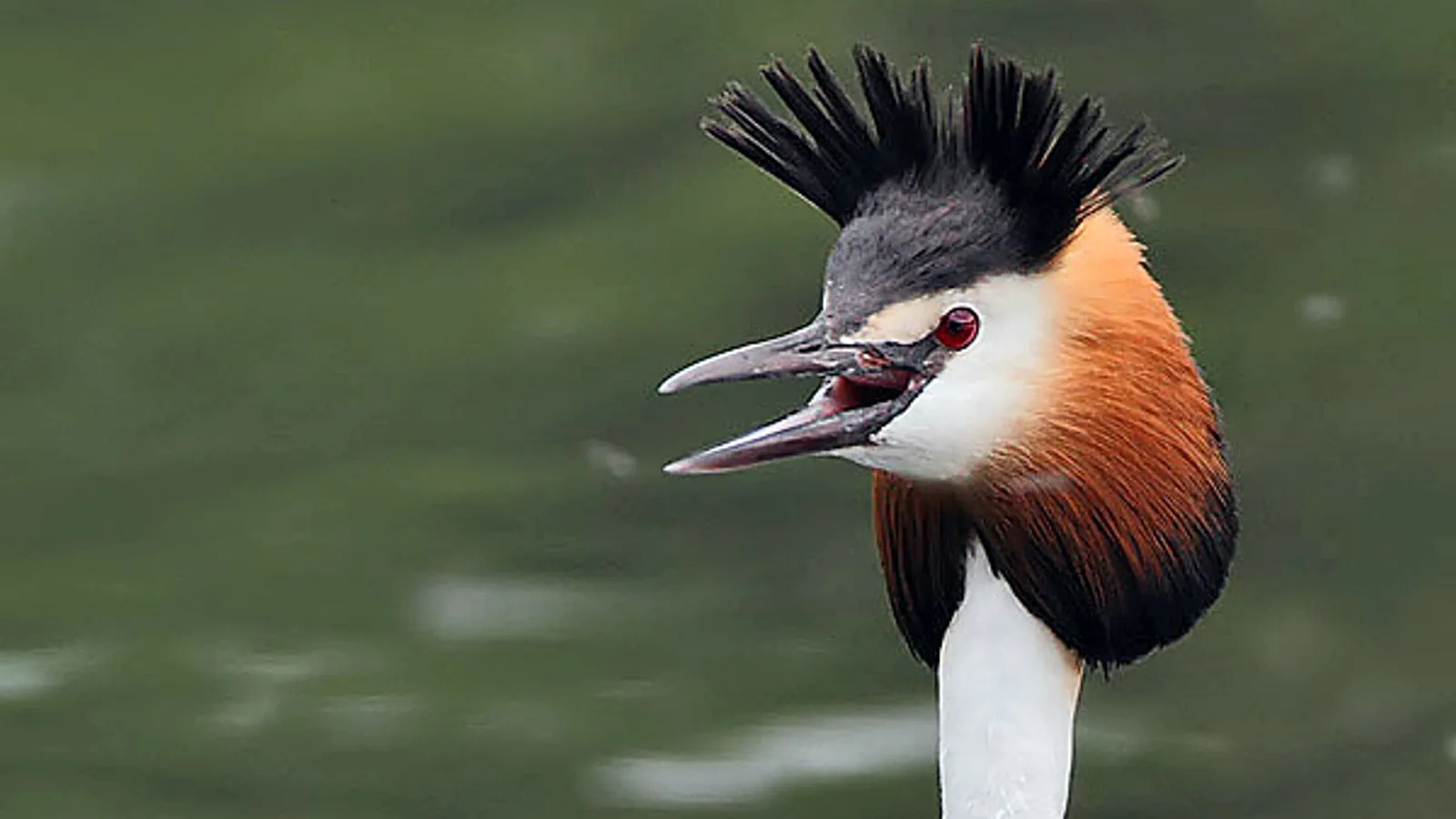
Podiceps is a contraction of podex and pes, “feet at the rump”: the legs are set so far back on the body that on land the animal can barely stand, and that is the price it pays for being a submarine. Cristatus refers to the double black tuft and orange ruff that appear in spring and vanish entirely in winter.
— Facts
- Group
- Birds · Aves
- Order
- Grebes
- Habitat
- Lakes, ponds, reservoirs, lagoons
- Range
- Europe, Asia, southern Africa, Australia and New Zealand
- Size
- 46–51 cm, wingspan 59–73 cm, 0.6–1.5 kg
- Diet
- Fish, aquatic insects, tadpoles
- Lifespan
- 15 years in the wild
— Characteristics
- 01
It carries the striped chicks on its back, under the wings, even while diving.
- 02
It eats its own feathers and gives them to the young: they filter the fish bones.
- 03
The nest floats, anchored to the reeds, rising and falling with the water.
— What sets it apart
Its courtship dance founded a discipline. In 1912 the young Julian Huxley spent the Easter weeks on a Hertfordshire pond describing every movement of the pair — the simultaneous surfacing, the head-shaking, the breast-to-breast run with a beakful of weed — and produced the first modern study of animal behaviour, showing that a ritual can be analysed the way an organ is. Twenty years earlier the species had nearly gone from England: its skin was used to make muffs, and it was precisely to stop that trade that the oldest bird protection society was founded.
