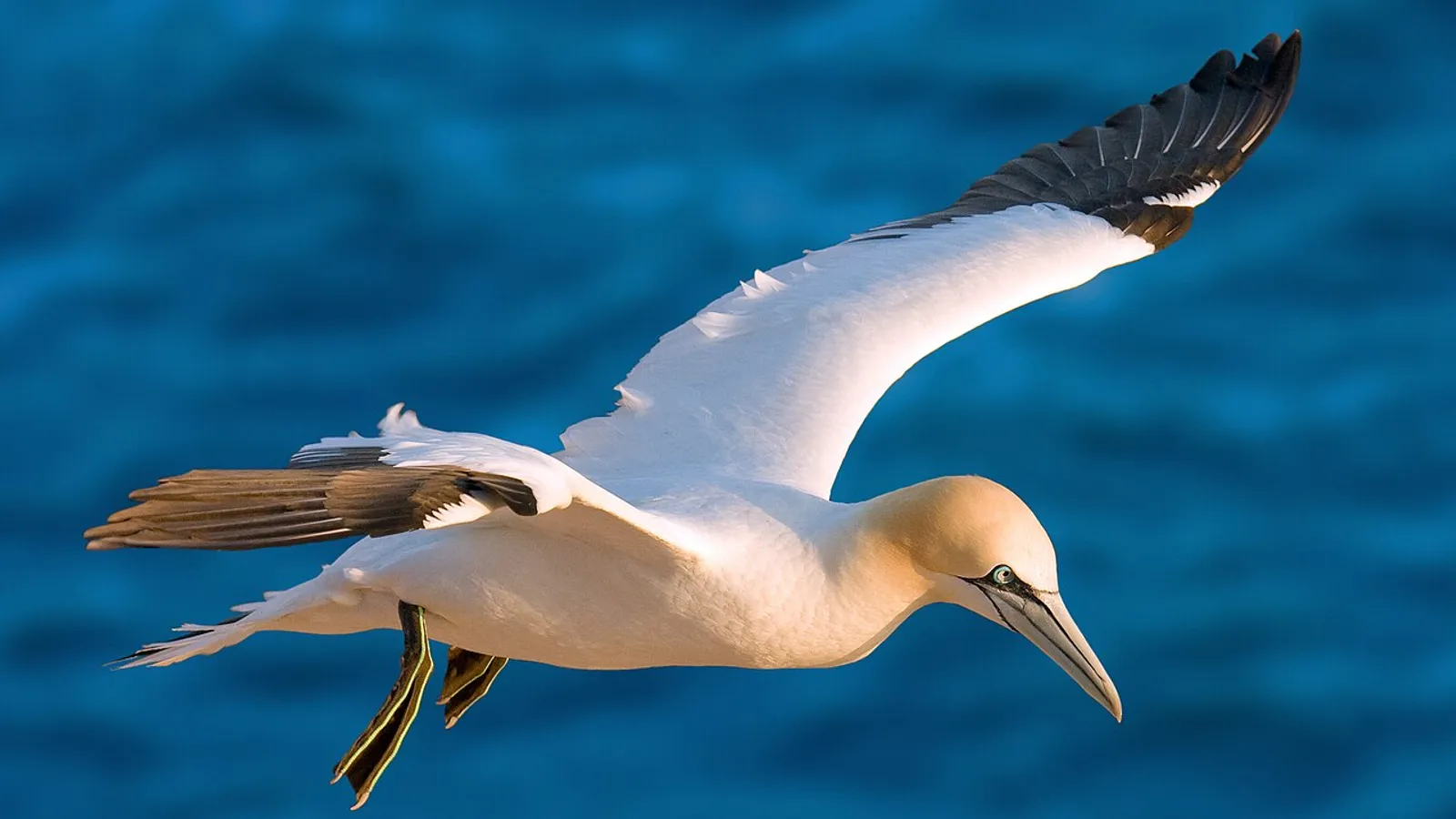
Northern gannet
Morus bassanus
— Where the name comes from
Morus is Greek, mōrós, “foolish”: gannets are clumsy on land and let people approach, and sailors killed them easily. Bassanus comes from the Bass Rock, a stack in the Firth of Forth in Scotland, home to the largest colony in the world. Sula is an Old Norse word, súla, which the Vikings already used for this bird.
— Facts
- Group
- Birds · Aves
- Order
- Cormorants and boobies
- Habitat
- Open and coastal sea; nests on cliffs and islets
- Range
- North Atlantic, from Canada to Norway; winters as far as West Africa and the Mediterranean
- Size
- 87–100 cm, wingspan 165–180 cm, 2.3–3.6 kg
- Diet
- Shoaling fish: mackerel, herring, sand eels
- Lifespan
- Over 30 years the record
— Characteristics
- 01
It has no external nostrils: they open inside the bill.
- 02
Its eyes face forward, giving good binocular vision for aiming.
- 03
Its head is tinged creamy yellow.
— What sets it apart
It dives like a bullet. Having spotted a shoal of fish, it folds its wings into an arrow and plunges from thirty or forty metres up, entering the water at almost a hundred kilometres an hour. To withstand the impact it has air sacs under the skin of its neck and breast that act as cushions, and its closed nostrils keep the water out. On the Bass Rock they are so numerous that the rock, seen from afar, looks white. In 2022 avian flu killed tens of thousands of them, and the colony is still trying to recover.