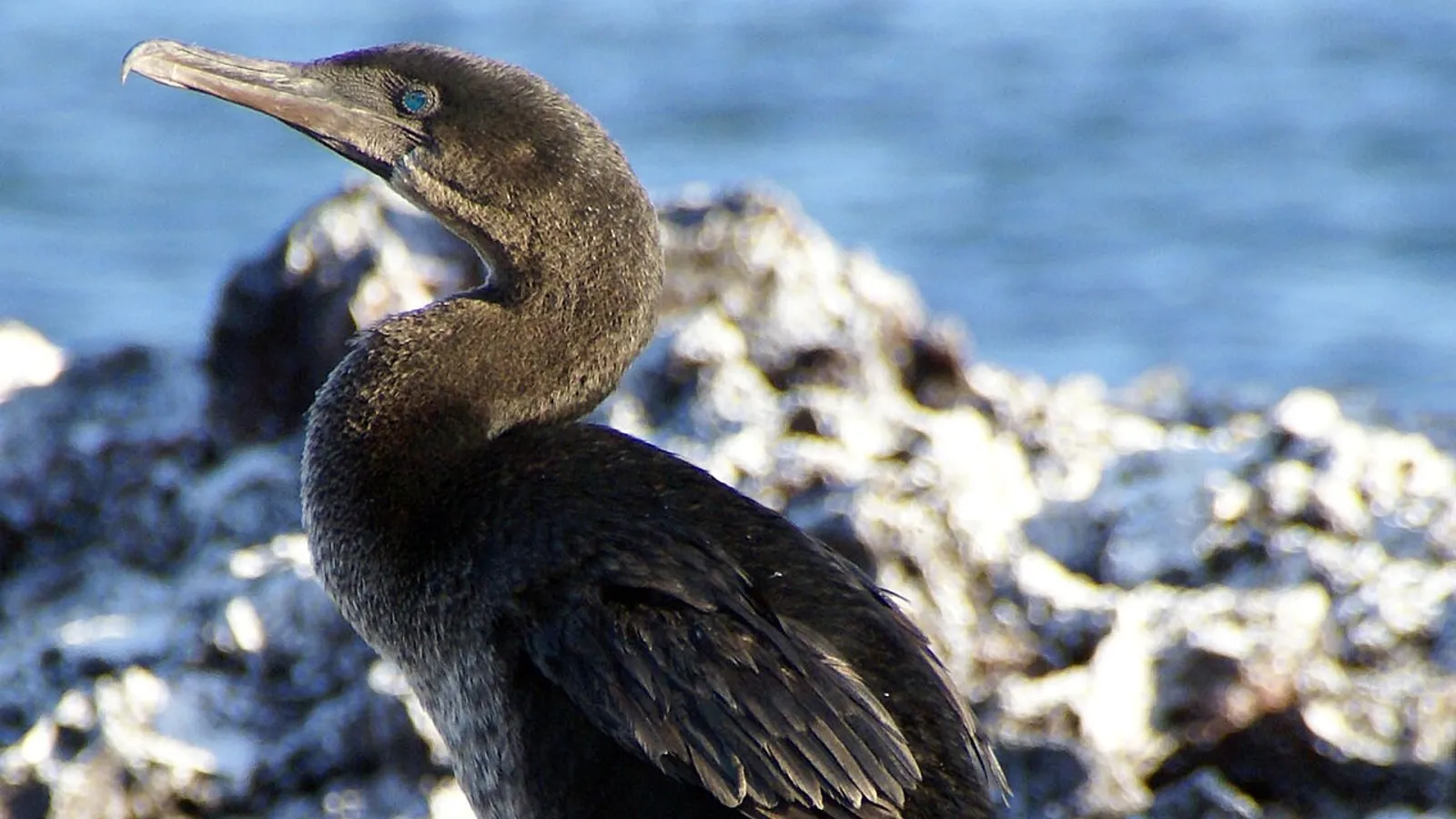
Flightless cormorant
Nannopterum harrisi
— Where the name comes from
Nannopterum is Greek, nánnos, “dwarf”, and pterón, “wing”: its wings are stumps a third of the size needed to fly. Harrisi recalls Charles Miller Harris, who led the Galápagos expedition funded by Walter Rothschild in 1897. The Italian attero means “wingless”, from the Greek á-pteros.
— Facts
- Group
- Birds · Aves
- Order
- Cormorants and boobies
- Habitat
- Rocky lava shores and cold, food-rich waters
- Range
- Fernandina and Isabela islands, in the Galápagos archipelago
- Size
- 89–100 cm, 2.5–5 kg
- Diet
- Eels, octopus and fish taken on the seabed
- Lifespan
- Over 13 years
— Characteristics
- 01
It is the only cormorant in the world that cannot fly.
- 02
After diving it holds out its stunted wings to dry them.
- 03
It is the heaviest cormorant of all.
— What sets it apart
It gave up flying in a very short time, perhaps only two million years, because on its islands there was no predator to flee and all its food lay underwater. In 2017 a team of geneticists compared its DNA with that of three flying cormorants, and found mutations in genes that regulate cell cilia and bone growth: the same genes that, altered in humans, cause diseases that shorten the limbs. Evolution took a defect and made an advantage of it.