Black stork
Ciconia nigra
— Where the name comes from
Ciconia is the Latin word for stork, which gives the Italian cicogna; nigra means “black”. It is the opposite of its white relative in almost everything: where that one seeks out houses, this one avoids people.
— Facts
- Group
- Birds · Aves
- Order
- Storks
- Habitat
- Old woodland near streams and wetlands, cliffs
- Range
- Europe, Asia to China; winters in Africa and India; resident in southern Africa
- Size
- 95–100 cm, wingspan 173–205 cm, about 3 kg
- Diet
- Fish, amphibians, aquatic insects
- Lifespan
- Over 20 years
— Characteristics
- 01
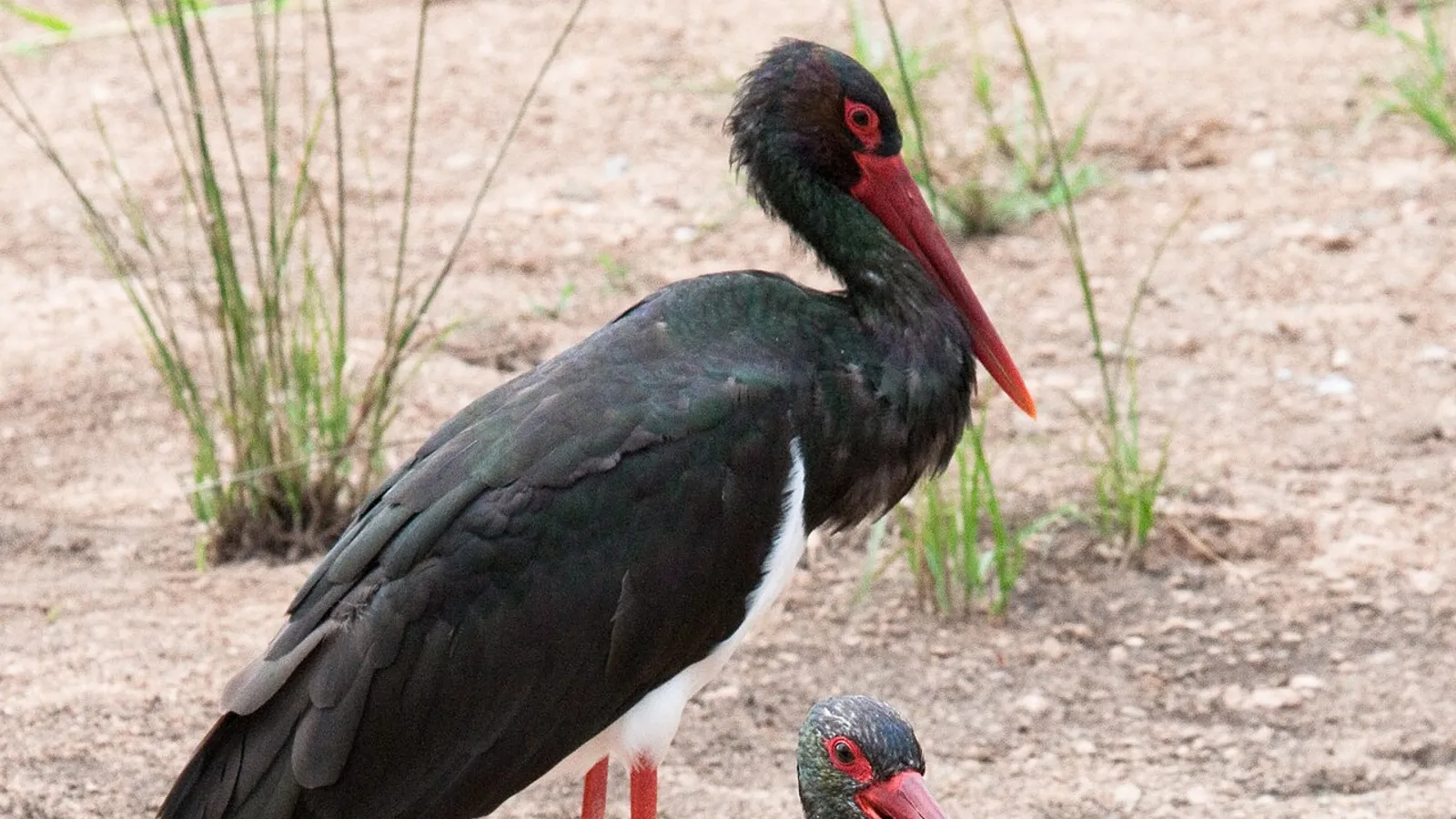
Its black plumage has green and purple sheens; bill and legs are red.
- 02
It nests alone, in large trees or on rock ledges.
- 03
It is extremely shy and is seen almost only in flight.
— What sets it apart
While the white stork has become the companion of villages, the black stork chose the opposite path, which has made it rare wherever old forests have been felled. In Italy it had disappeared as a breeder, and since the 1990s it has returned with a few dozen pairs scattered between the valleys of Piedmont and the woods of the southern Apennines. Birds fitted with satellite transmitters have revealed its routes: Italian black storks cross the Mediterranean and winter in Africa, south of the Sahara.