
Ochre sea star
Pisaster ochraceus
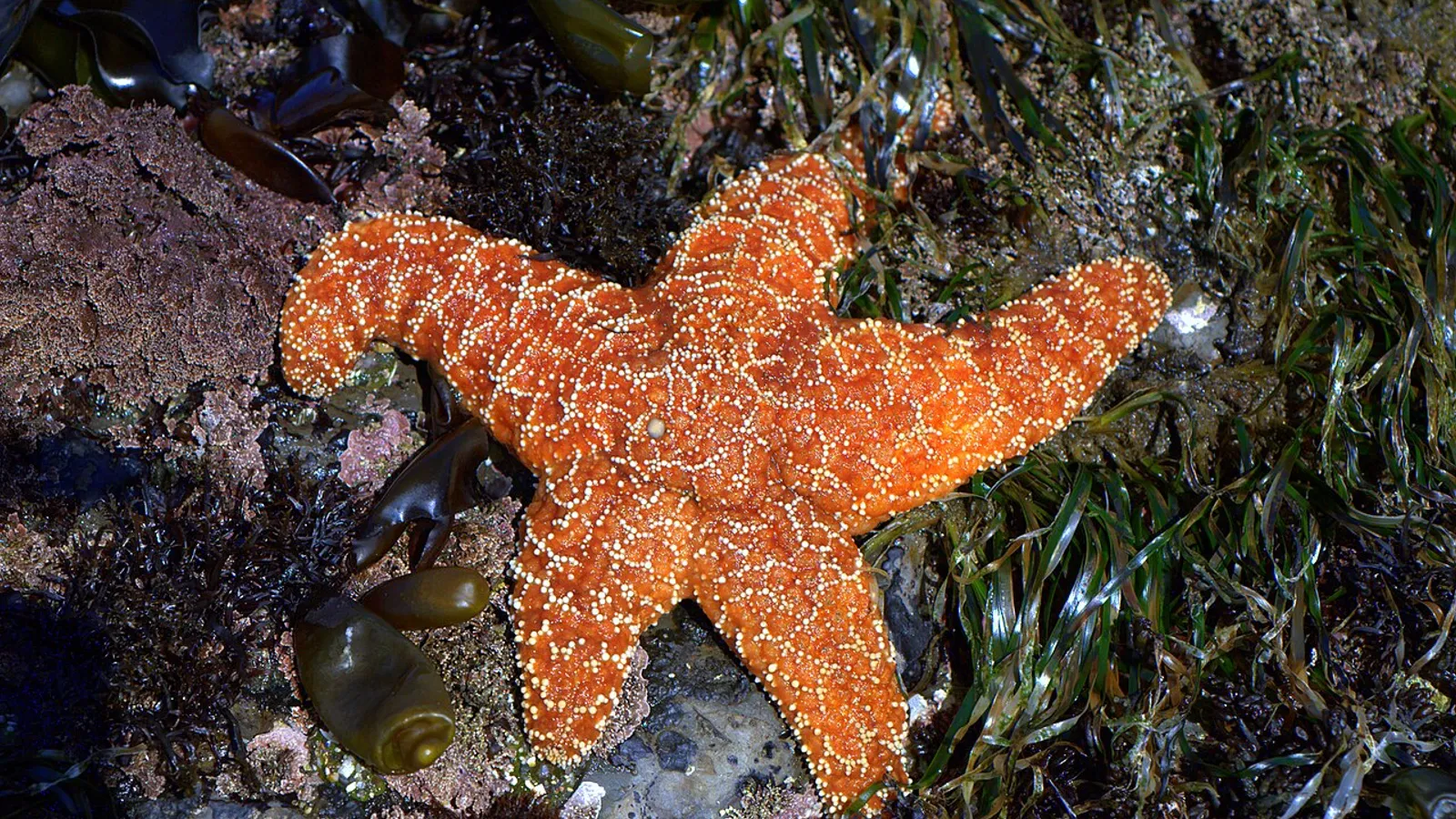
— Where the name comes from
Astḗr, inside the genus name, is the star: the same word as “astral”, “disaster” and “asterisk”. Ochraceus is the colour of ochre, though the species is often purple or brown. It is a wholly ordinary name for the animal on which one of the most influential ideas in modern ecology was born.
— Facts
- Group
- Echinoderms · Echinodermata
- Order
- Sea stars
- Habitat
- Wave-beaten intertidal rocks
- Range
- Pacific coast of North America, from Alaska to Baja California
- Size
- 25–50 cm across
- Diet
- Mussels, barnacles, chitons, shore snails
- Lifespan
- Over 20 years
— Characteristics
- 01
It opens mussels by pulling the two valves apart with its tube feet, for hours.
- 02
It everts its stomach inside the shell and digests the prey on the spot.
- 03
It withstands twelve hours of exposure to air at every low tide.
— What sets it apart
It is the animal that invented the concept of a keystone species. In 1963 Robert Paine began removing by hand every starfish from a stretch of shore in Washington State, and throwing them back into the sea for years: where they were gone, the mussels — the starfish’s prey — spread and within a short time eliminated almost all the other fifteen species on the shore, which was reduced to a monoculture. From that experiment comes the idea of the keystone species, whose weight in an ecosystem is out of all proportion to its numbers, and with it much of conservation biology. Since 2013 a devastating disease has killed tens of millions of them along the whole Pacific coast.
