
Precious red coral
Corallium rubrum
— Where the name comes from
Korállion is the Greek word, and the myth behind it is told by Ovid: Perseus, having killed Medusa, lays the severed head on a bed of seaweed by the shore, and the weed touched by the blood hardens and turns red. The nymphs gather the twigs and scatter them through the sea. That is the origin of coral, and it is also why for millennia amulets were made of it against the evil eye: it comes from a gaze that turned things to stone.
— Facts
- Group
- Cnidarians · Cnidaria
- Order
- Soft corals
- Habitat
- Shaded rock walls and caves, between 30 and 800 metres
- Range
- Mediterranean and the adjacent eastern Atlantic
- Size
- Colonies up to 50 cm, rarely more
- Diet
- Plankton and particles caught by the polyps
- Lifespan
- Colonies over 100 years
— Characteristics
- 01
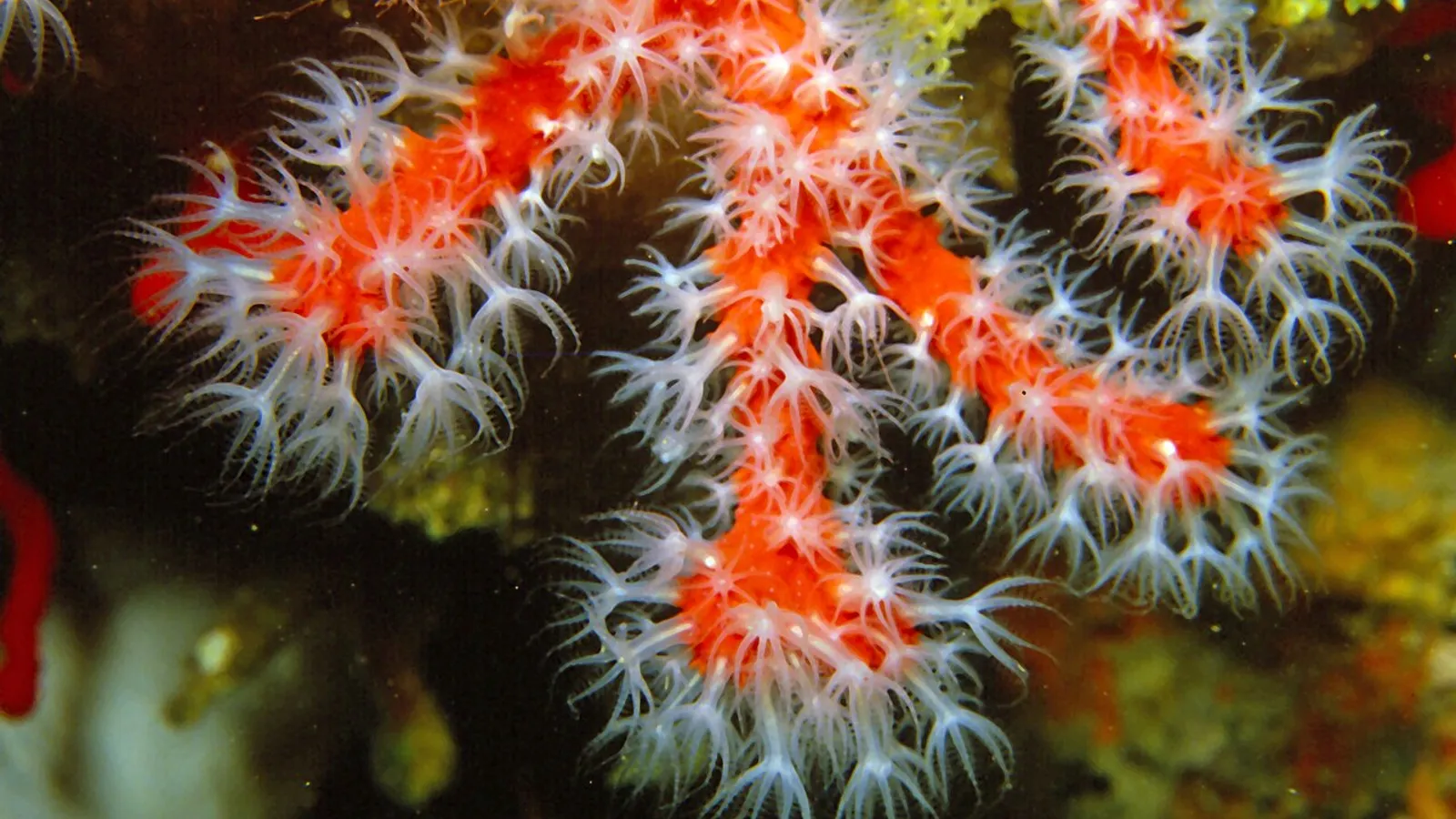
It is not a plant: it is a colony of white polyps with eight tentacles.
- 02
The red is the internal skeleton, visible only when the polyps withdraw.
- 03
It grows less than a millimetre a year in diameter.
— What sets it apart
It grows so slowly that a colony twenty centimetres high may be over a century old, and that is the reason for its crisis: from the Middle Ages onwards it has been harvested without pause for jewellery — Torre del Greco lived on it for two centuries — and the deep, accessible beds have been progressively exhausted. Today large colonies are extremely rare and harvesting is regulated, but regeneration takes times that have nothing to do with a market’s. The red seen in jewellery is not the animal but its internal calcite skeleton, tinted by carotenoids: alive, the coral is covered in white polyps that open like stars.
