
Staghorn coral
Acropora cervicornis
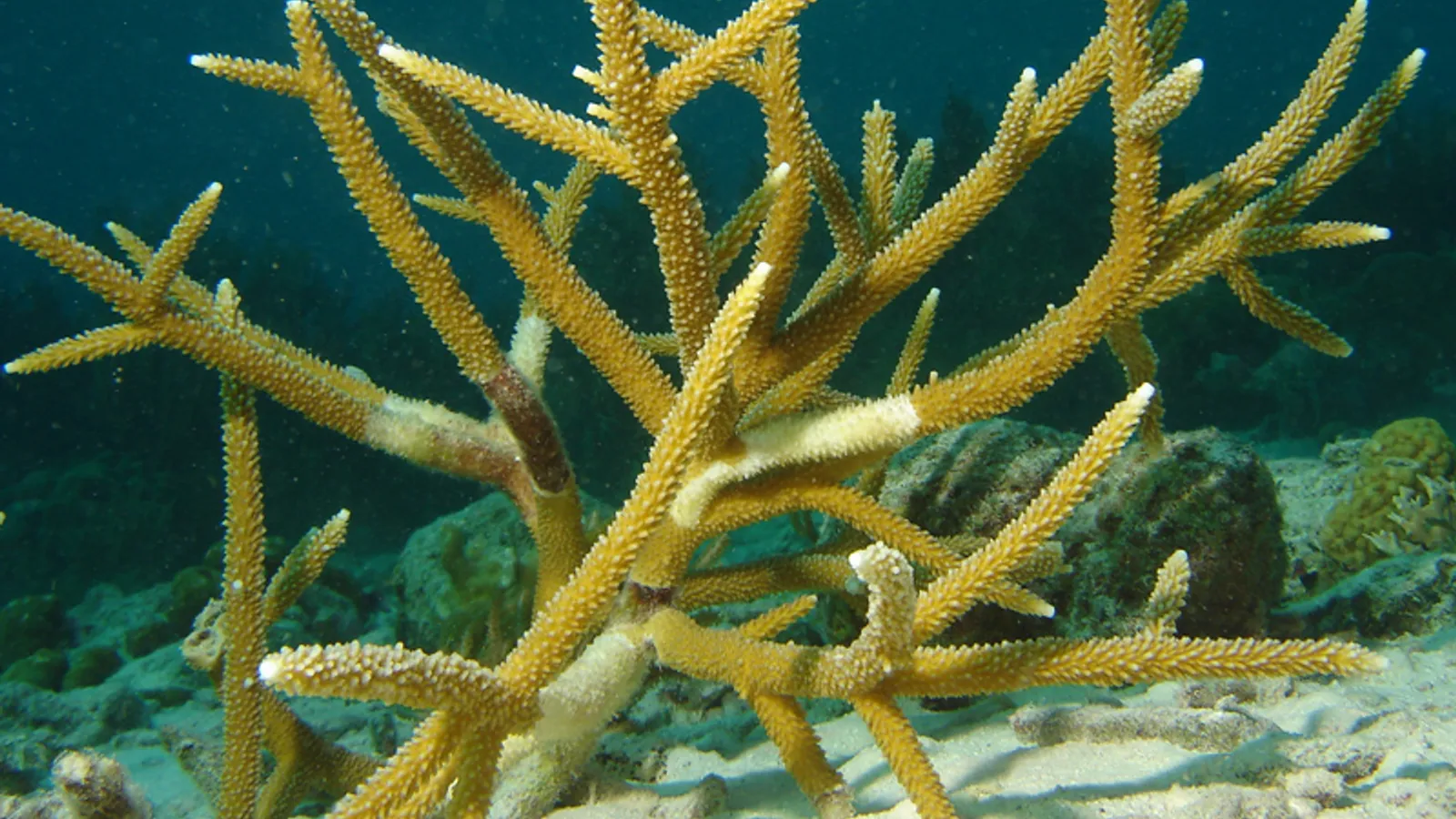
— Where the name comes from
Acropora is “with pores at the tip”, from ákros, the summit, and póros, the opening: every branch ends in a larger apical polyp, and that is the one that governs growth. Cervicornis gives the shape, stag’s horns. It is the genus that builds most of the world’s coral reefs, and its name speaks only of architecture.
— Facts
- Group
- Cnidarians · Cnidaria
- Order
- Stony corals
- Habitat
- Shallow coral reefs, between 5 and 25 metres
- Range
- The Caribbean, Florida, the Bahamas
- Size
- Colonies up to 2 metres
- Diet
- Symbiotic zooxanthellae and plankton caught at night
- Lifespan
- Colonies decades
— Characteristics
- 01
It grows up to 10 cm a year, among the fastest of corals.
- 02
It lives on symbiotic algae that supply most of its food.
- 03
It reproduces by fragmentation too: a broken branch takes root.
— What sets it apart
Bleaching is a divorce. The polyps house single-celled algae in their cells that supply, by photosynthesis, up to ninety per cent of their nourishment and give them their colour; when the water warms one or two degrees beyond the summer maximum the relationship breaks down, the algae are expelled and the coral is left white, that is, transparent over its skeleton. If the heat passes quickly it can take them back; if it lasts, it starves. This species has lost over ninety per cent of its Caribbean cover since the 1980s, and is now grown in underwater nurseries and replanted by hand, branch by branch.
